Reconstruction and resilience: the «Territori aperti» project (Open territories project) and the well-being of vulnerable communities

Journal title SOCIOLOGIA E RICERCA SOCIALE
Author/s Francesca Colella, Geraldina Roberti
Publishing Year 2025 Issue 2025/136
Language Italian Pages 16 P. 113-128 File size 209 KB
DOI 10.3280/SR2025-136007
DOI is like a bar code for intellectual property: to have more infomation click here

Below, you can see the article first page

If you want to buy this article in PDF format, you can do it, following the instructions to buy download credits
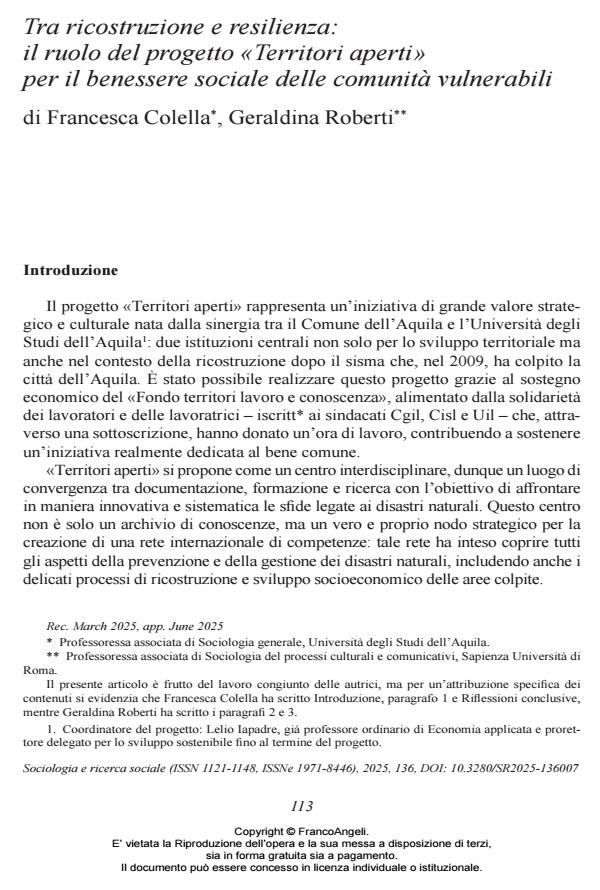
Article preview

FrancoAngeli is member of Publishers International Linking Association, Inc (PILA), a not-for-profit association which run the CrossRef service enabling links to and from online scholarly content.

The «Territori aperti» project, developed by the Municipality and University of L’Aquila, is a key cultural and strategic initiative in the city’s post­2009 earthquake reconstruction. A sociological study carried out within the project identified the most effective measures for rebuilding civil society. Findings highlight the need to integrate economic and socio-cultural dimensions, recognising culture, social ties and social capital as essential for cohesion and recovery.

  1. M.P. Pozzato, (2001), Semiotica del testo. Metodo, autori, esempi, Roma, Carocci.
  2. R. Putnam (2000), Bowling Alone. The Collapse and Revival of American Community, New York, Simon and Schuster.
  3. D.P. Aldrich (2012), Social Capital in Post Disaster Recovery: Towards a Resilient and Compassionate East Asian Community, in Y. Sawada, S. Oum (eds.), Economic and Welfare Impacts of Disasters in East Asia and Policy Responses, Eria Research Project Report 2011-8, Jakarta, Eria.
  4. D. Bertaux (1999), Racconti di vita. La prospettiva etnosociologica, Milano, FrancoAngeli.
  5. M. Bloor, J. Frankland, T. Mich, K. Robson (2002), I focus group nella ricerca sociale, Trento, Erickson.
  6. P. Bourdieu (2003), Per una teoria della pratica, Milano, Raffaello Cortina.
  7. R. Castorina, S. Pitzalis (2019), «Comprendere i disastri. Linee teoriche e applicazioni metodologiche della socio-antropologia nei terremoti de L’Aquila e dell’Emilia», Argomenti, 12, pp. 7-36.
  8. E. Chamlee-Wright, V.H. Storr, (2011), «Social Capital as Collective Narratives and PostDisaster Community Recovery», The Sociological Review, 59, 2, pp. 266-82, https://doi. org/10.1111/j.1467-954X.2011.02008.x.
  9. F. Colella (2011), Focus group. Ricerca social e strategie applicative, Milano, FrancoAngeli.
  10. P. Donati (2010), Sociologia. Un’introduzione allo studio della societa`, Assago, Cedam.
  11. P. Donati (2019), «Discovering the relational goods: Their nature, genesis and effects», International Review of Sociology, 29, 2, pp. 238-59.
  12. N.B. Ellison, R. Gray, C. Lampe, A. Fiore (2014), «Social capital and resource requests on Facebook», New Media & Society, 16, 7, pp. 1104-21.
  13. F. Ferrarotti (1991), Trattato di Sociologia, Torino, Utet Libreria.
  14. G. Forino (2015), «Disaster recovery: narrating the resilience process in the reconstruction of L’Aquila (Italy)», Geografisk Tidsskrift-Danish Journal of Geography, 115, 1, pp. 1-13.
  15. G. Gianturco (2005), L’intervista qualitativa. Dal discorso al testo scritto, Milano, Guerini.
  16. G. Grossi (2009), «Consumi culturali e politica dei consumi», Quaderni di Sociologia, 51, pp. 9-13.
  17. Istat (2024a), Bes 2023. Il benessere equo e sostenibile in Italia, https://www.istat.it/wp-content/uploads/2024/04/Bes­2023­Ebook.pdf.
  18. Istat (2024b), Il benessere equo e sostenibile dei territori: Abruzzo 2024, https://www.istat.it/ wp-content/uploads/2024/11/Abruzzo_BesT_2024.pdf.
  19. J. Rifkin (2000), L’era dell’accesso. La rivoluzione della new economy, Milano, Mondadori.
  20. D. Salzano (2018), «L’applicazione delle teorie di Putnam e Donati alle relazioni nei siti di social network: elementi per un’indagine empirica sugli utenti di Sns», Studi di Sociologia, 3, pp. 257-72.
  21. J.E. Stiglitz (2009), «Gdp Fetishism», The Economists’ Voice, 6, 8, pp. 1-3.
  22. J.E. Stiglitz (2019), «It’s time to retire metrics like Gdp. They don’t measure everything that matters», The Guardian, https://www.theguardian.com/commentisfree/2019/nov/24/me- trics-gdp-economic-performance-social-progress.
  23. A.W. Taylor, G. Kelly, E. Dal Grande, D. Kelly, T. Marin, N. Hey, K.J. Burke, J. Licinio (2017), «Population levels of wellbeing and the association with social capital», Bmc Psychology, 5, 23,

Francesca Colella, Geraldina Roberti, Tra ricostruzione e resilienza: il ruolo del progetto «Territori aperti» per il benessere sociale delle comunità vulnerabili in "SOCIOLOGIA E RICERCA SOCIALE " 136/2025, pp 113-128, DOI: 10.3280/SR2025-136007