The Pain of a Diva
Journal title PSICOTERAPIA PSICOANALITICA
Author/s Matilde Elia
Publishing Year 2025 Issue 2025/2
Language Italian Pages 11 P. 203-213 File size 88 KB
DOI 10.3280/PSP2025-002014
DOI is like a bar code for intellectual property: to have more infomation
click here
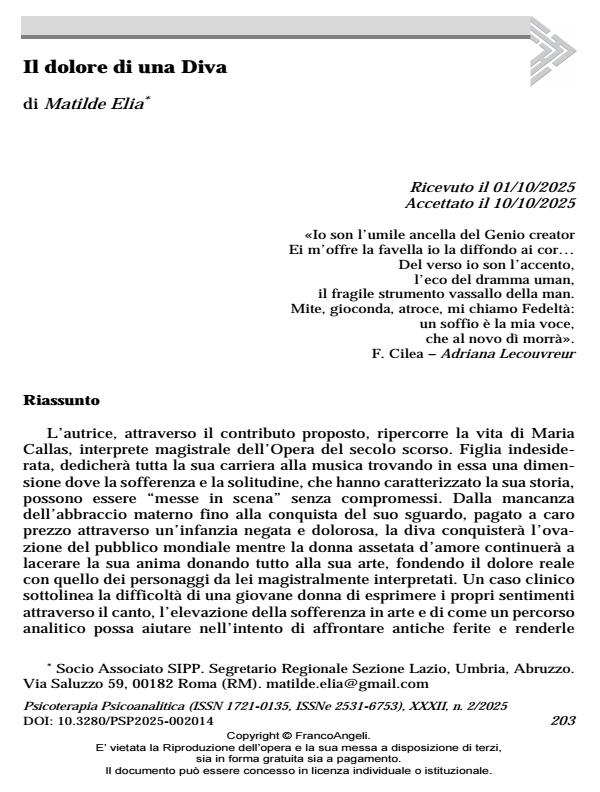
Below, you can see the article first page
If you want to buy this article in PDF format, you can do it, following the instructions to buy download credits
FrancoAngeli is member of Publishers International Linking Association, Inc (PILA), a not-for-profit association which run the CrossRef service enabling links to and from online scholarly content.
The author, through the proposed contribution, retraces the life of Maria Callas, a masterful opera singer of the last century. Maria Callass was an unwanted daughter, and she dedicated her entire career to music, finding in it a dimension where suffering and loneliness could be “staged” without compromise. From the loss of her mother’s embrace to the recapture of gaze, paid dearly through a denied and painful childhood, the diva won the ovation of audiences worldwide while the love-thirsty woman continued to tear her soul apart, giving everything to her art, merging her real pain with that of the characters she masterfully played. A clinical case highlights the difficulty of a young woman of expressing her feelings through music, the elevation of suffering to art, and how an analytic process can help in the attempt to confront old wounds and make them interpretable, in a process of transforming pain. A transformation that can allow for new investments and more vital and subjective movements.
Keywords: Opera, maternal gaze, loneliness, elevation of suffering, transformation of pain, analytic process.
Matilde Elia, Il dolore di una Diva in "PSICOTERAPIA PSICOANALITICA" 2/2025, pp 203-213, DOI: 10.3280/PSP2025-002014