Ravelins, gun carriages and dames. Projects, methods, costs and terminology for the maintenance of fortified towns in the 18th century: the case of Pizzighettone
Journal title STORIA IN LOMBARDIA
Author/s Guglielmo Alessandro Gambaretto
Publishing Year 2026 Issue 2025/2
Language Italian Pages 33 P. 5-37 File size 1016 KB
DOI 10.3280/SIL2025-002001
DOI is like a bar code for intellectual property: to have more infomation
click here
Below, you can see the article first page
If you want to buy this article in PDF format, you can do it, following the instructions to buy download credits
FrancoAngeli is member of Publishers International Linking Association, Inc (PILA), a not-for-profit association which run the CrossRef service enabling links to and from online scholarly content.
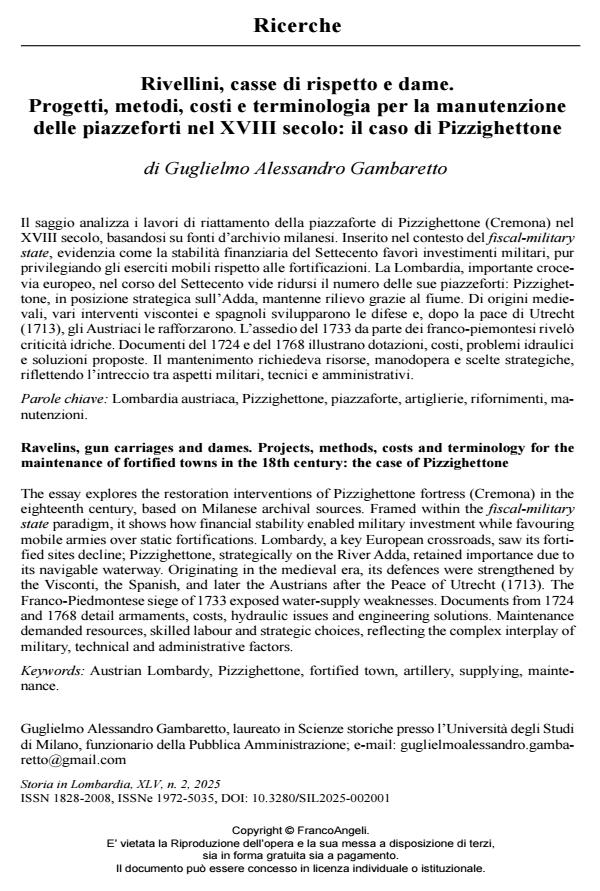
The essay explores the restoration interventions of Pizzighettone fortress (Cremona) in the eighteenth century, based on Milanese archival sources. Framed within the fiscalmilitary state paradigm, it shows how financial stability enabled military investment while favouring mobile armies over static fortifications. Lombardy, a key European crossroads, saw its fortified sites decline; Pizzighettone, strategically on the River Adda, retained importance due to its navigable waterway. Originating in the medieval era, its defences were strengthened by the Visconti, the Spanish, and later the Austrians after the Peace of Utrecht (1713). The FrancoPiedmontese siege of 1733 exposed watersupply weaknesses. Documents from 1724 and 1768 detail armaments, costs, hydraulic issues and engineering solutions. Maintenance demanded resources, skilled labour and strategic choices, reflecting the complex interplay of military, technical and administrative factors.
Keywords: Austrian Lombardy, Pizzighettone, fortified town, artillery, supplying, maintenance.
Guglielmo Alessandro Gambaretto, Rivellini, casse di rispetto e dame. Progetti, metodi, costi e terminologia per la manutenzione delle piazzeforti nel XVIII secolo: il caso di Pizzighettone in "STORIA IN LOMBARDIA" 2/2025, pp 5-37, DOI: 10.3280/SIL2025-002001