Gender-based violence and homeless women: Between invisibility and hiding

Journal title WELFARE E ERGONOMIA
Author/s Santa Giuseppina Tumminelli
Publishing Year 2026 Issue 2025/2
Language Italian Pages 12 P. 139-150 File size 68 KB
DOI 10.3280/WE2025-002010
DOI is like a bar code for intellectual property: to have more infomation click here

Below, you can see the article first page

If you want to buy this article in PDF format, you can do it, following the instructions to buy download credits
Article preview

FrancoAngeli is member of Publishers International Linking Association, Inc (PILA), a not-for-profit association which run the CrossRef service enabling links to and from online scholarly content.

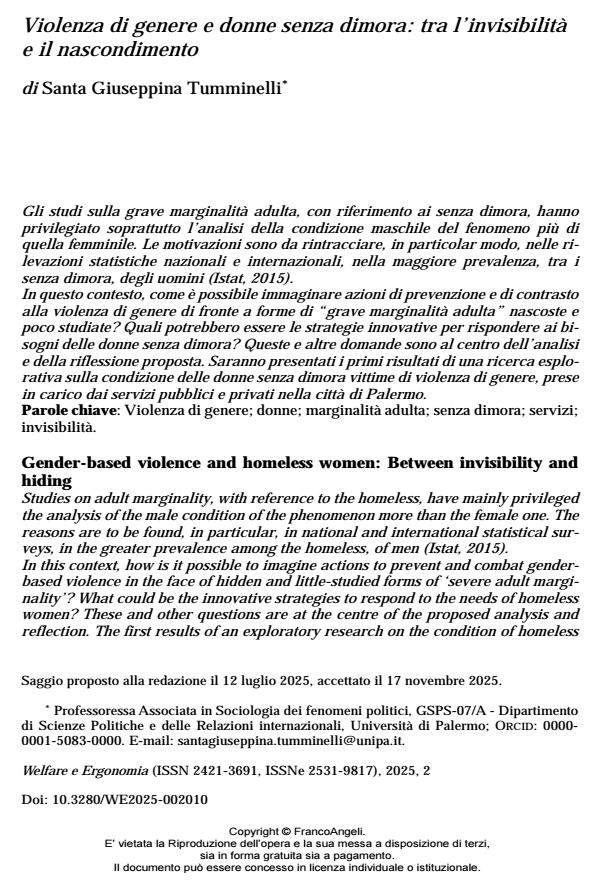
Studies on adult marginality, with reference to the homeless, have mainly privileged the analysis of the male condition of the phenomenon more than the female one. The reasons are to be found, in particular, in national and international statistical surveys, in the greater prevalence among the homeless, of men (Istat, 2015). In this context, how is it possible to imagine actions to prevent and combat gender-based violence in the face of hidden and little-studied forms of ‘severe adult marginality’? What could be the innovative strategies to respond to the needs of homeless women? These and other questions are at the centre of the proposed analysis and reflection. The first results of an exploratory research on the condition of homeless women victims of gender-based violence, taken care of by public and private services in the city of Palermo, will be presented.

Keywords: Gender-based violence; women; adult marginality; homelessness; services, invisibility.

  1. Baptista I. (2010). Women and homelessness in Europe. In: O’Sullivan E., Busch-Geertsema V., Quilgars D. and Pleace N., editors, Homelessness Research in Europe. Brussels: FEANTSA, 163-186.
  2. Bichi R. (2002). L’intervista biografica. Una proposta metodologica. Milano: Vita e Pensiero.
  3. Bonadonna F. (2005). Il nome del barbone. Vite di strada e povertà estreme in Italia. Roma: DeriveApprodi.
  4. Bretherton J. (2017). Reconsidering Gender in Homelessness. European Journal of Homelessness, 11(1): 1-22.
  5. Bretherton J. and Mayock P. (2021). Women’s Homelessness: European Evidence Review. Brussels: FEANTSA.
  6. Bretherton J. and Pleace N. (2018). Women and Rough Sleeping: A Critical Review of Current Research and Methodology. University of York: Centre for Housing Policy.
  7. Castel R. (1994). La dynamique des processus de marginalisation: de la vulnérabilité à la désaffiliation. Cahiers de recherche sociologique, (22): 11-27.
  8. De Filippi F. e Gambara L. (2019). Housing is more than a shelter. Riflessioni intorno alla homelessness in una prospettiva globale. Atti e rassegna tecnica, 1: 89-95.
  9. Decembrotto L. (2017). Homelessness e possibili interventi di contrasto alla povertà estrema. LLL Lifelong Lifewide Learning, 13(30): 42-51.
  10. FEANTSA (2005). Ethos: European Typology of Homelessness and Housing Exclusion. Brussels: FEANTSA.
  11. Fio.PSD (2018). Le donne senza dimora in Italia, -- https://www.fiopsd.org/donne-senza-dimora/ (ultima consultazione 11.11.25).
  12. Fiorillo L. (2024). Una prospettiva di genere: le donne senza dimora. In: Mauceri S. e Di Censi L., a cura di, Povertà estreme. Un’analisi sul sistema dei servizi per le persone senza dimora a Roma. Milano: FrancoAngeli: 87-105.
  13. Istat (2015). Le Persone senza Dimora in Italia. Anno 2014. Roma: Istat.
  14. Johnson G., Ribar D.C. and Zhu A. (2017). Women’s Homelessness: International Evidence on Causes, Consequences, Coping and Policies. IZA Discussion Paper No. 10614.
  15. Jovelin E. (2017). La honte des pauvres: l’exemple des femmes SDF. Pensée plurielle, 44: 73-83.
  16. KobeS-Van Iperen J. and Hazenberg-Boots M. (2016). Forced to be homeless due to domestic violence. In: Homeless in Europe, Summer 2016, Brussels, FEANTSA, p. 9.
  17. Loison-Leruste M. and Perrier G. (2019). Les trajectoires des femmes sans domicile à travers le prisme du genre: entre vulnérabilité et protection. Déviance et Société, 43(1): 77-110.
  18. Mayock P. and Bretherton J. (2016). Women’s Homelessness in Europe. London: Palgrave Macmillan.
  19. Mayock P., Bretherton J. and Baptista I. (2016). Women’s Homelessness and Domestic Violence – (In)visible Interactions. In: Mayock P., Bretherton J., editor, Women’s Homelessness in Europe. London: Palgrave Macmillan, 127-154.
  20. Mayock P., Parker S. and Sheridan S. (2015). Women, homelessness and service provision. Dublin: Simon Communities of Ireland.
  21. Mayock P., Sheridan S. and Parker S. (2012). Migrant women and homelessness: the role of gender-based violence. European Journal of Homelessness, 6: 59-78
  22. Meo A. (2009). Vivere in strada: carriere di povertà e pratiche di sopravvivenza. Uno sguardo sociologico sui senza dimora. In: Gnocchi R., a cura di, Homelessness e dialogo interdisciplinare. Roma: Carocci, 183-214.
  23. Moss K. and Singh P. (2015). Women rough sleepers in Europe: Homelessness and victims of domestic abuse. Bristol: Policy Press.
  24. Pellegrino M., Ciucci F. e Tomei G. (2011). Valutare l’invisibile. Milano: FrancoAngeli.
  25. Pleace N. (2016). Guida europea all’Housing First, Housing First Hub. -- www.fiopsd.org/housing-first/.
  26. Prandini R. e Ganugi G. (2021). Governance territoriali e politiche di contrasto alla grave emarginazione adulta. Verso un modello strategico integrato. Milano: FrancoAngeli.
  27. Quilgars D. and Pleace N. (2010). Meeting the needs of households at risk of domestic violence in England: The role of accommodation and housing-related support services. London: Communities and Local Government.
  28. Reeve K., Casey R. and Goudie R. (2006). Homeless women: still being failed yet striving to survive. London: Crisis.
  29. Williamson E. (2010). Living in the world of the domestic violence perpetrator: Negotiating the unreality of coercive control. Violence Against Women, 16(12): 1412-1423.

Santa Giuseppina Tumminelli, Violenza di genere e donne senza dimora: tra l’invisibilità e il nascondimento in "WELFARE E ERGONOMIA" 2/2025, pp 139-150, DOI: 10.3280/WE2025-002010