Transition to adulthood through new forms of living. The case study “Cohousing. Io cambio status”

Journal title WELFARE E ERGONOMIA
Author/s Liria Veronesi, Sabrina Berlanda
Publishing Year 2026 Issue 2025/2
Language Italian Pages 17 P. 183-199 File size 134 KB
DOI 10.3280/WE2025-002013
DOI is like a bar code for intellectual property: to have more infomation click here

Below, you can see the article first page

If you want to buy this article in PDF format, you can do it, following the instructions to buy download credits
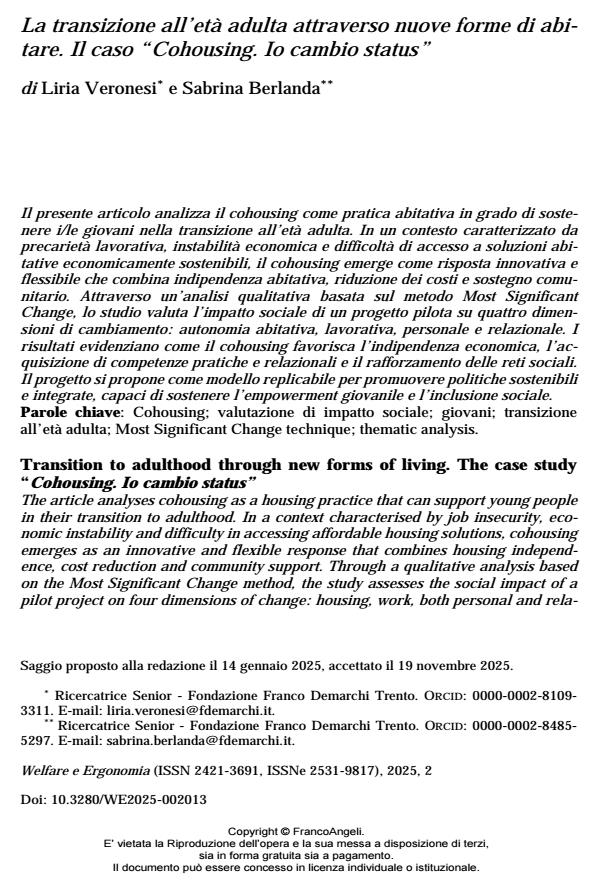
Article preview

FrancoAngeli is member of Publishers International Linking Association, Inc (PILA), a not-for-profit association which run the CrossRef service enabling links to and from online scholarly content.

The article analyses cohousing as a housing practice that can support young people in their transition to adulthood. In a context characterised by job insecurity, economic instability and difficulty in accessing affordable housing solutions, cohousing emerges as an innovative and flexible response that combines housing independence, cost reduction and community support. Through a qualitative analysis based on the Most Significant Change method, the study assesses the social impact of a pilot project on four dimensions of change: housing, work, both personal and relational autonomy. The results highlight how cohousing fosters economic independence, the acquisition of practical and relational skills and the strengthening of social networks. The project is proposed as a replicable model to promote sustainable and integrated policies capable of supporting youth empowerment and social inclusion.

Keywords: Cohousing; social impact evaluation; youth; transition to adulthood; Most Significant Change technique; thematic analysis.

  1. Agenzia per la famiglia e Gerardi A. (2019). Co-housing. La sperimentazione di una politica di transizione all’età adulta. Trento: Curcu Genovese.
  2. Albertini M. e Kohli M. (2013). The generational contract in the family: an analysis of transfer regimes in Europe. European sociological review, 29(4): 828-840.
  3. Arnett J.J. (2004). Emerging adulthood: The winding road from the late teens through the twenties. Oxford: Oxford University Press.
  4. Arnett J.J. (2000). Emerging adulthood: A theory of development from the late teens through the twenties. American Psychologist, 55(5): 469-480.
  5. Berton F., Richiardi M. e Sacchi S. (2012). The political economy of work security and flexibility: Italy in comparative perspective. Bristol: Policy Press.
  6. Bianchi F. (2015). Verso un nuovo spazio abitativo? Un’indagine sulle rappresentazioni sociali del cohousing. Studi di Sociologia, 53(3): 237-54.
  7. Blumer H. (1969). Symbolic interactionism: Perspective and methods. Englewood Cliffs, NJ: Prentice Hall.
  8. Braun,V., Clarke V., Hayfield N. and Terry G. (2019). Thematic Analysis. In: Liamputtong, P. Handbook of research methods in health social sciences. Singapore: Springer.
  9. Bricocoli M. e Sabatinelli S. (2020). La casa come servizio, la casa come standard? Riflessioni da Milano, Lombardia. Territorio, 90: 46-49.
  10. Buchmann M., Malti T. and Solga H., a cura di, (2017). Transition to young adulthood: The significance of inequalities of resources and contextual variations. Special section in Longitudinal and Life Course Studies, 8(1): 3-74.
  11. Buzzi C. (2002). Transizione all’età adulta e immagini del futuro. In: Buzzi C., Cavalli A. e de Lillo A., a cura di, Giovani del nuovo secolo. Quinto rapporto IARD sulla condizione giovanile in Italia. Bologna: il Mulino.
  12. Carrere J., Reyes A., Oliveras L., Fernández A., Peralta A., Novoa A.M., Pérez K. and Borrell C. (2020). The effects of cohousing model on people’s health and wellbeing: a scoping review. Public Health Rev, 41(22): 1-28.
  13. Clarke V. and Braun V. (2013). Teaching thematic analysis: Overcoming challenges and developing strategies for effective learning. Psychologist, 26: 120-123.
  14. Costa G. (2015). Politiche e progetti di nuova generazione a sostegno dell'autonomia abitativa dei giovani a Torino e a Milano. Autonomie locali e servizi sociali, 1: 35-54.
  15. Costarelli I. (2023). Politiche abitative e giovani generazioni. Il caso di Milano. Milano: FrancoAngeli.
  16. Cote J. (2014). The Dangerous Myth of Emerging Adulthood: An Evidence-Based Critique of a Flawed Developmental Theory. Applied Developmental Science, 18: 177-188.
  17. Dart, J. and Davies, R. (2003). A dialogical, story-based evaluation tool: The most significant change technique. The American Journal of Evaluation, 24(2): 137-155.
  18. Davies R. and Dart J. (2005). The most significant change technique: a guide to its use. MandE News.
  19. Deriu F. e Bucco G. (2013). Il social cohousing: una risposta innovativa alle incertezze presenti e future dei giovani in Italia. Sociologia urbana e rurale, XXXV(100): 74-91.
  20. Deriu F. (2015). Le politiche abitative in Italia: ricostruzione storica e note critiche. Welfare e Ergonomia, 1: 26-34.
  21. Droste C. (2015). German co-housing: an opportunity for municipalities to foster socially inclusive urban development?. Urban Research & Practice, 8(1): 79-92.
  22. Eurostat (2022). When do young Europeans leave their parental home?.
  23. Franklin A. and Tranter, B. (2011). Housing, loneliness and health. AHURI Final Report No.164. Melbourne: Australian Housing and Urban Research Institute.
  24. Frangioni T. (2022). Una comunità di gente che passa? Social housing e comunità a Torino. Politiche sociali, 3: 539-556.
  25. Granovetter M. (1973). The strength of weak ties?. American Journal of Sociology, 78: 1360-1380.
  26. Hendry L.B. and Kloep M. (2007). Conceptualizing Emerging Adulthood: Inspecting the Emperor’s New Clothes?. Child Development Perspectives, 1(2): 74-79.
  27. Impicciatore R. e Tosi F. (2021). Ritardi, esclusione e disuguaglianze nei corsi di vita dei giovani in Italia. Rivista di Politica Economica, 2: 81-105.
  28. Istat (2022). Gruppo di lavoro sulle politiche per la casa e l’emergenza abitativa, Roma: Ministero del Lavoro e delle Politiche Sociali.
  29. Istituto Toniolo (2020). La condizione giovanile in Italia. Bologna: il Mulino.
  30. Jarvis H. (2011). Saving space, sharing time: integrated infrastructures of daily life in cohousing. Environment and Planning, 43(3): 560-577.
  31. Krueger R.A. (2015). Using stories in evaluation. Handbook of practical program evaluation, 535-556. New Jersey: John Wiley & Sons, Inc.
  32. Leccardi C. (2020). Young Italians: Individualization, Uncertainty and Reconquesting the Future. In: Cuzzocrea V., Bello B.G. and Kazepov Y., editors, Italian Youth in International Context: Belonging, Constraints and Opportunities. London: Routledge.
  33. Lietaert M. (2010). Cohousing’s relevance to degrowth theories. Journal of cleaner production, 18(6): 576-580.
  34. Lietaert M. (2007). Cohousing e condomini solidali. Firenze: Terranuova.
  35. Maguire M. and Delahunt B. (2017). Doing a thematic analysis: A practical, step-by-step guide for learning and teaching scholars. AISHE-J, 9: 3351-3354.
  36. Markle E., Rodgers R., Sanchez W. and Ballou M. (2015). Social support in the cohousing model of community: a mixed-methods analysis. Community Development, 46: 1-16.
  37. Musumeci R. (2020). Vivere un presente precario, sognando un futuro autonomo nell’era della Flexploitation: voci di giovani del Nord e del Sud Italia. Polis, 35(2): 309-336.
  38. Nomisma (2024). 17° Rapporto sull’abitare 2024. Bologna.
  39. Olagnero M. (2018). Discorsi sull’abitare. Come e a chi parlano le nuove politiche abitative. La Rivista delle Politiche Sociali, 4: 25-41.
  40. Olagnero M. (1998). I muri e le barriere. Il disagio abitativo tra crisi del welfare, crisi del mercato e trasformazioni della famiglia. Rassegna Italiana di Sociologia, 1: 43-74.
  41. Provincia Autonoma di Trento (2016). Cohousing. Giovani e autonomia. TrentinoFamiglia, 10.2.
  42. Rek-Wozniak M. (2014). Transition into adulthood, life course, inequalities and social change. In: Eißel D., Rokicka E. and Leaman J., editors, Welfare State at Risk. Cham: Springer.
  43. Rogel L., Corubolo M., Gambarana C. e Omegna E. (2018). Cohousing, l’arte di vivere insieme. Principi, esperienze e numeri dell’abitare collaborativo. La prima mappatura in Italia. Milano: Altreconomia Edizioni.
  44. Ruiu M.L. (2016). The social capital of cohousing communities. Sociology, 50(2): 400-415.
  45. Ruiu M.L. (2015). The effects of cohousing on the social housing system: the case of the threshold centre. Journal of housing & the built environment, 30(4): 631-644.
  46. Salvini A. (2015). Percorsi di analisi dei dati qualitativi. Torino: UTET.
  47. Vitali A. (2010). Regional differences in young Spaniards’ living arrangement decisions: A multilevel approach. Advances in life course research, 15(2-3): 97-108.
  48. Warner E., Sutton E. and Andrews F. (2020). Cohousing as a model for social health: a scoping review. Cities & Health, 8(1): 107-119.
  49. Wyn J., Lantz S. and Harris A. (2012). Beyond the ‘transitions’ metaphor: Family relations and young people in late modernity. Journal of sociology, 48(1): 3-22.

Liria Veronesi, Sabrina Berlanda, La transizione all’età adulta attraverso nuove forme di abitare. Il caso “Cohousing. Io cambio status in "WELFARE E ERGONOMIA" 2/2025, pp 183-199, DOI: 10.3280/WE2025-002013