Innovazione e digitalizzazione nelle Pmi del settore moda in Campania: dinamiche, incentivi e traiettorie evolutive

Journal title SOCIOLOGIA E RICERCA SOCIALE
Author/s Feliciano Napoletano
Publishing Year 2026 Issue 2025/137
Language Italian Pages 26 P. 51-76 File size 280 KB
DOI 10.3280/SR2025-137003
DOI is like a bar code for intellectual property: to have more infomation click here

Below, you can see the article first page

If you want to buy this article in PDF format, you can do it, following the instructions to buy download credits
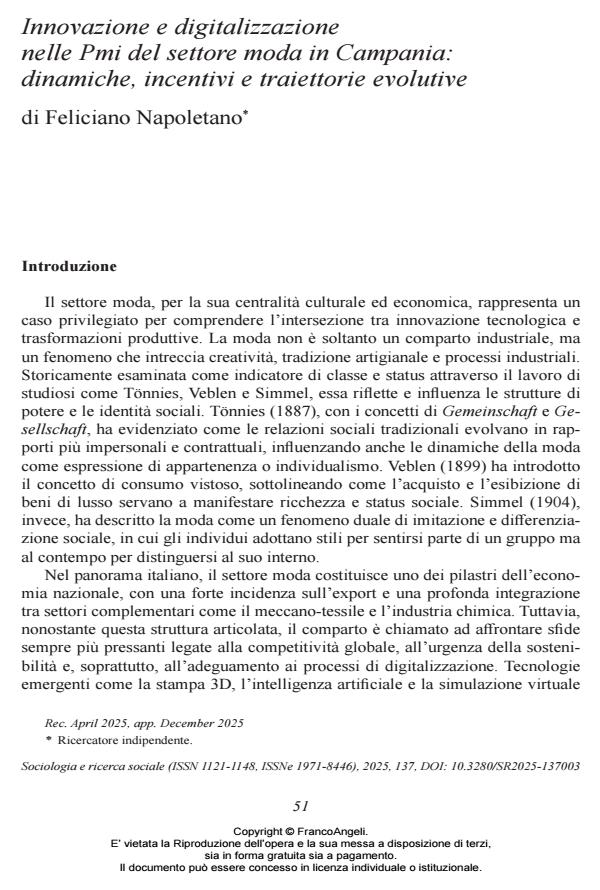
Article preview

FrancoAngeli is member of Publishers International Linking Association, Inc (PILA), a not-for-profit association which run the CrossRef service enabling links to and from online scholarly content.

This paper analyses the digital transformation of small and medium-sized en-terprises (Smes) in the fashion sector in Campania and the role of public incen-tives in innovation processes. Based on a sample of 1,191 firms selected through the Aida database, the study employs multiple correspondence analysis and clus-ter analysis to map firms’ digitalisation strategies. Four business clusters emerge, differentiated by access to public support and structural characteristics. The results show that instruments such as tax credits for capital goods and Industry 4.0 training constitute important levers for digital transformation, but are not always sufficient to fully support digitalisation processes, highlighting the need for more inclusive and systemic public policies.

  1. G. Becattini (2015), La coscienza dei luoghi. Il territorio come soggetto corale, Roma, Donzelli.
  2. J.P. Benzécri (1973), L’Analyse des Données, tome I: La Taxinomie; tome Il: L’Analyse des Corrispondances, Paris, Dunod.
  3. A. Caloffi, M. Bellandi (2017), «Enterprise and innovation policy in Italy: an overview of the recent facts», Revue d’économie industrielle, 158, pp. 129-41.
  4. P. Cooke (2001), «Regional innovation systems, clusters, and the knowledge economy», Indu-strial and Corporate Change, 10, 4, pp. 945-74, https://doi.org/10.1093/icc/10.4.945.
  5. R. Crescenzi, G. De Blasio, M. Giua (2020), «Cohesion Policy incentives for collaborative industrial research: evaluation of a Smart Specialisation forerunner programme», Regional Studies, 54, 10, pp. 1341-53.
  6. R. Crescenzi, A. Rodriguez-Pose, M. Storper (2007), «The territorial dynamics of innovation: a Europe-United States comparative analysis», Journal of Economic Geography, 7, 6, pp. 673-709.
  7. G. De Blasio, D. Fantino, G. Pellegrini (2015), «Evaluating the impact of innovation incenti-ves: Evidence from an unexpected shortage of funds», Industrial and Corporate Change, 24, 6, pp. 1285-314.
  8. C. Edquist (2013), Systems of innovation: Technologies, institutions and organizations, Lon-don, Routledge.
  9. R.D. Fitjar, A. Rodríguez-Pose (2011), «Innovating in the periphery: Firms, values and innova-tion in Southwest Norway», European Planning Studies, 19, 4, pp. 555-74, https://doi.org/ 10.1080/09654313.2011.548467.
  10. A.G. Frank, L.S. Dalenogare, N.F. Ayala (2019), «Industry 4.0 technologies: Implementation patterns in manufacturing companies», International Journal of Production Economics, 210, pp. 15-26, https://doi.org/10.1016/j.ijpe.2019.01.004.
  11. A. Gherardini, G. Pessina (2020), Politiche territoriali e sviluppo locale in Italia. Lezioni ap-prese e prospettive future, Roma, Carocci.
  12. M. Granovetter (1985), «Economic action and social structure: The problem of embeddedness», American Journal of Sociology, 91, 3, pp. 481-510, https://doi.org/10.1086/228311.
  13. M. Greenacre (1984), Theory and Applications of Correspondence Analysis, London-New York, Academic Press.
  14. Istat (2023), La struttura produttiva e la competitività delle imprese appartenenti alla filiera della moda, Rapporto n. 3, Roma.
  15. L. Kaufman, P.J. Rousseeuw (2009), Finding groups in data: an introduction to cluster analysis, New York, John Wiley & Sons.
  16. L. Lebart, A. Morineau, M. Piron (1995), Statistique exploratoire multidimensionnelle, Paris, Dunod, vol. 3.
  17. B.A. Lundvall (1992), National systems of innovation: towards a theory of innovation and interactive learning, London, Pinter, vol. 242.
  18. V.D. Marchi, E.D. Maria, S. Micelli (2013), «Environmental strategies, upgrading and com-petitive advantage in global value chains», Business Strategy and the Environment, 22, 1, pp. 62-72.
  19. M. Mazzucato (2013), The entrepreneurial state: Debunking public vs. private sector myths, London, Anthem Press.
  20. R.R. Nelson, S.G. Winter (1985), An evolutionary theory of economic change, Cambridge, Harvard University Press.
  21. F. Ramella (2013), Sociologia dell’innovazione economica, Bologna, il Mulino.
  22. A. Rodríguez-Pose (2013), «Do institutions matter for regional development?», Regional Stu-dies, 47, 7, pp. 1034-47, https://doi.org/10.1080/00343404.2012.748978.
  23. S. Roper, J.H. Love (2006), «Innovation and regional absorptive capacity: the labour market dimension», The Annals of Regional Science, 40, 2, pp. 437-47.
  24. K. Schwab (2017), The Fourth Industrial Revolution, Geneva, World Economic Forum.
  25. G. Simmel (1904), «Fashion», International Quarterly, 10, pp. 130-55.
  26. M. Storper (2018), Keys to the city: How economics, institutions, social interaction, and poli-tics shape development, Princeton, Princeton University Press.
  27. F. Tönnies (1887), Gemeinschaft und gesellschaft, in Studien zu Gemeinschaft und Gesellschaft: Herausgegeben von Klaus Lichtblau, Wiesbaden, VS Verlag für Sozialwissenschaften.
  28. F. Tödtling, M. Trippl (2005), «One size fits all? Towards a differentiated regional innova-tion policy approach», Research Policy, 34, 8, pp. 1203-19, https://doi.org/10.1016/j.re-spol.2005.01.018.
  29. C. Trigilia (2005), Sociologia economica. Stato, mercato e società nel capitalismo moderno, Bologna, il Mulino.
  30. T. Veblen (1899), Conspicuous consumption, in The Theory of the Leisure Class, Oxford, Ox-ford University Press, 2009.

Feliciano Napoletano, Innovazione e digitalizzazione nelle Pmi del settore moda in Campania: dinamiche, incentivi e traiettorie evolutive in "SOCIOLOGIA E RICERCA SOCIALE " 137/2025, pp 51-76, DOI: 10.3280/SR2025-137003