Challenges in the pursuit of promotion among public school teachers in the Philippines

Journal title SOCIOLOGIA E RICERCA SOCIALE
Author/s Paul Jeremy Aguja, Ruth Ortega-Dela Cruz
Publishing Year 2026 Issue 2025/137
Language English Pages 25 P. 95-119 File size 269 KB
DOI 10.3280/SR2025-137005
DOI is like a bar code for intellectual property: to have more infomation click here

Below, you can see the article first page

If you want to buy this article in PDF format, you can do it, following the instructions to buy download credits
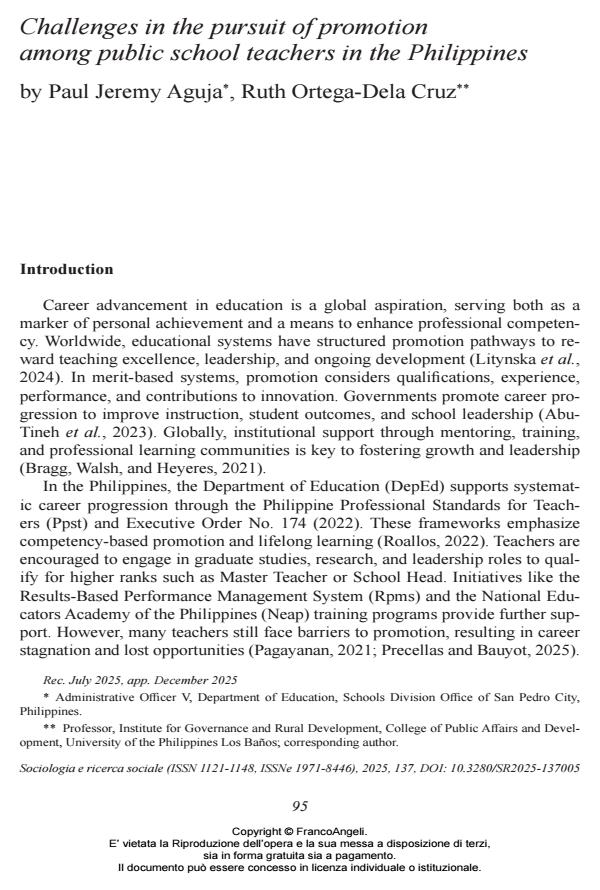
Article preview

FrancoAngeli is member of Publishers International Linking Association, Inc (PILA), a not-for-profit association which run the CrossRef service enabling links to and from online scholarly content.

This study explores career stagnation among public school teachers in the Philippines, focusing on those who have remained in Teacher I positions for over a decade. Despite structured promotion pathways by the Department of Educa-tion (DepEd), many teachers struggle to advance. Using a case study approach, data were collected through surveys with 124 purposively selected teachers and a focus group discussion with seven participants. A respondent profile and a brief Swot analysis of the promotion policy were presented. Findings reveal that while promotion policies, administrative support, and professional development are generally viewed as adequate, significant barriers persist. These include exces-sive documentation, unclear evaluation criteria, delays in promotion processes, lack of mentorship, perceived favoritism, limited access to scholarships and ex-ternal training, and funding constraints. Combined with personal challenges such as family obligations and the emotional toll of repeated failed attempts, these factors hinder teachers’ motivation and ability to pursue promotions, highlighting the need for targeted reforms.

  1. A.M. Abu-Tineh, M.H., Romanowski, Y. Chaaban, H. Alkhatib, N. Ghamrawi, Y.M. Alshaboul (2023), «Career Advancement, job satisfaction, career retention, and other related dimen-sions for sustainability: A perception study of Qatari public-school teachers», Sustainabil-ity, 15, 5, 4370.
  2. S. Ahmed (2024), How to choose a sampling technique and determine sample size for re-search: A simplified guide for researchers, https://www.sciencedirect.com/science/article/ pii/S2772906024005089#sec3.
  3. H. Altaf, Q.A. Shabir (2023), «Reforming Pakistan’s bureaucracy; enhancing governance, insti-tutional quality, and professionalism for effective public administration», Int. J. Contemp. Issues Soc. Sc., 2, pp. 1507-27.
  4. J.R. Albert, M.R. Abrigo, F.M. Quimba, J.F. Vizmanos (2020), Poverty, the middle class, and income distribution amid Covid-19, Philippine Institute for Development Studies Series, No. 2020-22, 1-56, Https://pidswebs.pids.gov.ph/CDN/PUBLICATIONS/pidsdps2022.pdf.
  5. A. Bandura (1999), «Social cognitive theory: An agentic perspective», Asian Journal of Social Psychology, 2, 1, pp. 21-41.
  6. L.A. Bragg, C. Walsh, M. Heyeres (2021), «Successful design and delivery of online professional development for teachers: A systematic review of the literature», Computers & Education, 166, 104158, Https://www.sciencedirect.com/science/article/abs/pii/S036013152100035X.
  7. A. Bryman, E. Bell (2007), Ethical considerations. Research-Methodology, https://re-search-methodology.net/research-methodology/ethical-considerations/.
  8. Y.P. Chua (2019), Managing teacher motivation through policy clarity and accessibility, Que-zon City, Academic Press.
  9. H. Coombs (2022), Case Study Research Defined, White Paper, 10.5281/zenodo.7604301, https://www.researchgate.net/publication/364126131_Case_Study_Research_Defined_ White_Paper.
  10. J.W. Creswell (2006), Qualitative inquiry and research design: Choosing among five ap-proaches, London, Sage Publications, https://us.sagepub.com/sites/default/files/upm-bina-ries/10982_Chapter_4.pdf.
  11. J.W. Creswell, J.D. Creswell (2018), Research design: Qualitative, quantitative, and mixed methods approaches, London, Sage Publications, 5th ed., https://cumming.ucalgary.ca/ sites/default/files/teams/82/communications/Creswell%202003%20-%20Research%20De-sign%20 %20Qualitative%2C%20Quantitative%20and%20Mixed%20Methods.pdf.
  12. R.A.O.D. Cruz (2016), «Attrition of private and public-school teachers: A comparative analy-sis», Advances in Social Research, 2, 1, pp. 29-32.
  13. R.A.O.D. Cruz (2025), «Managing stress to promote resilience and productivity among fu-ture-oriented teachers and students in higher education», Journal of Community Positive Practices, 3, pp. 106-24, DOI: 10.35782/JCPP.2025.3.06
  14. L.M. Desimone, M.S. Garet (2015), «Best practices in teacher’s professional development in the United States», Psychology, Society & Education, 7, 3, pp. 252-63, https://repositorio. ual.es/bitstream/handle/10835/3930/Desimone%20En%20ingles.pdf?sequence=1.
  15. G. Gilbert, S. Prion (2016), Making Sense of Methods and Measurement: Lawshe’s Content Validity Index, https://www.researchgate.net/publication/308761291_Making_Sense_of_ Methods_and_Measurement_Lawshe’s_Content_Validity_Index, https://linkinghub.else-vier.com/retrieve/pii/S1876139916300688.
  16. W. Hammad, N. Norris (2020), «Institutionalizing transparency and fairness in teacher promo-tion practices: Evidence from developing countries», International Journal of Educational Development, 74, 102146,
  17. C.D. Jorilla, J.M. Bual (2021), «Assessing the teachers’ competence in diocesan Catholic schools relative to the Philippine Professional Standards for Teachers», Philippine Social Science Journal, 4, 2, pp. 71-79, https://philssj.org/index.php/main/article/view/343.
  18. V. Litynska, L. Romanovska, T. Kravchyna, S. Shandruk, O. Sopotnytska, L. Kondratsk? (2024), «Personnel Career Advancement Factors: Evidence from Educational Institutions», European Journal of Sustainable Development, 13, 2, 228, https://ecsdev.org/ojs/index. php/ejsd/article/view/1536.
  19. M.A. Llego, R.T. Mendoza (2021), «Career advancement in the Philippine public school sys-tem: Challenges faced by teachers in applying for promotion», Asian Journal of Education-al Research and Policy, 13, 1, pp. 22-36.
  20. C.B. Macapagal, J.D. Ricafort (2023), «Teachers? Aspirations toward Career Advancement», American Research Journal of Humanities Social Science (Arjhss), 6, 5, pp. 136-43, https:// www.arjhss.com/wp-content/uploads/2023/05/R65136143.pdf.
  21. C. Mackenzie, F. Nwafor (2019), «Promotion and recognition as predictor of teachers’ commit-ment in public senior secondary schools in Abia state», Mackenzie Journal of Education in Developing Areas, https://journals.journalsplace.org/index.php/JEDA/article/view/208.
  22. A.H. Maslow (1943), «A theory of human motivation», Psychological Review, 50, 4, pp. 370-96, http://psychclassics.yorku.ca/Maslow/motivation.htm.
  23. K. Nikolopoulou (2023), What is purposive sampling? Definition & examples, https://www. scribbr.com/methodology/purposive-sampling/.
  24. A.J. Osman, L. Adanza (2024), «Examining Teachers’ Perspectives on the New Changes to the Promotion System of the Department of Education: Basis for Career Path Orientation Program», Jpair Multidisciplinary Research, 57, 1, pp. 27-47.
  25. R.P. Pagayanan (2021), «Career advancement stagnation among public school teachers in Ta-cloban City: A phenomenological study», International Journal of Research Publications, 79, 1, pp. 192-201, DOI: 10.47119/IJRP100791620212016
  26. L.A. Palinkas, S.M. Horwitz, C.A. Green, J.P. Wisdom, N. Duan, K. Hoagwood (2015), «Pur-poseful Sampling for Qualitative Data Collection and Analysis in Mixed Method Imple-mentation Research», Adm. Policy Ment. Health, Sep., 42, 5, pp. 533-44,
  27. R.C. Perez, R.A.O.D. Cruz (2024), «Effect of seminar on teaching on the performance of teach-ers in higher education», Pan-African Journal of Education and Social Sciences, 5, 1, pp. 112-19,
  28. L.G.C. Precellas, M.M. Bauyot (2025), «Navigating Career Stagnation: The Lived Experiences of Unpromoted Seasoned Teachers», Asian Journal of Advanced Research and Reports, 19, 1, pp. 318-32,
  29. L.M. Roallos (2022), «Utilization of pedagogical approaches in implementing Philippine Pro-fessional Standards for Teachers (Ppst)», Ioer International Multidisciplinary Research Journal, 4, 1, pp. 64-73, https://www.researchgate.net/publication/360535910_Utiliza-tion_of_Pedagogical_Approaches_in_Implementing_Philippine_Professional_Standards_ for_Teachers_PPST.
  30. C.M. Stello (2011), Herzberg’s two-factor theory 1 Herzberg’s two-factor theory of job satis-faction: An integrative, https://www.semanticscholar.org/paper/Herzberg-%E2%80%99-s-Two-Factor-Theory-1-Herzberg-%E2%80%99-s-of-%3A-Stello/5c203ef79d233a1788ee4e-9c433af1b71db55ade.
  31. R.V. Suelto-Cordovilla, R.A.O.D. Cruz (2021), «Performance-Based Bonus on the Efficacy of Public High School Teachers in the Philippines», Erzincan Üniversitesi Egitim Fakültesi Dergisi, 23, 1, pp. 236-47,
  32. V.N. Tarrayo, M.C. Potestades (2019), «Teacher empowerment through participatory govern-ance: Exploring promotion and career paths», The Asia Pacific Education Review, 20, 3, pp. 413-26.
  33. D.J.C. Tindowen (2019), «Influence of leadership support and organizational culture on teach-ers’ morale», International Journal of Educational Management, 33, 4, pp. 819-31, https:// doi.org/10.1108/IJEM-02-2018-0063.
  34. Ucla (n.d.), What does Cronbach’s Alpha mean? | Spss Faq. Oarc Stats – Statistical Consulting Web Resources, https://stats.oarc.ucla.edu/spss/faq/what-does-cronbachs-alpha-mean/.
  35. E. Vigoda-Gadot, G. Meisler (2010), «Emotions in management and the management of emo-tions: The impact of emotional intelligence and organizational politics on public sector em-ployees», Public Administration Review, 70, 1, pp. 72-86,
  36. S. Yeboah, A. Kuranchie (2023), «Challenges teachers encounter while seeking for promotion and upgrading», European Journal of Education Studies, 10, 3, pp. 243-58.
  37. R.K. Yin (2018), Case study research and applications, Thousand Oaks, Sage.

Paul Jeremy Aguja, Ruth Ortega-Dela Cruz, Challenges in the pursuit of promotion among public school teachers in the Philippines in "SOCIOLOGIA E RICERCA SOCIALE " 137/2025, pp 95-119, DOI: 10.3280/SR2025-137005