Construction and psychometric analysis of a new instrument for measuring the quality of work relationships among healthcare professionals
Journal title PSICOLOGIA DELLA SALUTE
Author/s Monica Giuli, Costanza Gori, Maria Anna Donati, Emanuele Baroni, Laura Belloni, Daniela Matarrese, Caterina Primi
Publishing Year 2026 Issue 2026/1
Language Italian Pages 22 P. 139-160 File size 227 KB
DOI 10.3280/PDS2026-001009
DOI is like a bar code for intellectual property: to have more infomation
click here
Below, you can see the article first page
If you want to buy this article in PDF format, you can do it, following the instructions to buy download credits
FrancoAngeli is member of Publishers International Linking Association, Inc (PILA), a not-for-profit association which run the CrossRef service enabling links to and from online scholarly content.
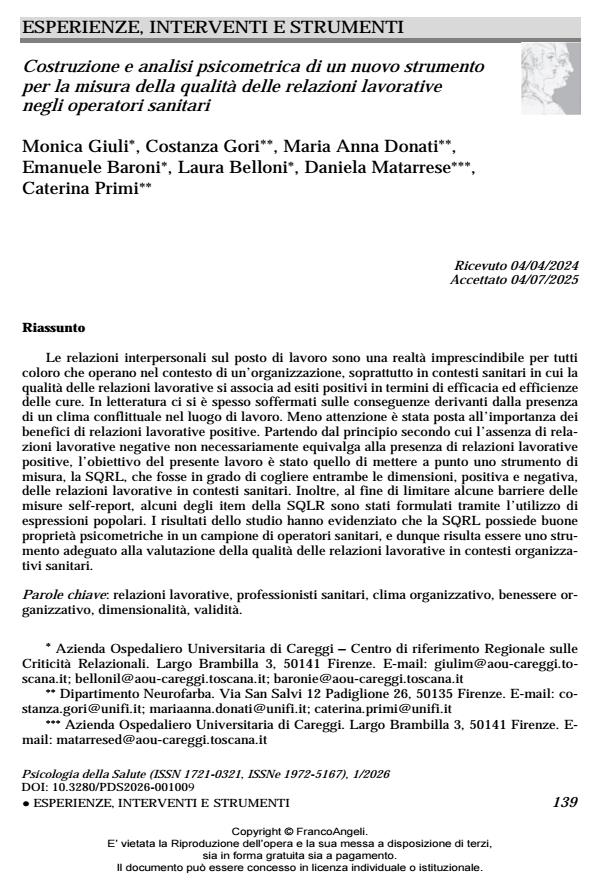
Interpersonal relationships in the workplace are an essential reality for anyone working in the context of an organization, particularly in healthcare, where the quality of working relationships is associated with positive outcomes in terms of effectiveness and efficiency of care. The literature has often focused on the consequences that result from a conflictual workplace climate. Less attention has been paid to the importance of the benefits of positive working relationships. Based on the principle that the absence of negative working relationships does not necessarily equate to the presence of positive working relationships, the aim of this work was to develop a measurement tool, the SQRL, that can capture both the positive and negative dimensions of working relationships in healthcare. In addition, some of the SQLR items were formulated using popular expressions to limit some barriers of self-report measures. The results of the study show that the SQRL has good psychometric properties in a sample of healthcare workers and therefore appears to be a suitable instrument for assessing the quality of working relationships in the organizational context of healthcare.
Keywords: work relationships, healthcare workers, organizational climate, organizational well-being, dimensionality, validity.
- Allen, T. D., Eby, L. T., Poteet, M. L., Lentz, E., & Lima, L. (2004). Career benefits associated with mentoring for protégés: A meta-analysis. Journal of applied psychology, 89(1): 127-136. DOI: 10.1037/0021-9010.89.1.12
- Aiken, L. H., & Patrician, P. A. (2000). Measuring organizational traits of hospitals: The revised nursing work index. Nursing Research, 49(3): 146–153. DOI: 10.1097/00006199-200005000-0000
- Almost, J., Wolff, A. C., Stewart-Pyne, A., McCormick, L. G., Strachan, D., & D’Souza, C. (2016). Managing and mitigating conflict in healthcare teams: an integrative review. Journal of advanced nursing, 72(7): 1490-1505.
- Bartunek, J. M. (2011). Intergroup relationships and quality improvement in healthcare. BMJ Quality & Safety, 20(Suppl 1): i62–i66.
- Baumeister, R. F., & Leary, M. R. (1995). The need to belong: Desire for interpersonal attachments as a fundamental human motivation. Psychological Bulletin, 117(3): 497–529. DOI: 10.1037/0033-2909.117.3.497
- Beale, D., & Leather, P. (2015). Working with care – improving working relationships in health and social care: Self-assessment tools for health and social care teams. London, UK: Royal College of Nursing.
- Berman, E. M., West, J. P., & Richter, Jr, M. N. (2002). Workplace relations: Friendship patterns and consequences (according to managers). Public administration review, 62(2): 217-230. DOI: 10.1111/0033-3352.0017
- Bowling, N. A., &Beehr, T. A. (2006). Workplace harassment from the victim’s perspective: a theoretical model and meta-analysis. Journal of applied psychology, 91(5): 998. DOI: 10.1037/0021-9010.91.5.99
- Calamai, M., Baroni, E., Romoli, D., & Belloni, L. (2015). Prendersi cura delle organizzazioni sanitarie: relazioni che curano e cura delle relazioni. Gruppi, (2): 9–19. DOI: 10.3280/GRU2015-00200
- Chang, T. F., Chen, C. K., & Chen, M. J. (2017). A study of interpersonal conflict among operating room nurses. Journal of Nursing Research, 25(6): 400-410. DOI: 10.1097/JNR.000000000000018
- Cortina, L. M., & Magley, V. J. (2003). Raising voice, risking retaliation: Events following interpersonal mistreatment in the workplace. Journal of occupational health psychology, 8(4): 247-265. DOI: 10.1037/1076-8998.8.4.24
- D’amour, D., & Oandasan, I. (2005). Interprofessionality as the field of interprofessional practice and interprofessional education: An emerging concept. Journal of interprofessional care, 19(sup1): 8-20. DOI: 10.1080/1356182050008160
- Duddle, M., & Boughton, M. (2007). Development and psychometric testing of the Nursing Workplace Relational Environment Scale (NWRES). Journal of Clinical Nursing, 16(9): 1667–1675.
- Dunn, T. J., Baguley, T., & Brunsden, V. (2014). From alpha to omega: A practical solution to the pervasive problem of internal consistency estimation. British Journal of Psychology, 105(3): 399-412.
- Dutton, J. E., Dukerich, J. M., & Harquail, C. V. (1994). Organizational images and member identification. Administrative science quarterly, 239-263. DOI: 10.2307/239323
- Elena Losa Iglesias, M., & Becerro de Bengoa Vallejo, R. (2012). Conflict resolution styles in the nursing profession. Contemporary Nurse, 43(1): 73-80.
- Erickson, J. I., & Duffy, M. E. (2009). Development and psychometric evaluation of the Revised Professional Practice Environment (RPPE) scale. Journal of Nursing Administration, 39(5): 236–243.
- Estabrooks, C. A., Squires, J. E., Cummings, G. G., Birdsell, J. M., & Norton, P. G. (2009). Development and assessment of the Alberta Context Tool. BMC Health Services Research, 9, 234. DOI: 10.1186/1472-6963-9-23
- Feeley, T. H., Hwang, J., & Barnett, G. A. (2008). Predicting employee turnover from friendship networks. Journal of Applied Communication Research, 36(1): 56-73. DOI: 10.1080/0090988070179979
- Gittell, J. H., Fairfield, K. M., Bierbaum, B., Head, W., Jackson, R., Kelly, M., & Zuckerman, J. (2000). Impact of relational coordination on quality of care, postoperative pain and functioning, and length of stay: A nine-hospital study of surgical patients. Medical Care, 38(8): 807–819. DOI: 10.1097/00005650-200008000-0000
- Gupta, N., & Sharma, V. (2016). The relationship between corporate social responsibility and employee engagement and its linkage to organizational performance: A conceptual model. IUP Journal of Organizational Behavior, 15(3): 59-75.
- Heaphy, E. D., & Dutton, J. E. (2008). Positive social interactions and the human body at work: Linking organizations and physiology. Academy of management review, 33(1): 137-162.
- Hocking, B. A. (2006). Using reflection to resolve conflict. AORN journal, 84(2): 249-259. DOI: 10.1016/S0001-2092(06)60492-
- Hu, L. T., & Bentler, P. M. (1998). Fit indices in covariance structure modeling: Sensitivity to under parameterized model misspecification. Psychological methods, 3(4): 424-453. DOI: 10.1037/1082-989X.3.4.42
- Ilies, R., Johnson, M. D., Judge, T. A., & Keeney, J. (2011). A within-individual study of interpersonal conflict as a work stressor: Dispositional and situational moderators. Journal of Organizational Behavior, 32(1), 44-64.
- Ives Erickson, J., Duffy, M. E., Ditomassi, M., & Jones, D. (2017). Development and Psychometric Evaluation of the Professional Practice Work Environment Inventory. The Journal of Nursing Administration, 47(5): 259–265. DOI: 10.1097/NNA.000000000000047
- Jaramillo, F., Mulki, J. P., & Boles, J. S. (2011). Workplace stressors, job attitude, and job behaviors: is interpersonal conflict the missing link?. Journal of personal selling & sales management, 31(3): 339-356. DOI: 10.2753/PSS0885-313431031
- Kline, R. B. (2013). Assessing statistical aspects of test fairness with structural equation modelling. Educational Research and Evaluation, 19(2–3): 204–222. DOI: 10.1080/13803611.2013.767624
- Kostova, T., & Roth, K. (2003). Social capital in multinational corporations and a micro-macro model of its formation. Academy of management review, 28(2): 297-317.
- Kramer, R. M. (1991). Intergroup Relations and Organizational Dilemmas-The role of categorization processes. Research in organizational behavior, 13: 191-228.
- Lake, E. T. (2002). Development of the practice environment scale of the Nursing Work Index. Research in Nursing & Health, 25(3): 176–188.
- Lanham, H. J., McDaniel, R. R., Crabtree, B. F., Miller, W. L., Stange, K. C., Tallia, A. F., & Nutting, P. A. (2009). How improving practice relationships among clinicians and nonclinicians can improve quality in primary care. Joint Commission Journal on Quality and Patient Safety, 35(9): 457–466. DOI: 10.1016/S1553-7250(09)35063-3
- Lease, S. H., Shuman, W. A., & Gage, A. N. (2020). Female and male coworkers: Masculinity, sexism, and interpersonal competence at work. Psychology of Men & Masculinities, 21(1): 139-147.
- Liden, R. C., Wayne, S. J., & Sparrowe, R. T. (2000). An examination of the mediating role of psychological empowerment on the relations between the job, interpersonal relationships, and work outcomes. Journal of applied psychology, 85(3): 407-416. DOI: 10.1037/0021-9010.85.3.40
- Litwin, G. H., & Stringer, R. A., Jr. (1968). Motivation and organizational climate. Boston: Division of Research, Graduate School of Business, Harvard University.
- Mainiero, L. A. (1989). Office romance: Love, power, and sex in the workplace. New York: Rawson Associates.
- Maassen, S. M., Weggelaar Jansen, A. M. J. W., Brekelmans, G., Vermeulen, H., & van Oostveen, C. J. (2020). Psychometric evaluation of instruments measuring the work environment of healthcare professionals in hospitals: A systematic literature review. International Journal for Quality in Health Care, 32(8): 545–557.
- McDonald, R. P. (2013). Test theory: A unified treatment. New York, NY: Psychology Press.
- Nicolucci, A., Giorgino, R., Cucinotta, D., Zoppini, G., Muggeo, M., Squatrito, S., Corsi, A., Lostia, S., Pappalardo, L., Benaduce, E., Girelli, A., Galeone, F., Maldonato, A., Perriello, G., Pata P., Marra, G. & Coronel, G. A. (2004). Validation of the Italian version of the WHO-Well-Being Questionnaire (WHO-WBQ) and the WHO-Diabetes Treatment Satisfaction Questionnaire (WHO-DTSQ). Diabetes, nutrition & metabolism, 17(4): 235-243.
- Okello, D. R. O., & Gilson, L. (2015). Exploring the influence of trust relationships on motivation in the health sector: A systematic review. Human Resources for Health, 13(1): 16.
- Payton, J. (2014). Conflict in the dialysis clinic. Nephrology Nursing Journal, 41(4): 365-368.
- Primi, C., Giuli, M., Baroni, E., Zurkirch, V., Galanti, M., Belloni, L., Gori, C., & Donati, M. A. (2023). The Individual- and Organization-Related Stressors in Pandemic Scale for Healthcare Workers (IOSPS-HW): Development and Psychometric Properties of a New Instrument to Assess Individual and Organizational Stress Factors in Periods of Pandemics. International Journal of Environmental Research and Public Health, 20(5): 4082.
- Rafferty, A. M., Philippou, J., Fitzpatrick, J. M., & Ball, J. (2017). Development and testing of the ‘Culture of Care Barometer’ (CoCB). Journal of Research in Nursing, 22(4): 228–248. DOI: 10.1177/174498711770781
- Reid, K., & Courtney, M. (2007). A model for clinical practice within a managed practice environment: The Brisbane Practice Environment Measure (B-PEM). Contemporary Nurse, 25(1-2): 118–129.
- Reich, T. C., & Hershcovis, M. S. (2011). Interpersonal relationships at work. In: Zedeck, S. (ed.), Handbook of industrial and organizational psychology (Vol. 3). Washington, DC: American Psychological Association, pp. 223-248.
- Schroder, C., Medves, J., Paterson, M., Byrnes, V., Chapman, C., O’Riordan, A., & Kelly, C. (2011). Development and pilot testing of the Collaborative Practice Assessment Tool. Journal of Interprofessional Care, 25(3): 189–195. DOI: 10.3109/13561820.2010.53262
- Spector, P. E., & Jex, S. M. (1998). Development of four self-report measures of job stressors and strain: interpersonal conflict at work scale, organizational constraints scale, quantitative workload inventory, and physical symptoms inventory. Journal of occupational health psychology, 3(4): 356-367. DOI: 10.1037/1076-8998.3.4.35
- Stahl, M., & Schirmer, M. (2017). Development of the Picker Employee Questionnaire for midwives. Midwifery, 55: 16–23.
- Sutherland, J. M., Liu, G., Crump, R. T., & McGrail, K. M. (2022). Good working relationships: How healthcare system proximity influences trust between healthcare workers. Health Policy, 126(2): 99–107.
- Sveningsson, S., & Alvesson, M. (2003). Managing managerial identities: Organizational fragmentation, discourse and identity struggle. Human relations, 56(10): 1163-1193. DOI: 10.1177/0018726703561000
- Terraciano, A., McCrae, R. R., & Costa Jr, P. T. (2003). Factorial and construct validity of the Italian Positive and Negative Affect Schedule (PANAS). European journal of psychological assessment, 19(2): 131. DOI: 10.1027/1015-5759.19.2.13
- Tsui, P. L. (2021). Would organizational climate and job stress affect wellness? An empirical study on the hospitality industry in Taiwan during covid-19. International Journal of Environmental Research and Public Health, 18(19): 10491.
- Williams, K. D. (2002). Ostracism: The power of silence. New York, NY: Guilford Press.
Monica Giuli, Costanza Gori, Maria Anna Donati, Emanuele Baroni, Laura Belloni, Daniela Matarrese, Caterina Primi, Costruzione e analisi psicometrica di un nuovo strumento per la misura della qualità delle relazioni lavorative negli operatori sanitari in "PSICOLOGIA DELLA SALUTE" 1/2026, pp 139-160, DOI: 10.3280/PDS2026-001009