Merit: a controversial and rejected idea

Journal title SOCIOLOGIA E RICERCA SOCIALE
Author/s Alberto Baldissera
Publishing Year 2026 Issue 2025/138
Language English Pages 28 P. 5-32 File size 264 KB
DOI 10.3280/SR2025-138001
DOI is like a bar code for intellectual property: to have more infomation click here

Below, you can see the article first page

If you want to buy this article in PDF format, you can do it, following the instructions to buy download credits
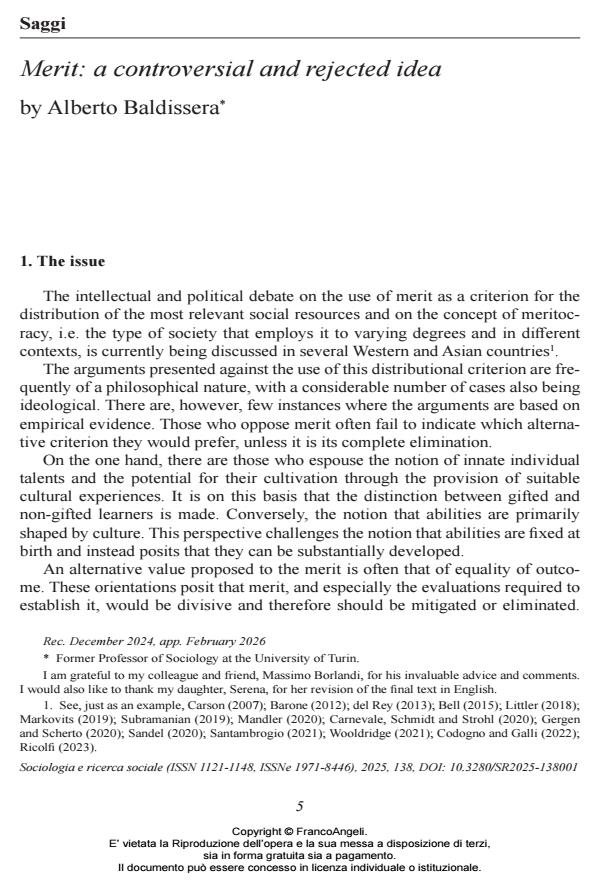
Article preview

FrancoAngeli is member of Publishers International Linking Association, Inc (PILA), a not-for-profit association which run the CrossRef service enabling links to and from online scholarly content.

The idea of merit eludes a firm and precise definition. The concept varies across social groups, cultural, religious and national contexts, and historical periods. Any definition of merit involves an element of evaluation. Even some relevant conse-quences. For example, on the order of social statuses. This paper examines varia-tions in the meaning, and utilisation, of the term in different cultural and religious contexts – from India to China and many Western countries. In conclusion, a debate on value judgments cannot be resolved scientifically. The social sciences can instead shed light on the consequences of different value orientations and the practices associated with them.

  1. A. Allen (2011), «Michael Young’s The Rise of the Meritocracy: A Philosophical Critique», British Journal of Educational Studies, 59, 4, pp. 367-82.
  2. Anonymous (2024), «Suffering from the Bhopal disaster in India continues,40 years on», The Economist, Dec 1st.
  3. H. Arendt (1954), The Crisis in Education, in Between Past and Future, London, Penguin, 2006, https://thi.ucsc.edu/wp-content/uploads/2016/09/Arendt-Crisis_In_Education-1954.pdf.
  4. A. Baldissera (2001), Il declino della meritocrazia nell’università italiana, in R. Grimaldi (a c. di), Valutare l’Università, Torino, Utet.
  5. A. Baldissera (a c. di) (2002), Gli usi della comparazione, Milano, FrancoAngeli.
  6. A. Baldissera (2024), Sul disordine italiano, Accademia University Press, Torino.
  7. C. Barone (2012), Le trappole della meritocrazia, Bologna, il Mulino.
  8. C. Barone (2022), Towards an Education-based Meritocracy? Why Modernisation and So-cial Reproduction theories cannot explain trends in educational inequalities: outline of an alternative explanation, Isa eSymposium for Sociology, 2019, 9.1, https://hal-sciencespo. archives-ouvertes.fr/hal-03567103.
  9. A. Bell, R. Chetty, X. Jaravel, N. Petkova, J. Van Reenen (2019), «Who becomes an Inventor in America? The Importance of Exposure to Innovation», The Quarterly Journal of Econom-ics, 134, 2, pp. 647-713.
  10. D. Bell (1973), The Coming of Post-Industrial Society, A Venture into Social Forecasting, New York, Basic Books, 1976, 1999.
  11. D.A. Bell (2015), The China model: political meritocracy and the limits of democracy, Prince-ton and Oxford, Princeton University Press.
  12. D.A. Bell, W. Pei (2020), Just Hierarchy. Why Social Hierarchies Matter in China and the Rest of World, Princeton, Princeton University Press.
  13. L. Benadusi, N. Bottani (a c. di) (2006), Uguaglianza ed equità nella scuola, Trento, Edizioni Erickson.
  14. L. Benadusi, O. Giancola (2021), Equità e merito nella scuola: teorie, indagini empiriche, politiche, Milano, FrancoAngeli.
  15. A. Béteille (1996), Caste in Contemporary India, in C.J. Fuller (ed.), Caste Today, Delhi-New York, Oxford University Press.
  16. A. Bianco (2009), Merito? No, grazie. Meritocrazia ed egualitarismo nella scuola italiana, Acireale, Bonanno.
  17. M. Blair-Loy, E.A. Cech (2022), Misconceiving merit: paradoxes of excellence and devotion in academic science and engineering, Chicago-London, The University of Chicago Press.
  18. R. Boudon (1973), L’inégalité des chances. La mobilité sociale dans les sociétés industrielles, Paris, A. Colin.
  19. R. Boudon, F. Bourricaud (1982), A Critical Dictionary of Sociology, London, Routledge, Tay-lor & Francis Group, 2015.
  20. P. Bourdieu (1966), «L’école conservatrice. Les inégalités devant l’école et devant la culture», Revue française de sociologie, 3, pp. 325-34.
  21. P. Bourdieu (1984), Homo Academicus, Paris, Les Editions de Minuit; en. tr. Homo Academi-cus, Stanford, Stanford University Press, 1988.
  22. P. Bourdieu (1986), The Forms of Capital in Handbook of Theory and Research for the Sociol-ogy of Education, ed. by J. Richardson, Westport, Greenwood Press.
  23. P. Bourdieu, J.-C. Passeron (1964), Les héritiers. Les étudiants et la culture, Paris, Editions de Minuit; en. tr. Reproduction in Education, Society, and Culture, London, Sage, 1990.
  24. E. Caniglia (2019), «La neutralità assiologica weberiana e le sociologie di secondo livello», SocietàMutamentoPolitica, 10, 20 pp. 73-83.
  25. A.P. Carnevale, P. Schmidt, J. Strohl (2020), The Merit Myth. How Colleges favor the Rich and divide America, New York-London, The New Press.
  26. J. Carson (2007), The Measure of Merit: Talents, Intelligence, and Inequality in the French and American Republics, 1750-1940, Princeton, Princeton University Press.
  27. R. Chetty, W. Dobbie, B. Goldman, S.R. Porter, C.S. Yang (2024), Changing Opportunity: Sociological Mechanisms Underlying Growing Class Gaps and Shrinking Race Gaps in Economic Mobility, Nber Working Paper No. 32697.
  28. P. Cipollone (2008), «Un commento», Stato e mercato, 82, pp. 71-6.
  29. L. Codogno, G. Galli (2022), Meritocracy, Growth, and Lessons from Italy’s Economic Decline: Lobbies (and Ideologies) Against Competition and Talent, Oxford, Oxford University Press.
  30. J. Coleman, E.Q. Campbell, C.J. Hobson, J. McPartland, A.M. Mood, F.D. Weinfeld, R.L. York (1966), Equality of educational opportunity, Washington DC, National Center for Educa-tional Statistic.
  31. D.J. de la Torre (2020), Chance, Merit, and Economic Inequality. Rethinking Distributive Justice and the Principle of Desert, Cham, Springer International Publishing-Palgrave Macmillan.
  32. A. del Rey (2013), La tyrannie de l’évaluation, Paris, Éditions La Découverte.
  33. S. Deshpande (2006), «Exclusive Inequalities: Merit, Caste and Discrimination in Indian High-er Education Today», Economic and Political Weekly, 41, 24, pp. 2438-44.
  34. S. Deshpande (2013), «Caste and Castelessness: Towards a Biography of the “General Catego-ry”», Economic and Political Weekly, 48, 15, pp. 32-9.
  35. Draghi Report (2024), The Future of European Competitiveness, Part A: A competitiveness strategy for Europe, https://commission.europa.eu/topics/competitiveness/draghi-report_en.
  36. E. Durkheim (1897), Le Suicide: étude de sociologie, Paris, F. Alcan; en. tr. (by J.A. Spalding and G. Simpson) Suicide: A Study in Sociology, London, Routledge Classics, 2005.
  37. R. Erikson (2020), «Inequality of Educational Opportunity. The Role of Performance and Choice», European Review, 28, pp. 544-55.
  38. K. Forss, I.K. Lindkvist, M. McGillivray (2021), Long Term Perspectives in Evaluation. In-creasing Relevance and Utility, New York-London, Routledge.
  39. S. Friedman, C. Ellersgaard, A. Reeves, A.G. Larsen (2024), «The Meaning of Merit: Talent versus Hard Work Legitimacy», Social Forces, 102, 3, pp. 861-79.
  40. K.J. Gergen, R.G. Scherto (2020), Beyond the Tyranny of Testing. Relational Evaluation in Education, New York, Oxford University Press.
  41. J. Goldthorpe, M. Jackson (2008), Education-based Meritocracy: The Barriers to its Realisa-tion, in A. Lareau, D. Conley (eds.), Social Class: How Does it Work?, London, Russell Sage Foundation.
  42. E. Granaglia (2022), Uguaglianza di opportunità. Sì, ma quale?, Roma-Bari, Laterza.
  43. R.J. Herrnstein, C. Murray (1994), The bell curve: intelligence and class structure in American life, New York, Free Press.
  44. Z.M. Howlett (2021), Meritocracy and its discontents: anxiety and the national college en-trance exam in China, Ithaca, Cornell University Press.
  45. C. Jenks (1972), Inequality. A reassessment of the effect of family and schooling in America, New York, Basic Books.
  46. A. Lee (2020), From Hierarchy to Ethnicity. The Politics of Caste in Twentieth-Century India, Cambridge, Cambridge University Press.
  47. J. Littler (2018), Against Meritocracy. Culture, Power and Myths of Mobility, New York-Abin-gdone-New York, Routledge.
  48. D. Lockwood (1992), Solidarity and schism: «the problem of disorder» in Durkheimian and Marxist sociology, Clarendon Press, Oxford.
  49. A. Madan (2007), «Sociologising Merit», Economic and Political Weekly, Jul. 21-27, 42, 29, pp. 3044-50.
  50. R. Malhotra, V. Viswanathan (2023), The Battle for Itts: A Defense of Meritocracy, Princeton, Infinity Foundation.
  51. P. Mandler (2020), The Crisis of the Meritocracy. Britain’s Transition to Mass Education since the Second World War, New York, Oxford University Press.
  52. D. Markovits (2019), The Meritocracy Trap. How America’s Foundational Myth Feeds Ine-quality, Dismantles the Middle Class, and Devours the Elite, New York, Penguin Press.
  53. A. Marradi (1985), Natura, forme e scopi della comparazione: un bilancio, in D. Fisichella, Metodo scientifico e ricerca politica, Roma, Nuova Italia Scientifica.
  54. P-M. Menger (2023), Mérite et méritocratie, Cours au Collège de France, https://www.col-leg-de-france.fr/fr/agenda/cours/merite-et-meritocratie-suite/juger-le-merite-dans-les-con-cours-internationaux-de-piano-1-introduction.
  55. P-M. Menger (2024), «Talent and the Social Physics of Inequalities», Revue européenne des sciences sociales, 62, 1, pp. 13-44.
  56. D.M. Mertens (2024), Research and Evaluation in Education and Psychology. Integrating Di-versity with Quantitative, Qualitative and Mixed Methods, Los Angeles, Sage, 6th ed.
  57. J.B. Mijs (2022), «Merit and ressentiment: how to tackle the tyranny of merit», Theory and Research in Education, 20, 2, pp. 173-181.
  58. L. Milani (1967), Lettera a una professoressa, Milano, Mondadori, 2023.
  59. D.C. Mutz (2018), Status threat, not economic hardship, explains the 2016 presidential vote, in Proceedings of National Academy of Science USA, 8, 115, 19, E4330-E4339.
  60. Y. Okumura (2023), Educational Evaluation and Improvement in Japan. Linking Lesson Study, Curriculum Management and School Evaluation, Cham, Springer.
  61. P. Perrenoud (1970), «Stratification socio-culturelle et réussite scolaire: les défaillances de l’ex-plication causale», Cahiers Vilfredo Pareto, 8, 20, pp. 5-75.
  62. P. Perrenoud (1998), L’évaluation des élèves. De la fabrication de l’excellence à la régulation des apprentissages. Entre deux logiques, Brussels, De Boeck, https://www.education-nou-velle.ch/wp-content/uploads/2020/04/Perrenoud-Evaluation-INTRO-1998-.pdf.
  63. S.K. Portillo, N. Humphrey, D. Bearfield (2023), The Myth of Bureaucratic Neutrality. An Ex-amination of Merit and Representation, New York & Abington, Routledge.
  64. J.-D. Reynaud (1987), «Qualification et marché de travail», Sociologie du travail, 29, 1, pp. 86-109.
  65. L. Ricolfi (2023), La rivoluzione del merito, Milano, Rizzoli.
  66. J. Saglio (1986), Les classifications comme constats de qualification : quelques interrogations mal venues, in AA.VV., Première rencontre «Sociologie du travail» (Nantes, les 13 et 14 janvier 1986). La sociologie face à la «qualification», Lesco, Université de Nantes Pirttem, Cnrs, polycopié, pp. 275-84.
  67. M.J. Sandel (2010), Justice: What’s the Right Thing to do?, New York, Farrar, Straus and Giroud.
  68. M.J. Sandel (2020), The Tyranny of Merit. What’s Become of the Common Good?, London, Penguin Random House.
  69. M. Santambrogio (2021), Il complotto contro il merito, Roma-Bari, Laterza.
  70. G. Sartori (1991), «Comparing and Miscomparing», Journal of Theoretical Politics, 3, 3, pp. 243-57.
  71. G. Shah, K.K. Bagchi, V. Kalaiah (2020), Education and Caste in India. The Dalit Question, London-New York, Routledge.
  72. M. Scheler M. (1912), Über Ressentiment und moralisches Werturteil, Leipzig, W. Engelmann; en. tr. Ressentiment, New York, Schocken, 1972.
  73. L. Shriver (2024), Mania, London, The Borough Press-HarperCollins Pub.
  74. R. Stockmann, W. Meyer, L. Taube (2020), The Institutionalisation of Evaluation in Europe, Cham, Palgrave Macmillan.
  75. S.A. Stouffer, E.A. Suchman, L.C. DaVinney, S.A. Star, R.M. Williams jr. (1949a), The Ameri-can Soldier: Adjustment to Army Life, vol. I, Princeton, Princeton University Press.
  76. S.A. Stouffer, A.A. Lumsdaine, M. Harper Lumsdaine, R.M. Williams, jr., M. Brewster Smith,
  77. J.L. Janib, S.A. Star, L.S. Cottrell, jr. (1949b), The American Soldier: Combat and Its After-math, vol II, Princeton, Princeton University Press.
  78. A. Subramanian (2015), «Making Merit: The Indian Institutes of Technology and the Social
  79. Life of Caste», Comparative Studies in Society and History, 57, 2, pp. 291-322.
  80. A. Subramanian (2019), The caste of merit: engineering education in India, Cambridge, Har-vard University Press.
  81. A. de Tocqueville (1835), De la démocratie en Amérique, Paris, C. Gosselin; en. tr. Democracy
  82. in America, Chicago, University of Chicago Press, 2002.
  83. P. Trivellato (1997), «Paese che vai, formazione che trovi. Appunti per un confronto sui modi di apprendere in Italia e in Giappone», Quaderni di Sociologia, 15, pp. 65-80.
  84. L. Volante (ed.) (2018), The Pisa Effect on Global Educational governance, New York-London, Routledge.
  85. L. Volante, S.V. Schnepf, J. Jerrim, D.A. Klinger (eds.) (2019), Socioeconomic Inequality and Stu-dent Outcomes. Cross-National Trends, Policies, and Practices, Singapore, Springer Nature.
  86. G. Wagner (2007), «Does excellence matter? Eine wissenschaftsoziologische Perspective», Soziologie, 36, pp. 7-20,
  87. B. Wegener (1987), “The Illusion of Distributive Justice”, European Sociological Review, 3, 1, pp. 1-13.
  88. M. Weber (1915-20), Religious Rejections of the World and Their Directions, in H.H Gerth,
  89. C. Wright Mills (eds.) From Max Weber. Essays in Sociology, Abingdon, Routledge, 2009.
  90. A. Wooldridge (2021), The Aristocracy of Talent: How Meritocracy Made the Modern World,
  91. London, Allen Lane; Penguin Books, 2023.
  92. M. Young (1958), The Rise of the Meritocracy, Harmondsworth, Penguin.
  93. M. Young (2001), «Down with Meritocracy», The Guardian, June 29th.

Alberto Baldissera, Merit: a controversial and rejected idea in "SOCIOLOGIA E RICERCA SOCIALE " 138/2025, pp 5-32, DOI: 10.3280/SR2025-138001