Exegesis and ideology. For a sociology of Bruno Latour’s catholicism

Journal title SOCIOLOGIA E RICERCA SOCIALE
Author/s Stefano Mancin
Publishing Year 2026 Issue 2025/138
Language Italian Pages 19 P. 60-78 File size 216 KB
DOI 10.3280/SR2025-138003
DOI is like a bar code for intellectual property: to have more infomation click here

Below, you can see the article first page

If you want to buy this article in PDF format, you can do it, following the instructions to buy download credits
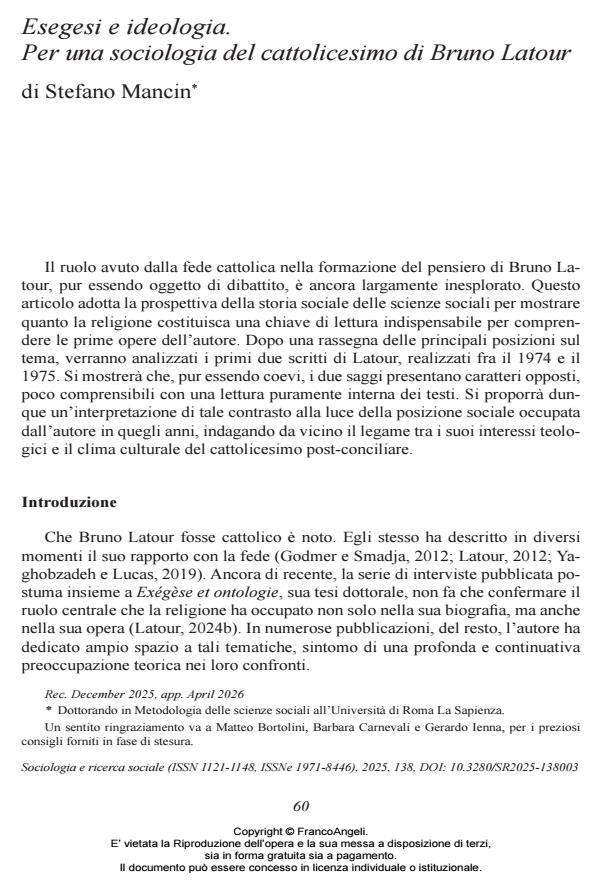
Article preview

FrancoAngeli is member of Publishers International Linking Association, Inc (PILA), a not-for-profit association which run the CrossRef service enabling links to and from online scholarly content.

Despite being a subject of debate, the role played by the Catholic faith in the formation of Bruno Latour’s thought remains largely unexplored. This article adopts the perspective of the social history of social sciences to show how religion constitutes an indispensable key to understand the author’s early works. After a review of the main positions on the subject, the paper will analyze Latour’s first two writings, produced between 1974 and 1975. It will be shown that, despite being contemporary, the two essays possess opposing characteristics that are dif-ficult to understand through a purely internal reading of the texts. Therefore, an interpretation of this contrast will be proposed by considering the social position occupied by the author during those years, and by closely investigating the link between his philosophical and theological interests and the cultural climate of post-conciliar Catholicism.

  1. D. Agacinski (2012), «Comment la guerre d’Algérie a politisé le milieu étudiant», Cahiers du Grm, 3, pp. 1-15,
  2. M. Augé (1975), Theorie des Pouvoirs et Ideologie, Paris, Hermann,
  3. M. Augé (1976), «Anthropology and the Problem of Ideology», Journal of the Anthropological Society of Oxford, 7, 1, pp. 1-10.
  4. R. Barthes (1971), L’Analyse structurale du rêcit: à propos d’Actes X-XI, in AAVV, Éxègese et herméneutique, Paris, Seuil.
  5. P. Bourdieu (1971), «Genèse et structure du champ religieux», Revue Française de Sociologie, 12, 3, pp. 295-334.
  6. R. Catto (2014), «Book Review Symposium, Rejoicing: or the torments of religious speech», Sociology, 48, 2, pp. 403-4.
  7. Concilio ecumenico vaticano II (1979), Costituzione pastorale «Gaudium et spes» del 7 dicem-bre 1965, in Enchiridion Vaticanum 1, parr. 1324-5, Bologna, Dehoniane.
  8. G. Davie (2014), «Book Review Symposium, Rejoicing: or the torments of religious speech», Sociology, 48, 2, pp. 406-8.
  9. A. Day (2014), «Book Review Symposium, Rejoicing: or the torments of religious speech», Sociology, 48, 2, pp. 408-9.
  10. J. Delorme (1996), Sémiotique, in Dictionnaire de la Bible: Supplément, vol. XII: Satan-Songe, Paris, Letouzey&Ané.
  11. J. Delorme, P. Geoltrain (1982), Le discours religieux, in Sémiotique. L’école de Paris, Paris, Hachette.
  12. G. de Vries (2016), Bruno Latour, Cambridge-Malden, Polity Press.
  13. A. Favier (2019), «La révision de vie: Une pratique religieuse méconnue au cœur du catholici-sme français», Archive des Sciences Sociales des Religions, 186, pp. 145-51,
  14. F. Flipo (2025), Les écologistes sans la nature? Le faux ami Bruno Latour, Paris, Textuel.
  15. É. Fouilloux (1988), Une Eglise en quête de liberté. La pensée catholique française entre mo-dernisme et Vatican II, 1914-1962, Paris, Desclée de Brouwer.
  16. B. Giroux (2011), La Jec de la Libération aux années 1960, in C. Sorrel, B. Barbiche (sous la dir. de), La Jeunesse étudiante chrétienne 1929-2009, Lyon, Larhra,
  17. B. Giroux (2013), La Jeunesse étudiante chrétienne. Des origines aux années 1970, Paris, Clerf.
  18. L. Godmer, D. Smadja (2012), «The Work of Bruno Latour: Exegetical Political Thinking»,
  19. Raisons Politiques, 47, 3, pp. III-XXXIV,
  20. J. Golinski (2010), Science and religion in postmodern perspective. The case of Bruno Latour, in T. Dixon, G. Cantor, S. Pumfrey (eds.), Science and Religion, Cambridge, Cambridge University Press, DOI: 10.1017/CBO9780511676345.004
  21. N. Heinich, (2007), «Une sociologie très catholique? À propos de Bruno Latour», Esprit, Mai, 5, pp. 14-26,
  22. A. Hennion (2024), «Bruno Latour and Religion: A Strange Parishioner», Theory, Culture & Society, 41, 5, pp. 105-12, DOI: 10.1177/02632764241275443
  23. B. Humphris (2025), «Sort of Sermons: An Exploration of Critique, Literary Style and Catholi-cism in Bruno Latour’s Religious Writings», Implicit Religion, 26, 2-3, pp. 259-86.
  24. G.-R. Horn (2015), The spirit of Vatican II: Western european progressive catholicism in the long sixties, Oxford, Oxford University Press.
  25. G.-R. Horn (2018), «Quand l’esprit de Vatican II se mêle à l’esprit de “68”», Tumultes, 50, 1, pp. 43-56,
  26. T. Howles (2018a), «La religion comme élément structurel du système philosophique de Bruno Latour», Symposium, 22, 2, pp. 27-42,
  27. T. Howles (2018b), The Political Theology of Bruno Latour, Oxford, Phd Thesis, https:// ora.ox.ac.uk/objects/uuid:3f3d63ca-890e-409e-acce-cd803e51bcc8/files/mcf2f825e-13f3e5627239fc46c39491a8.
  28. J. Kirwan (2018), An avant-garde theological generation: The «nouvelle théologie» and the French crisis of modernity, Oxford, Oxford University Press.
  29. J. Lamy (2021), «Sociology of a disciplinary bifurcation: Bruno Latour and his move from philosophy/theology to sociology in the early 1970s», Social Science Information, 60, 1, pp. 107-30, DOI: 10.1177/0539018420984053
  30. B. Latour (1987), Science in action: How to follow scientists and engineers through society, Cambridge, Harvard University Press.
  31. B. Latour (2012), «Biographie d’une enquête. À propos d’un livre sur les modes d’existence», Archives de Philosophie, 75, 4, pp. 549-66,
  32. B. Latour (2024a), Exégèse et ontologie à propos de la résurrection, in La religion à l’épreuve de l’écologie, Paris, La Découverte.
  33. B. Latour (2024b), La religion à l’épreuve de l’écologie, Paris, La Découverte.
  34. B. Latour, A. Shabou (1974), Les idéologies de la competence en milieu industriel à Abidjan, Abidjan, Orstom Sciences Humaines.
  35. A. Malet (1962), Mythos et Logos, la pensée de Rudolf Bultmann, Géneve, Labor et Fides.
  36. D. Marguerait (1987), «A quoi sert l’exégèse? Finalité et méthodes dans la lecture du Nouveau Testament», Revue de Théologie et de Philosophie, 119, 2, pp. 149-69.
  37. A. Pénicaud (2001), «Vers une lecture figurative de la bible: Les mutations de la sémiotique biblique», Recherches de Science Religieuse, 89, 3, pp. 377-401,
  38. P. Peverini (2023), Inchiesta sulle reti di senso. Bruno Latour nella svolta semiotica, Milano, Meltemi.
  39. M. Quisinsky (2008), «Philosophie et théologie: Quelques intuitions du père Chenu revisitées par ses héritiers», Revue des sciences philosophiques et théologiques, Tome 92, 3, pp. 569-89,
  40. L. Santori (1995), La Chiesa nel mondo contemporaneo. Introduzione alla Gaudium et spes, Padova, Messaggero.
  41. J.-L. Schlegel (2021), «L’herméneutique et les méthodes d’exégèse biblique» La Revue des revues, 66, 2, pp. 64-74,
  42. H. Schmidgen (2015), Bruno Latour in Pieces: An Intellectual Biography, New York, Fordham.
  43. B. Smith (2016), «Anthropotheology: Latour Speaking Religiously», New Literary History, 47, 2-3, pp. 331-51.
  44. V. Soulage (2011), Aprés 68, le «moment politique» d’un mouvement qui se cherche (1965-1982), in C. Sorrel, B. Barbiche (sous la dir. de), La Jeunesse étudiante chrétienne 1929-2009, Lyon, Larhra,
  45. J.-Y. Thériault (2007), «Quand la Bible s’ouvre à la lecture sémiotique», Protée, 34, 1, pp. 67-75,
  46. P-F. Tremlett (2014), «Book Review Symposium, Rejoicing: or the torments of religious speech», Sociology, 48, 2, pp. 404-6.
  47. R. Yaghobzadeh, H. Lucas (2019), «Bruno Latour: “L’apocalypse, c’est enthousiasmant”», Le Monde, 31 mai

Stefano Mancin, Esegesi e ideologia. Per una sociologia del cattolicesimo di Bruno Latour in "SOCIOLOGIA E RICERCA SOCIALE " 138/2025, pp 60-78, DOI: 10.3280/SR2025-138003