Care in motion: Family practices and care mobility in Sassoleone
Journal title ARCHIVIO DI STUDI URBANI E REGIONALI
Author/s Francesca Acetino
Publishing Year 2026 Issue 2026/146
Language Italian Pages 23 P. 66-88 File size 159 KB
DOI 10.3280/ASUR2026-146004
DOI is like a bar code for intellectual property: to have more infomation
click here
Below, you can see the article first page
If you want to buy this article in PDF format, you can do it, following the instructions to buy download credits
FrancoAngeli is member of Publishers International Linking Association, Inc (PILA), a not-for-profit association which run the CrossRef service enabling links to and from online scholarly content.
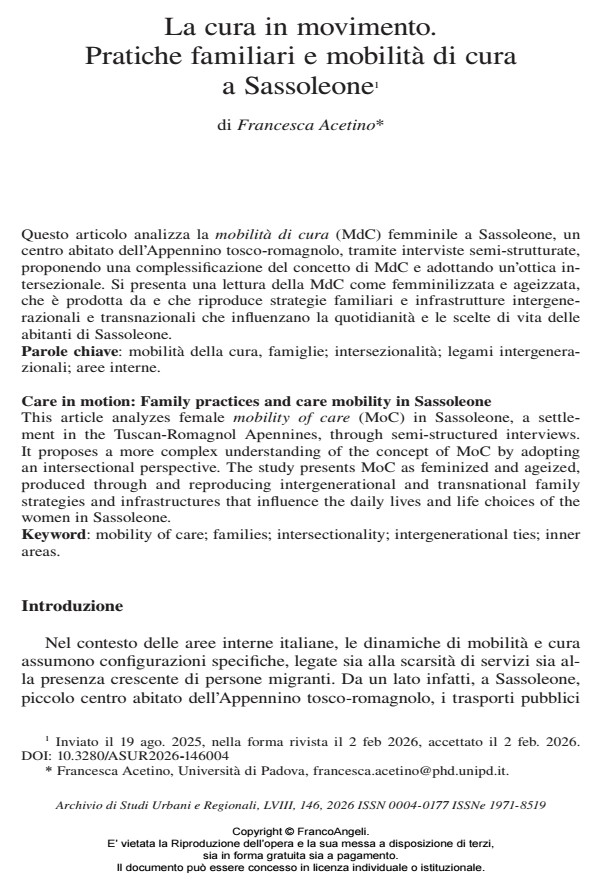
This article analyzes female mobility of care (MoC) in Sassoleone, a settlement in the TuscanRomagnol Apennines, through semistructured interviews. It proposes a more complex understanding of the concept of MoC by adopting an intersectional perspective. The study presents MoC as feminized and ageized, produced through and reproducing intergenerational and transnational family strategies and infrastructures that influence the daily lives and life choices of the women in Sassoleone.
Keywords: mobility of care; families; intersectionality; intergenerational ties; inner areas.
- Ahmed S. (2014). Selfcare as Warfare, Feminist Killjoys. Testo disponibile al sito: https://feministkilljoys.com/2014/07/12/selfcareaswarfare/ (ultimo accesso: 11 giugno 2025).
- Arruzza C., Bhattacharya T. and Fraser N. (2019). Feminism for the 99 Percent: A Manifesto. LondonNew York: Verso.
- Artamonova A., Gillespie B.J. and Brandén M. (2020). Geographic mobility among older people and their adult children: The role of parents’ health issues and family ties. Popul Space Place, 26(8).
- Baldassar L. and Merla L. (2014). Transnational Families, Migration and the Circulation of Care: Understanding Mobility and Absence in Family Life. New York: Routledge.
- Barbera F., Cersosimo D. e De Rossi A. (2022). Contro i borghi. Il Belpaese che dimentica i paesi. Roma: Donzelli.
- Bhattacharya T. and Vogel L., eds. (2017). Social Reproduction Theory: Remapping Class, Recentering Oppression. London: Pluto Press.
- Borghi R. e Dell’Agnese E. (2009). Genere. In: Dell’Agnese E., a cura di, GeoGrafia. Strumenti e Parole. Milano: Unicopli, 291315.
- Bowlby S. (2012). Recognising the Time—Space Dimensions of Care: Caringscapes and Carescapes. Environment and Planning A: Economy and Space, 44(9): 21012118.
- Chizzali C., Dianin A. and Rabbiosi C. (2025). Needs and norms shaping the mobility of care of women in rural areas: A case study in the Alps. Journal of Transport Geography, 127.
- Coulter R., Ham M.V. and Findlay A.M. (2016). Rethinking residential mobility: Linking lives through time and space. Progress in Human Geography, 40(3): 352374. DOI: 10.1177/030913251557541
- Crenshaw K. (1989). Demarginalizing the Intersection of Race and Sex: A Black Feminist Critique of Antidiscrimination Doctrine, Feminist Theory and Antiracist Politics. University of Chicago Legal Forum, 1989(1): 139167. DOI: 10.4324/9780429499142
- Cresswell T. (1992). In Place/out of Place: Geography, Ideology, and Transgression. Minneapolis: University of Minnesota Press.
- Curcio A. (2024). L’Italia è un paese razzista. Bologna: DeriveApprodi.
- Di Feliciantonio C. (2021). (Un)Ethical Boundaries: Critical Reflections on What We Are (Not) Supposed to Do. The Professional Geographer, 73(3): 496503. DOI: 10.1080/00330124.2021.188344
- Di Gessa G., Glaser K. and Zaninotto P. (2022). Is grandparental childcare socioeconomically patterned? Evidence from the English longitudinal study of ageing. European Journal of Ageing, Springer Science and Business Media LLC, 19(3): 763774.
- Dyck I. (2005). Feminist geography, the ‘everyday’, and localglobal relations: hidden spaces of placemaking: Feminist geography, the ‘everyday’, and localglobal relations. Canadian Geographer/Le Géographe Canadien, 49(3): 233243.
- Emidio Di Treviri (2018). Sul fronte del sisma. Un’inchiesta militante sul postterremoto dell’Appennino centrale (20162017). Bologna: DeriveApprodi.
- Fan Y. (2017). Household structure and gender differences in travel time: spouse/ partner presence, parenthood, and breadwinner status. Transportation, 44(2): 271291.
- Felski R. (2000). Doing Time: Feminist Theory and Postmodern Culture. New York: New York University Press.
- Finch J. (2007). Displaying Families. Sociology, 41(1): 6581. DOI: 10.1177/003803850707228
- Fragnito M. e Tola M., a cura di (2021). Ecologie della cura: prospettive transfemministe. Napoli: Orthotes.
- Frisina A. (2020). Razzismi contemporanei: le prospettive della sociologia. Roma: Carocci editore.
- Gilligan C. (1982). In a Different Voice: Psychological Theory and Women’s Development. Harvard: Harvard University Press.
- GómezVaro I., DelclòsAlió X., MirallesGuasch C. and Marquet, O. (2024). Accounting for care in everyday mobility: an exploration of carerelated trips and their sociospatial correlates. Geografiska Annaler: Series B, Human Geography, 106(3): 347363. DOI: 10.1080/04353684.2023.222615
- Gülgönen T. and Corona, Y. (2015). Children’s Perspectives on Their Urban Environment and Their Appropriation of Public Spaces in Mexico City. Children, Youth and Environments, 25(2).
- Hamilton M., Adamson E., Williams A., Craig L. and Timonen V. (2025). The Relationship Between Public Policy and Grandparents’ Involvement in Childcare: A Scoping Review of the International Evidence. Social Policy and Society.
- Hanson S. (2010). Gender and mobility: new approaches for informing sustainability. Gender, Place & Culture, 17 (1): 523. DOI: 10.1080/0966369090349822
- Haraway D. (1988). Situated Knowledges: The Science Question in Feminism and the Privilege of Partial Perspective. Feminist Studies, 14(3). DOI: 10.2307/317806
- Ho E.L.E., Zhou G., Liew J.A., Chiu T.Y., Huang S. and Yeoh B.S.A. (2021). Webs of Care: Qualitative GIS Research on Aging, Mobility, and Care Relations in Singapore. Annals of the American Association of Geographers, 111(5): 14621482. DOI: 10.1080/24694452.2020.180790
- Kindon S., Pain R. and Kesby M. (2007). Participatory Action Research Approaches and Methods: Connecting People, Participation and Place. London: Routledge.
- Lorde A. (1988). A Burst of Light: Essays. London: Sheba Feminist Press. Massey D.B. (2005). For Space. Los Angeles: Sage.
- Massey D.B. (1994). Space, Place and Gender. Cambridge: Polity Press.
- Mattioli G. (2021). Transport poverty and car dependence: A European perspective. Advances in Transport Policy and Planning, 8: 101133.
- McDowell L. (1992). Doing Gender: Feminism, Feminists and Research Methods in Human Geography. Transactions of the Institute of British Geographers, 17(4): 399416.
- McDowell L. (1999). Gender, Identity and Place: Understanding Feminist Geographies. Cambridge: Polity press.
- Moïse M. e Prunetti A. (2018). Nota di traduzione. In: Davis A., a cura di, Donne, razza e classe. Roma: Alegre.
- Mol A. (2008). The Logic of Care: Health and the Problem of Patient Choice. London: Routledge.
- Montanari G. and Schlinzig T. (2022). Family and space – an interpretive perspective on two central concepts in population geography. Geographica Helvetica, 77(2): 255262.
- Morgan D.H.J. (2020). Family practices in time and space. Gender, Place & Culture, 27(5): 733743. DOI: 10.1080/0966369X.2018.154187
- Næss P. (2006). Accessibility, Activity Participation and Location of Activities: Exploring the Links between Residential Location and Travel Behaviour. Urban Studies, 43(3): 627652. DOI: 10.1080/0042098050053467
- Oberhauser A.M., Fluri J., Whitson R. and Mollett S. (2018). Feminist Spaces: Gender and Geography in a Global Context. London: Routledge.
- Orjuela J.P. and Schwanen, T. (2023). Reconsidering mobility of care: Learning from the experiences of lowincome women during the COVID19 lockdown in Itagüí, Colombia. Habitat International, 142.
- Ouassak F. (2023). Pour Une Écologie Pirate: Et Nous Serons Libres. Paris: La Découverte.
- Pain R. (2004). Social geography: participatory research. Progress in Human Geography, 28(5): 652663.
- Powell M.A., Taylor N. and Smith A.B. (2013). Constructions of rural childhood: challenging dominant perspectives. Children’s Geographies, 11(1): 117131. DOI: 10.1080/14733285.2013.74328
- Ravensbergen L., Fournier J. and ElGeneidy A. (2023). Exploratory Analysis of Mobility of Care in Montreal, Canada. Transportation Research Record: Journal of the Transportation Research Board, 2677(1): 14991509. DOI: 10.1177/0361198122110507
- Rose G. (1993). Feminism and Geography: The Limits of Geographical Knowledge. Cambridge: Cambridge: Polity Press.
- Rubin M. and Parker A. (2023). Many ways to care: mobility, gender and Gauteng’s geography. Gender, Place & Culture, 30(5): 714737. DOI: 10.1080/0966369X.2022.213309
- Sabatini F. (2024a). Borghi. In: Tomeo N., a cura di, Vocabolario delle Aree Interne. 100 parole per l’uguaglianza dei territori. Capistrello: Radici Edizioni. Sabatini F. (2024b). Oltre aree interne e borghi: i paesi come spazi relazionali.
- Scarti di zolfo e nuovi abitanti a Cianciana (Sicilia). Tracce urbane. Rivista italiana transdisciplinare di studi urbani, 11(15): 253273. DOI: 10.13133/25326562/1865
- Sánchez de Madariaga I. (2009). Vivienda, movilidad y urbanismo para la igualdad en la diversidad: ciudades, género y dependencia. Ciudad Y Territorio Estudios Territoriales, 41: 581597.
- Sánchez de Madariaga I. and Roberts M., eds. (2013), Fair Shared Cities: The Impact of Gender Planning in Europe. London: Routledge.
- Scholten C. and Joelsson T., eds. (2019). Integrating Gender into Transport Planning: From One to Many Tracks. New York: Palgrave Macmillan.
- Soukhov A., Mooney N. and Ravensbergen L. (2025). Exploring mobility of care with measures of accessibility. Journal of Transport Geography, 123.
- Teti V. (2011). Pietre di pane: un’antropologia del restare. Macerata: Quodlibet. Teti V. (2022). La restanza. Torino: Einaudi.
- Tronto J.C. (1993). Moral Boundaries: A Political Argument for an Ethic of Care. New York: Routledge.
Francesca Acetino, La cura in movimento. Pratiche familiari e mobilità di cura a Sassoleone in "ARCHIVIO DI STUDI URBANI E REGIONALI" 146/2026, pp 66-88, DOI: 10.3280/ASUR2026-146004