Right to green spaces: Rethinking urban standards in terms of spatial justice. The case of Verona
Journal title ARCHIVIO DI STUDI URBANI E REGIONALI
Author/s Giulia Vallone, Catherine Dezio, Francesco Pagliacci
Publishing Year 2026 Issue 2026/146
Language Italian Pages 34 P. 112-145 File size 595 KB
DOI 10.3280/ASUR2026-146006
DOI is like a bar code for intellectual property: to have more infomation
click here
Below, you can see the article first page
If you want to buy this article in PDF format, you can do it, following the instructions to buy download credits
FrancoAngeli is member of Publishers International Linking Association, Inc (PILA), a not-for-profit association which run the CrossRef service enabling links to and from online scholarly content.
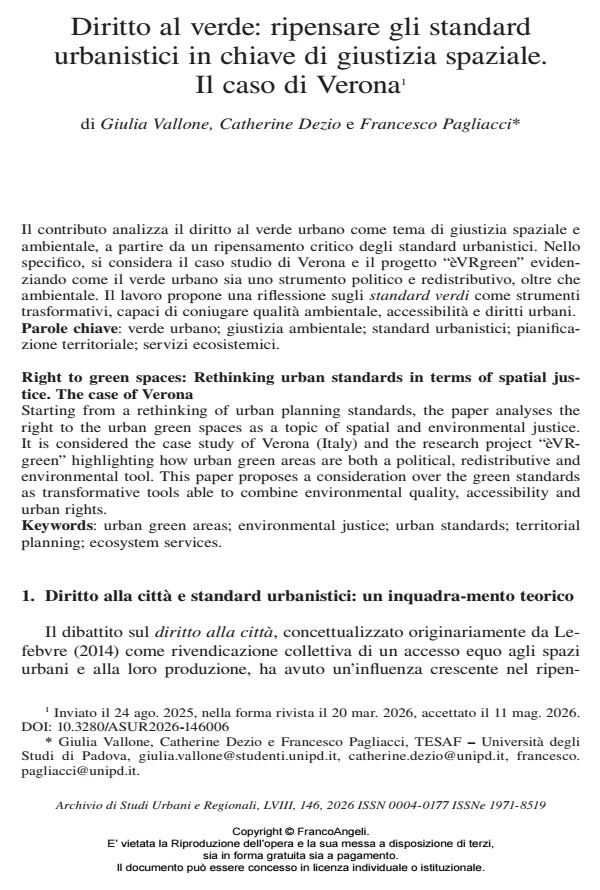
Starting from a rethinking of urban planning standards, the paper analyses the right to the urban green spaces as a topic of spatial and environmental justice. It is considered the case study of Verona (Italy) and the research project “èVRgreen” highlighting how urban green areas are both a political, redistributive and environmental tool. This paper proposes a consideration over the green standards as transformative tools able to combine environmental quality, accessibility and urban rights.
Keywords: urban green areas; environmental justice; urban standards; territorial planning; ecosystem services.
- Alonso, W. (1964). Location and Land Use. Toward a General Theory of Land Rent. Cambridge: Harvard University Press.
- Besati L. (1995). Contributi ad una storia dell’Inu: 19301975. In: Pompei S., a cura di, Urbanisti italiani. Albo dei membri effetti e soci dell’Istituto nazionale di urbanistica. Roma: INU Edizioni, 395450.
- Bolund P. and Hunhammar S. (1999). Ecosystem services in urban areas, in Ecological Economics, 29. DOI: 10.1016/S09218009(99)00013
- Città di Torino (2021). Piano Strategico dell’Infrastruttura Verde Torinese. Torino. CastilloCastillo A., Walker R., Keeler B., Lonsdorf E. and Ramer H. (2025).
- Race and income moderate the effect of parks on housing prices in a segregated city. Landscape and Urban Planning, 259: 105340.
- Cole H.V.S., Anguelovski I., Connolly J. J. T., GarcíaLamarca M., PerezdelPulgar C., Shokry G. and TrigueroMas M. (2021). Adapting the environmental risk transition theory for urban health inequities: An observational study examining complex environmental riskscapes in seven neighborhoods in Global North cities. Social Science and Medicine, 277.
- EEA (2021a). Ripristinare il mondo naturale. Segnali 2021. Copenhagen: Agenzia Europea dell’Ambiente.
- EEA (2021b). Naturebased solutions in Europe: Policy, knowledge and practice for climate change adaptation and disaster risk reduction. Report n. 01/2021. Luxembourg: Publications Office of the European Union. DOI: 10.2800/91931
- Falco L., a cura di (1978). Gli standard urbanistici. Roma: Edizioni delle Autonomie.
- Fregolent L. e Savino M. (2022). Case e Quartieri | Houses and Neighborhoods. Urbanistica, 165166: 200208.
- Giaimo C., Martorana V., Vitulano V. e Pantaloni G.G. (2022). Rileggere Falchera: un approccio urbanistico. In: Giaimo C., a cura di, Contenuti e strumenti della pianificazione urbana e territoriale. Dalla lezione di Giampiero Vigliano alle prospettive del green New Deal. Urbanistica Dossier, 027.
- Han Y., He J., Liu D., Zhao H. and Huang J. (2023). Inequality in urban green provision: A comparative study of large cities throughout the world, in Sustainable Cities and Society, 89: 104229.
- Harvey D. (2012). Il diritto alla città. In: Harvey D., Il capitalismo contro il diritto alla città: neoliberismo, urbanizzazione, resistenze. Verona: Ombre Corte, 2349.
- ISPRA (2024). I Piani comunali del verde: strumenti per riportare la natura nella città. Quaderni ISPRA, 33/24.
- ISPRA (2025). Consumo di suolo, dinamiche territoriali e servizi ecosistemici – Rapporto 2024. Roma: Istituto Superiore per la Protezione e la Ricerca Ambientale.
- ISTAT (2024). Nuovo picco delle presenze turistiche. Testo disponibile al sito: www.istat.it/wpcontent/uploads/2024/11/StatisticaToday_Turismo2023_rev. pdf.
- Konijnendijk C.C. (2023). Evidencebased guidelines for greener, healthier, more resilient neighbourhoods: Introducing the 3–30–300 rule. J. For. Res. 34: 821830.
- Krzywnicka I. and Jankowska P. (2021). The accessibility of public urban green space. A case study of Bialystok city. Acta Scientiarum Polonorum, Administratio Locorum, 20(3): 203214.
- Lefebvre H. (2014). Il diritto alla città. Verona: Ombre Corte (ed. orig. 1968).
- Lu W., Jiang W., Qiao D., Liu Q., Chen G., Huang Q. and Xu C. (2023). Embracing green spaces: Exploring spatiotemporal changes in urban green space accessibility and its equity in Guangzhou, China for sustainable urban greening. Environmental and Sustainability Indicators, 19: 100290.
- Mahmoudpour A. and Shirazi M.R. (2026). Critical debates on the 15minute city: A systematic content analysis of the literature. Cities, 169: 106576.
- Marchigiani E. e Savoldi P., a cura di (2019). Sugli standard. Questioni e bilanci. Territorio, 90: 2183.
- Michelangeli A., Östh J., Toger M. and Türk U. (2025). Inequality in access to urban amenities. NPJ Urban Sustainability, 5: 54.
- Mills E.S. (1967). An Aggregative Model of Resource Allocation in a Metropolitan Area. The American Economic Review 57(2): 197210.
- Moreno C. (2024). La città dei 15 minuti: per una cultura urbana democratica, Torino: ADD Editore.
- Moretti E. (2013). Real wage inequality. American Economic Journal: Applied Economics, 5: 65103.
- Moroni S. (2023). Cosa possiamo plausibilmente intendere quando invochiamo la “giustizia spaziale”. DiTe, 15 nov. Testo disponibile al sito: www.diteaisre. it/cosapossiamoplausibilmenteintenderequandoinvochiamolagiustiziaspaziale.
- Muth R.F. (1969). Cities and Housing: The Spatial Pattern of Urban Residential Land Use. Chicago: The University of Chicago Press.
- Owen D., Fitch A., Fletcher D., Knopp J., Levin G., Farley K., Banzhaf E., Zandersen G., Grandin G. and Jones L. (2024). Opportunities and constraints of implementing the 330300 rule for urban greening. Urban Forestry & Urban Greening, 98: 128393.
- Renzoni C., a cura di (2018). Cinquant’anni di standard urbanistici (19682018). Radici. Territorio, 84: 2176.
- RStudio Team (2022). RStudio: Integrated Development Environment for R. Boston: RStudio, PBC.
- Soja E.W. (2010). Seeking Spatial Justice. Minneapolis: University of Minnesota Press.
- Tosi M.C. e Munarin S. (2021). Tra servizi ecosistemici e mobilità attiva: gli standard come progetto di suolo. In: Laboratorio Standard, a cura di, Diritti in città: gli standard urbanistici in Italia dal 1968 ad oggi. Roma: Donzelli.
- Wolch J.R., Byrne J. and Newell J.P. (2014). Urban green space, public health, and environmental justice: The challenge of making cities ‘just green enough’. Landscape and Urban Planning, 125: 234244.
Giulia Vallone, Catherine Dezio, Francesco Pagliacci, Diritto al verde: ripensare gli standard urbanistici in chiave di giustizia spaziale. Il caso di Verona in "ARCHIVIO DI STUDI URBANI E REGIONALI" 146/2026, pp 112-145, DOI: 10.3280/ASUR2026-146006