From adolescent gambling to the system of services dedicated to gambling disorder: risk formation and institutional response capacity in Lazio
Journal title SOCIOLOGIA E RICERCA SOCIALE
Author/s Sergio Mauceri, Maria Paola Faggiano, Luca Di Censi
Publishing Year 2026 Issue 2026/139
Language Italian Pages 31 P. 49-79 File size 341 KB
DOI 10.3280/SR2026-139003
DOI is like a bar code for intellectual property: to have more infomation
click here
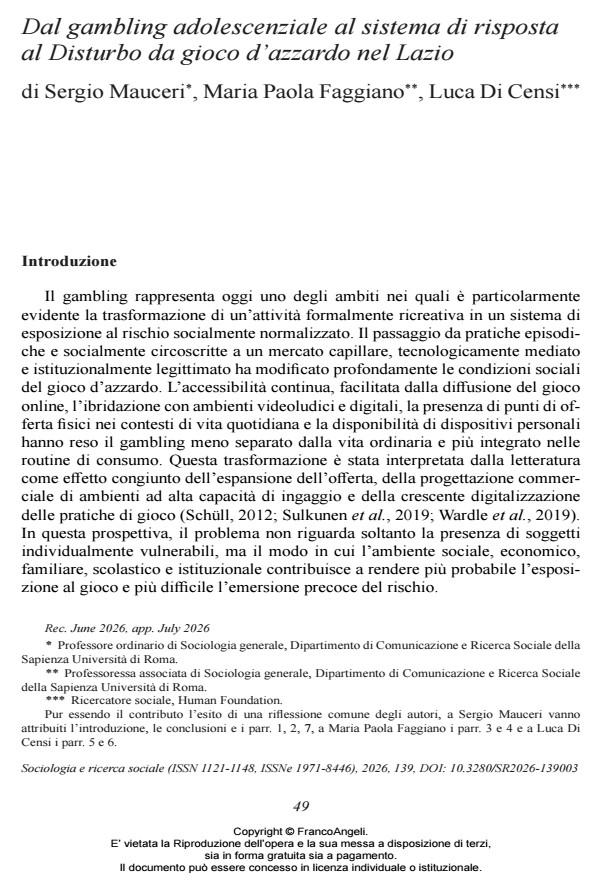
Below, you can see the article first page
If you want to buy this article in PDF format, you can do it, following the instructions to buy download credits
FrancoAngeli is member of Publishers International Linking Association, Inc (PILA), a not-for-profit association which run the CrossRef service enabling links to and from online scholarly content.
The article interprets gambling as a socially produced risk, situated at the intersection of processes of normalisation, adolescent trajectories of vulnerability, and institutional response capacity. It presents the results of a Sapienza University of Rome Research Project, organised into two research strands integrated through a mixed methods design. The first, focused on adolescents, combines a survey of 6,293 students with qualitative followup investigations. The second, centred on services dedicated to Gambling Disorder, includes a web survey of 42 services and projects, a social network analysis, and three case studies. The findings show that risk does not depend solely on individual characteristics, but also on configurations of beliefs, relationships, practices, and protective factors. With regard to service provision, the study reveals a diversified yet fragmented system, alongside difficulties in early detection. The thesis of «double displacement» highlights the gap between the ordinary contexts in which risk is produced and institutional responses that are often belated and specialised.
- E. Amaturo, G. Punziano (2016), I Mixed Methods nella ricerca sociale, Roma, Carocci. American Psychiatric Association (2013), Diagnostic and Statistical Manual of Mental Disorders, 5th ed., Washington, DC, Apa; tr. it. Dsm5, Milano, Raffaello Cortina, 2013.
- R. Barbier (1996), La recherche action, Paris, Anthropos; tr. it. La ricercaazione, Roma, Armando, 2007.
- E. Benedetti, S. Biagioni, S. Molinaro (2026), Gambling, gaming e giochi pericolosi nell’esperienza di Espad, in S. Mauceri, L. Di Censi (a c. di), Il lato oscuro del gioco. Un’indagine sui rischi associati a gambling, gaming e altre pratiche ludiche in età adolescenziale, Milano, FrancoAngeli, https://series.francoangeli.it/index.php/oa/catalog/book/1532.
- A. Blaszczynski, L. Nower (2002), «A pathways model of problem and pathological gambling», Addiction, 97, 5,
- C. Bruni, C. Antonelli, V. Brattelli, G. Masci (2026), Magliana ’80 Cooperativa Sociale: uno studio di caso, in S. Mauceri, L. Di Censi (a c. di), Gambling disorder. Un’analisi del sistema dei servizi dedicati al disturbo da gioco d’azzardo nel Lazio, Milano, FrancoAngeli, https://series.francoangeli.it/index.php/oa/catalog/book/1572.
- C. Bruni, C. Antonelli, O. De Luca, F. Gorgone (2026), Il Presidio Asl Roma 1 di via dei Frentani: uno studio di caso, in S. Mauceri, L. Di Censi (a c. di), Gambling disorder. Un’analisi del sistema dei servizi dedicati al disturbo da gioco d’azzardo nel Lazio, Milano, FrancoAngeli, https://series.francoangeli.it/index.php/oa/catalog/book/1572.
- C. Bruni, M. Carta, M.C. Massotti (2026), Parsec Cooperativa Sociale: uno studio di caso, in S. Mauceri, L. Di Censi (a c. di), Gambling disorder. Un’analisi del sistema dei servizi dedicati al disturbo da gioco d’azzardo nel Lazio, Milano, FrancoAngeli, https://series. francoangeli.it/index.php/oa/catalog/book/1572.
- F. Calado, M.D. Griffiths (2016), «Problem gambling worldwide: An update and systematic review of empirical research (20002015)», Journal of Behavioral Addictions, 5, 4, pp. 592613, DOI: 10.1556/2006.5.2016.073
- A. Camposeragna, F. Mataloni, F. Pasqualini, L. Orlando, A.C. Rosa, M. Davoli (a c. di) (2024), Progetto di ricerca sul Disturbo da gioco d’azzardo nella Regione Lazio, Roma, Dipartimento di Epidemiologia del Servizio sanitario regionale del Lazio.
- C. Cippitelli, C. Antonelli, S. Cavallo (2026), L’approfondimento qualitativo nelle scuole ad alto rischio, in S. Mauceri, L. Di Censi (a c. di), Il lato oscuro del gioco. Un’indagine sui rischi associati a gambling, gaming e altre pratiche ludiche in età adolescenziale, Milano, FrancoAngeli, https://series.francoangeli.it/index.php/oa/catalog/book/1532.
- E. Colasante, M. Gori, L. Bastiani, M. Scalese, V. Siciliano, S. Molinaro (2014), «Italian adolescent gambling behaviour: Psychometric evaluation of the South Oaks Gambling Screen: Revised for Adolescents (SogsRA) among a sample of Italian students», Journal of Gambling Studies, 30, 4, pp. 789801,
- J.W. Creswell, V.L. Plano Clark (2011), Designing and Conducting Mixed Methods Research, Thousand Oaks, Sage, 2nd ed.
- F. Deriu, L. Di Censi, R. Gallo, S. Mauceri (2026), L’attività dei servizi dedicati al disturbo da gioco d’azzardo nella regione Lazio, in S. Mauceri, L. Di Censi (a c. di), Gambling disorder. Un’analisi del sistema dei servizi dedicati al disturbo da gioco d’azzardo nel Lazio, Milano, FrancoAngeli, https://series.francoangeli.it/index.php/oa/catalog/book/1572.
- F. Deriu, R. Gallo (2026), La rete territoriale per la prevenzione e il contrasto del Dga nel Lazio. Attori, legami e prospettive di collaborazione, in S. Mauceri, L. Di Censi (a c. di), Gambling disorder. Un’analisi del sistema dei servizi dedicati al disturbo da gioco d’azzardo nel Lazio, Milano, FrancoAngeli, https://series.francoangeli.it/index.php/oa/catalog/book/1572.
- L. Dickson, J.L. Derevensky, R. Gupta (2008), «Youth gambling problems: Examining risk and protective factors», International Gambling Studies, 8, 1, pp. 2547, DOI: 10.1080/14459790701870118
- N.A. Dowling, D. Smith, T. Thomas (2015), «Early risk and protective factors for youth problem gambling: A systematic review and metaanalysis of longitudinal studies», Clinical Psychology Review, 38, pp. 6576,
- M.P. Faggiano (2026), Il fenomeno del gambling tra gli adolescenti del Lazio tra fattori di rischio e leve protettive, in S. Mauceri, L. Di Censi (a c. di), Il lato oscuro del gioco. Un’indagine sui rischi associati a gambling, gaming e altre pratiche ludiche in età adolescenziale, Milano, FrancoAngeli, https://series.francoangeli.it/index.php/oa/catalog/ book/1532.
- M. Fiasco (2024), «Gioco d’azzardo, nuove e rischiose scelte dopo la legge di bilancio. Verso la cooptazione di tutte le dipendenze patologiche», Alea Bulletin, 1, 1, pp. 1115.
- S.M. Gainsbury (2015), «Online gambling addiction: The relationship between Internet gambling and disordered gambling», Current Addiction Reports, 2, pp. 18593,
- Gambling Commission (2022), Young People and Gambling Survey 2022, London, UK Gambling Commission, https://www.gamblingcommission.gov.uk/statisticsandresearch/publication/youngpeopleandgambling2022.
- J.E. Grant, M.N. Potenza (eds.) (2021), Gambling Disorder: A Clinical Guide to Treatment, Washington, DC, American Psychiatric Association Publishing, 2nd ed.
- E. Langham, H. Thorne, M. Browne, P. Donaldson, J. Rose, M. Rockloff (2016), «Understanding gambling related harm: a proposed definition, conceptual framework, and taxonomy of harms», Bmc Public Health, 16, 80,
- K. Lewin (1946), «Action research and minority problems», Journal of Social Issues, 2, 4, pp. 3446,
- S. Mauceri (2019), Qualità nella quantità. La survey research nell’era dei Mixed Methods, Milano, FrancoAngeli.
- S. Mauceri, L. Di Censi (a c. di) (2026a), Il lato oscuro del gioco. Un’indagine sui rischi associati a gambling, gaming e altre pratiche ludiche in età adolescenziale, Milano, FrancoAngeli, https://series.francoangeli.it/index.php/oa/catalog/book/1532.
- S. Mauceri, L. Di Censi (a c. di) (2026b), Gambling disorder. Un’analisi del sistema dei servizi dedicati al disturbo da gioco d’azzardo nel Lazio, Milano, FrancoAngeli, https://series. francoangeli.it/index.php/oa/catalog/book/1572.
- S. Mauceri, M.P. Faggiano, L. Di Censi (2020), «Survey 2.0. L’indagine con questionario nell’era digitale», Sociologia e ricerca sociale, 51, 121, pp. 2548, DOI: 10.3280/SR2020121002
- N.D. Schüll (2012), Addiction by Design: Machine Gambling in Las Vegas, Princeton, Princeton University Press.
- J. Scott (2017), Social Network Analysis, London, Sage, 4th ed.
- B. Sena (2021), Il case study nella ricerca sociale, Roma, Carocci.
- P. Sulkunen, T.F. Babor, J. Cisneros Örnberg, M. Egerer, M. Hellman, C. Livingstone, V. Marionneau, J. Nikkinen, J. Orford, R. Room, I. Rossow (2019), Setting Limits: Gambling, Science and Public Policy, Oxford, Oxford University Press.
- R.A. Volberg, R. Gupta, M.D. Griffiths, D.T. Olason, P. Delfabbro (2010), «An international perspective on youth gambling prevalence studies», International Journal of Adolescent Medicine and Health, 22, 1, pp. 338, DOI: 10.1515/IJAMH.2010.22.1.3
- H. Wardle, G. Reith, E. Langham, R.D. Rogers (2019), «Gambling and public health: we need policy action to prevent harm», Bmj, 365, l1807,
- S. Wasserman, K. Faust (1994), Social Network Analysis: Methods and Applications, Cambridge, Cambridge University Press.
- K.C. Winters, R.D. Stinchfield, J. Fulkerson (1993), «Toward the development of an adolescent gambling problem severity scale», Journal of Gambling Studies, 9, 1, pp. 6384, DOI: 10.1007/BF01019925
Sergio Mauceri, Maria Paola Faggiano, Luca Di Censi, Dal gambling adolescenziale al sistema di risposta al Disturbo da gioco d’azzardo nel Lazio in "SOCIOLOGIA E RICERCA SOCIALE " 139/2026, pp 49-79, DOI: 10.3280/SR2026-139003