Inhabiting the future across the life course. Pandemic experience and temporal inequalities
Journal title SOCIOLOGIA E RICERCA SOCIALE
Author/s Dario Verderame
Publishing Year 2026 Issue 2026/139
Language Italian Pages 21 P. 118-138 File size 232 KB
DOI 10.3280/SR2026-139006
DOI is like a bar code for intellectual property: to have more infomation
click here
Below, you can see the article first page
If you want to buy this article in PDF format, you can do it, following the instructions to buy download credits
FrancoAngeli is member of Publishers International Linking Association, Inc (PILA), a not-for-profit association which run the CrossRef service enabling links to and from online scholarly content.
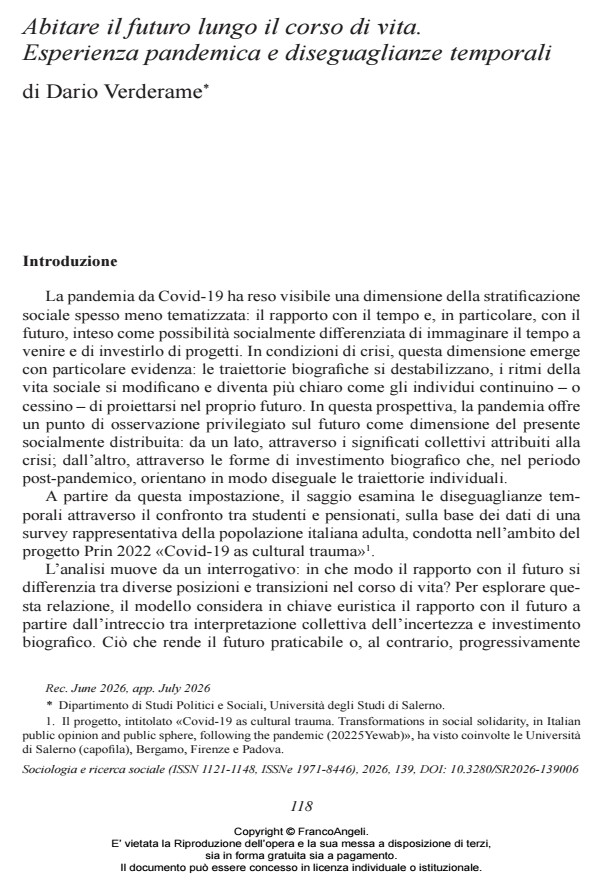
Through the prism of the Covid19 pandemic, this article examines the relationship to the future as a dimension of social stratification across the life course. Drawing on a nationally representative survey of the Italian population conducted in 2025, it interprets the pandemic as a formative context in which collective risk is reinterpreted and individual orientations towards the future acquire meaning. By comparing students and retirees – two distinct positions in social time – and examining the thresholds of education, work and retirement, the article brings into focus the tensions between adaptation, the narrowing of aspirations, individual initiative, defensive activation and exit, revealing polarisations and ambivalences in the ways people inhabit the future.
- B. Adam, C. Groves (2007), Future Matters. Action, Knowledge, Ethics, Leiden, Brill.
- A. Appadurai (2004), The Capacity to Aspire: Culture and the Terms of Recognition, in V. Rao, M. Walton (eds.), Culture and Public Action, Stanford, Stanford University Press.
- J. Atzendorf, S. Gruber (2022), «Depression and loneliness of older adults in Europe and Israel after the first wave of Covid19», European Journal of Ageing, 19, 4, pp. 84961,
- E.M. Aucejo, J. French, M.P. Ugalde Araya, B. Zafar (2020), «The impact of Covid19 on student experiences and expectations: Evidence from a survey», Journal of Public Economics, 191, 104271,
- G. Bazzani (2023), «Futures in Action: Expectations, Imaginaries and Narratives of the Future», Sociology, 57, 2, pp. 38297, DOI: 10.1177/00380385221138010
- U. Beck, E. BeckGernsheim (2002), Individualization. Institutionalized Individualism and its Social and Political Consequences, London, Sage.
- A. Bonanomi, F. Luppi (2022), Progetti di vita in un anno di pandemia: fra ostacoli e nuovi stimoli, in Istituto Giuseppe Toniolo (a c. di), La condizione giovanile in Italia. Rapporto Giovani 2022, Bologna, il Mulino.
- P. Bourdieu (1974), «Avenir de classe et causalité du probable», Revue française de sociologie, 15, 1, pp. 342.
- P. Bourdieu (1997), Méditations pascaliennes, Paris, Seuil; tr. it. Meditazioni pascaliane, Milano, Feltrinelli, 1998.
- L.P. Brinkhof, J.M.J. Murre, S. de Wit, H.J. Krugers, K.R. Ridderinkhof (2023), «Changes in perceived ageism during the Covid19 pandemic: Impact on quality of life and mental wellbeing among Dutch adults aged 55 and older», Aging & Mental Health, 27, 12, pp. 24908, DOI: 10.1080/13607863.2023.2205832
- J. Bristow, E. Gilland (2021), The Corona Generation: Coming of Age in a Crisis, Alresford, Zero Books.
- V. Cappellato, E. Mercuri (2022), «Essere, diventare, o scoprirsi anziani durante l’emergenza Covid19», Cambio. Rivista sulle Trasformazioni Sociali, 11, 22, pp. 5568,
- Censis (2022), Generazione post pandemia. Bisogni e aspettative dei giovani italiani nel post Covid19. Rapporto finale, Roma, http://agenziagioventu.gov.it/wpcontent/uploads/2022/10/GiovaniCOVIDreport_DEF_05.09.221.pdf.
- M. Ciampi, M. Finco (2024), «La generazione Z fra incertezza e contingenza. Una ricerca teoricoempirica», Metis. Rivista di Sociologia, 31, 1, pp. 26183.
- E. Colombo, P. Rebughini, I. Demirsu (2026), «Enchanted realism: Representations of selffulfilment among Italian youth after the pandemic», Current Sociology, 74, 1, pp. 6077, DOI: 10.1177/00113921241289608
- V. Cuzzocrea (2025), «“Timing” Transitions or “Times” in Transition? Revisiting the Value of Time Suspension for Young People in Italy After the Covid19 Pandemic», Time & Society, 34, 3, pp. 37695, DOI: 10.1177/0961463X241309804
- G.H. Elder Jr. (1994), «Time, Human Agency, and Social Change: Perspectives on the Life Course», Social Psychology Quarterly, 57, 1, pp. 415, DOI: 10.2307/2786971
- Eurofound (2022), Covid19 and older people: Impact on their lives, support and care, Luxem bourg, Publications Office of the European Union.
- M.P. Faggiano (a c. di) (2024), Gli italiani nell’evoluzione pandemica. Analisi dei processi cognitivi e delle pratiche collettive in una prospettiva longitudinale e mixed methods, Milano, FrancoAngeli.
- M.G. Gambardella, S. Magaraggia (2024), Un’infinita stanchezza… Le forme del disagio nei vissuti giovanili, in C. Leccardi (a c. di), Vite aperte al possibile. Un’indagine longitudinale qualitativa sulle realtà giovanili in Italia, Bologna, il Mulino.
- M. Gott, J. Wiles, T. Morgan, L. Williams, K. Morgan, S. Black, A. Koh, E. Fanueli, J. Xu, H. Goodwin, D. Pilimatalawwe, T. MoekeMaxwell (2024), «Older people’s Contributions During the Covid19 Pandemic Response», Journal of Aging & Social Policy, 36, 6, pp. 1396416, DOI: 10.1080/08959420.2024.2384322
- L. Hytman, M. Hemming, T. Newman, N.J. Newton (2023), «Future Time Perspective and Psychological WellBeing for Older Canadian Women During the Covid19 Pandemic», Journal of Adult Development, 30, 4, pp. 393403,
- C. Leccardi (a c. di) (2024), Vite aperte al possibile. Un’indagine longitudinale qualitativa sulle realtà giovanili in Italia, Bologna, il Mulino.
- C. Lombardo, S. Mauceri (a c. di) (2020), La società catastrofica. Vita e relazioni sociali ai tempi dell’emergenza Covid19, Milano, FrancoAngeli.
- F. Luppi, A. Rosina, E. Sironi (2021), «On the changes of the intention to leave the parental home during the COVID19 pandemic: A comparison among five European countries», Genus, 77, 10, pp. 123,
- G. Mandich (2023), Sociologie del futuro, Milano, Meltemi.
- G. Mandich (a c. di) (2024), Navigare il futuro. Una survey sui giovani in epoca pandemica, Milano, Egea.
- K.U. Mayer (2022), «Aspects of a sociology of the pandemic: Inequalities and the life course», Vienna Yearbook of Population Research, 20, pp. 1537,
- Oecd (2021), Supporting Young People’s Mental Health Through the Covid19 Crisis, Paris, Oecd Publishing.
- M. Pantalone (2025), Un tempo sospeso. Rileggere la pandemia attraverso le memorie degli anziani, in M. Pendenza et al. (a c. di), Il trauma raccontato. Narrare la memoria del Covid, Perugia, Morlacchi Editore.
- M. Pendenza, D. Verderame (a c. di) (2026), Gli effetti trasformativi della pandemia. Futuri diseguali nella società italiana, Perugia, Morlacchi.
- C. Phillipson, C. Lewis, A. Grenier (2025), «The social organisation of Covid19: Experiences and consequences for older people», Cogent Gerontology, 4, 1, pp. 114, DOI: 10.1080/28324897.2025.2554141
- I. Pitti (2022), «In pausa: I giovani e la gestione del “tempo vuoto” durante la pandemia da Covid19», SocietàMutamentoPolitica, 13, 26, pp. 8392,
- S. Poli (2020), «Invecchiamento e Coronavirus: la costruzione sociale del rischio e la marginalizzazione degli anziani oltre il lockdown», SocietàMutamentoPolitica, 11, 21, pp. 27180,
- S. Poli (2021), «Anziani in lockdown: Tra fragilità, vulnerabilità e resilienza», SocietàMutamentoPolitica, 12, 24, pp. 16380,
- M. Romito (2025), «“A little one among giants”: Firstgeneration students transitioning to university in Italy, before and beyond the pandemic», European Educational Research Journal, 24, 6, pp. 73856, DOI: 10.1177/14749041241306459
- H. Rosa (2015), Accelerazione e alienazione. Per una teoria critica del tempo nella tarda modernità, Torino, Einaudi.
- C. Saraceno (a c. di) (2001), Età e corso della vita, Bologna, il Mulino.
- I. Schoon, S. Shukla, S. Verma, E. Terol, J. Moreira Da Cunha (2025), «The Covid19 pandemic and young people’s civic engagement: A scoping review», Journal of Research on Adolescence, 35, 1, pp. 127,
- L. Schudde, S. Castillo, L. Shook, H. Jabbar (2022), «The Age of Satisficing? Juggling Work, Education, and Competing Priorities during the Covid19 Pandemic», Socius: Sociological Research for a Dynamic World, 8, pp. 113, DOI: 10.1177/23780231221088438
- R.A. Settersten Jr., L. Bernardi, J. Härkönen, T.C. Antonucci, P.A. Dykstra, J. Heckhausen, D. Kuh, K.U. Mayer, P. Moen, J.T. Mortimer, C.H. Mulder, T.M. Smeeding, T. van der Lippe,
- G.O. Hagestad, M. Kohli, R. Levy, I. Schoon, E. Thomson (2020), «Understanding the effects of Covid19 through a life course lens», Advances in Life Course Research, 45, pp. 111,
- L. Suckert (2022), «Back to the Future. Sociological Perspectives on Expectations, Aspirations and Imagined Futures», European Journal of Sociology, 63, 3, pp. 393428, DOI: 10.1017/S0003975622000339
- H.J. Swift, A.L. Chasteen (2021), «Ageism in the time of Covid19», Group Processes & Intergroup Relations, 24, 2, pp. 24652, DOI: 10.1177/1368430220983452
- C. Van de Velde, C. Hardy, S. Boudreault, J. Richard, K. Tennessee (2025), «Youth, Interrupted? Young Adults, Time and the Future During the Covid19 Pandemic», Sociological Research Online, 30, 4, pp. 86784, DOI: 10.1177/13607804241298621
- B. Van Vleet, H.R. Fuller, B. Hofmann, A. HusethZosel (2025), «Older Adults’ Future Perspectives and Attitudes Amid Uncertainty: Shifts Across 2 Years of Covid19», Journal of Adult Development, 32, 1, pp. 95106,
- L. Velotti, G. Punziano, F. Addeo (2022), Covid19 in Italy. Social Behavior and Governmental Policies, London, Routledge.
- K. Wazinski, A. Wanka, M. Kylén, S. Schmidt (2025), «Linked Transitions in Later Life – Retiring as Transitional Assemblage in the Covid19 Pandemic», Journal of Intergenerational Relationships, 23, 4, pp. 46077, DOI: 10.1080/15350770.2024.2430012
Dario Verderame, Abitare il futuro lungo il corso di vita. Esperienza pandemica e diseguaglianze temporali in "SOCIOLOGIA E RICERCA SOCIALE " 139/2026, pp 118-138, DOI: 10.3280/SR2026-139006