La dimensione relazionale dell’identità migrante. Un’applicazione esplorativa della network analysis alle reti italiane in California
Titolo Rivista SOCIOLOGIA E RICERCA SOCIALE
Autori/Curatori Stefania Tusini, Maria Dentale
Anno di pubblicazione 2026 Fascicolo 2026/139
Lingua Italiano Numero pagine 22 P. 80-101 Dimensione file 358 KB
DOI 10.3280/SR2026-139004
Il DOI è il codice a barre della proprietà intellettuale: per saperne di più
clicca qui
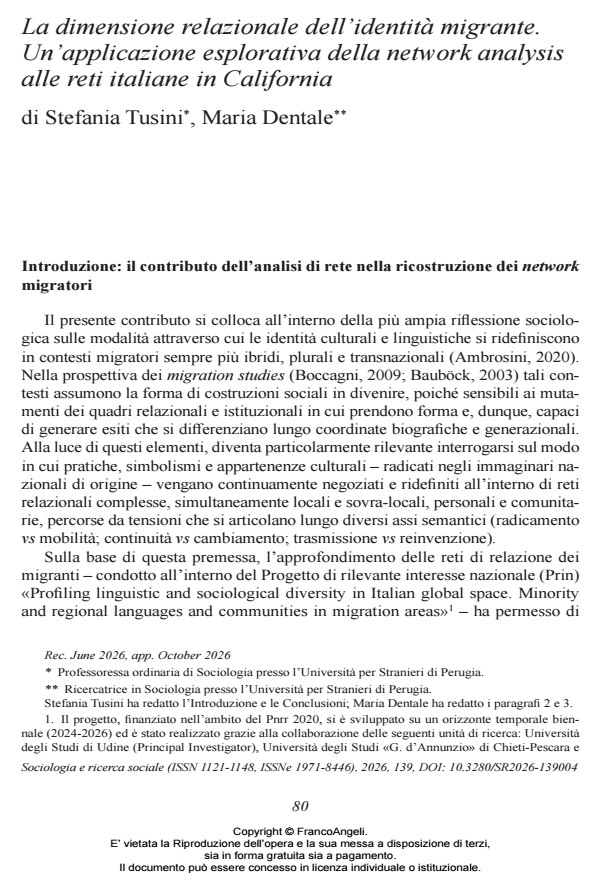
Qui sotto puoi vedere in anteprima la prima pagina di questo articolo.
Se questo articolo ti interessa, lo puoi acquistare (e scaricare in formato pdf) seguendo le facili indicazioni per acquistare il download credit. Acquista Download Credits per scaricare questo Articolo in formato PDF
FrancoAngeli è membro della Publishers International Linking Association, Inc (PILA), associazione indipendente e non profit per facilitare (attraverso i servizi tecnologici implementati da CrossRef.org) l’accesso degli studiosi ai contenuti digitali nelle pubblicazioni professionali e scientifiche.
This contribution examines the processes through which cultural and linguistic identities are constructed, negotiated, and transmitted among Italian migrants in California, situating the analysis within migration studies and sociological debates on transnational and plural forms of belonging. Drawing on a theoretical perspective that conceives migratory contexts as relational and evolving social constructions, the study explores the role of personal and community social networks in the contemporary reworking of italianità abroad, focusing on secondand thirdgeneration descendants as well as more recent Italian expats in the San Francisco Bay Area. The article specifically presents the results of a Network Analysis based on social network data collected through network survey forms administered to 14 informants, reconstructing the structure, composition, and transnational reach of significant ties maintained with Italy and activated in the context of settlement. These findings are interpreted in relation to the evidence emerging from earlier phases of the research, which included a websurvey (N = 151) and remote focused interviews (N = 14), and which had already outlined differentiated patterns of identity formation, linguistic practices, and relational dynamics. By integrating networklevel results with quantitative and qualitative evidence, the analysis shows how the density of connections, the presence of central actors, and the interplay between strong and weak ties shape processes of identity maintenance, transformation, and transmission. Social networks emerge not merely as instrumental resources, but as key arenas of symbolic recognition and identity reproduction, highlighting the profoundly relational nature of contemporary migration trajectories and the central role of social capital in the continuity and reinvention of Italian identity within diasporic communities.
- M. Ambrosini (2006), Delle reti e oltre: processi migratori, legami sociali e istituzioni, in F. Decimo, G. Sciortino, Reti migranti, Bologna, il Mulino.
- M. Ambrosini (2020), Sociologia delle migrazioni, il Mulino, Bologna.
- R. Bauböck (2003), «Towards a Political Theory of Migrant Transnationalism», The International Migration Review, 37, 3, pp. 70023, http://www.jstor.org/stable/30037754.
- P. Boccagni (2009), «Il transnazionalismo, fra teoria sociale e orizzonti di vita dei migranti», Rassegna Italiana di Sociologia, 3, 50, pp. 519544, DOI: 10.1423/30234
- P. Bourdieu (1979), La distinction. Critique sociale du Jugement, Paris, Minuit; tr. it. La distinzione. Critica sociale del gusto, Bologna, il Mulino, 1983.
- R.S. Burt (2000), «The Network Structure of Social Capital», Research in Organizational Behavior, 22, pp. 345423, DOI: 10.1016/S01913085(00)220091
- S.P. Borgatti, M.G. Everett, J.C. Johnson (2013), Analyzing Social Networks, London, Sage.
- S. Castles (2004), «The Factors that Make and Unmake Migration Policies», The International Migration Review, 8, 3, Fall, pp. 85284, http://www.jstor.org/stable/27645419.
- J.S. Coleman (1990), Foundations of Social Theory, Cambridge, Harvard University Press.
- N. Crossley, E. Bellotti, G. Edwards, M.G. Everett, J. Koskinen, M. Tranmer (2015), Social Network Analysis for EgoNets, London, Sage.
- M. Dentale, S. Scaglione (2025), Lingue e comunità minoritarie in contesti migratori. Dinamiche sociolinguistiche e identitarie, Roma, Il Calamo.
- M. Dentale (2025), Reti in movimento e identità italiane all’estero: una lettura transgenerazionale tra radicamento e trasformazione, in M. Dentale, S. Scaglione, Lingue e comunità minoritarie in contesti migratori. Dinamiche sociolinguistiche e identitarie, Roma, Il Calamo.
- P. Donati, I. Colozzi (2006), Terzo settore e valorizzazione del capitale sociale in Italia: luoghi e attori, Milano, FrancoAngeli.
- L.C. Freeman (2004), The Development of Social Network Analysis: A Study in the Sociology of Science, New York, Empirical Press.
- N. Glick Schiller, L. Basch, C. BlancSzanton (1992), «Towards a Transnationalization of Migration: Race, Class, Ethnicity and Nationalism Reconsidered», The Annals of the New York Academy of Sciences, 645, pp. 124, https://www.researchgate.net/publication/285339451_ Towards_a_Transnational_Perspective_on_Migration_Race_Class_Ethnicity_and_Nationalism_Reconsidered.
- M.S. Granovetter (1973), «The Strength of Weak Ties», American Journal of Sociology, 78, 6, pp. 136080, http://www.jstor.org/stable/2776392.
- L.E. Guarnizo (2003), «The Economics of Transnational Living», The International Migration Review, 3, 37, pp. 666 699, http://www.jstor.org/stable/30037753.
- P. Kivisto (2001), «Theorizing Transnational Immigration: A Critical Review of Current Efforts», Ethnic and Racial Studies, 24, 4, pp. 54977.
- P. Levitt, J. DeWind, S. Vertovec S. (2003), «International Perspectives on Transnational Migration», The International Migration Review, 37, 3, pp. 56575, http://www.jstor.org/stable/30037749.
- P. Levitt (2005), «Building Bridges: What Migration Scholarship and Cultural Sociology Have to Say to Each Other», Poetics, 33, pp. 4962, https://doi.org/10.1016/j.poetic.2005.01.004.
- A. Marin, B. Wellman (2011), Social Network Analysis: An Introduction, in J. Scott, P.J. Carrington (eds.), The Sage Handbook of Social Network Analysis, London, Sage.
- D.S. Massey, J. Arango, G. Hugo (1998), Worlds in Motion. Understanding International Migration at the End of the Millennium, Oxford, Clarendon Press.
- F. Mattioli, G. Anzera, L. Toschi (2017), Teoria e tecniche della rilevazione nelle reti sociali, Milano, FrancoAngeli.
- C. McCarty, M.J. Lubbers, R. Vacca, J.L. Molina (2019), Conducting Personal Network Rese arch: A Practical Guide, New York, Guilford Press.
- R.D. Putnam (2001), Bowling Alone: The Collapse and Revival of American Community, London, Simon & Schuster.
- J. Scott (2017), Social Network Analysis, London, Sage, 4th ed.
- R.C. Smith (2003), «Diasporic Membership in Historical Perspective: Comparative Insights From the Mexican, Italian and Polish Cases», The International Migration Review, 37, 3,
- pp. 72459, http://www.jstor.org/stable/30037755.
- L. Tronca (2013), Sociologia relazionale e social network analysis. Analisi delle strutture sociali, Milano, FrancoAngeli.
- C. Tilly (1990), Transplanted Networks, in V. YansMcLaughlin (ed.), Immigration Reconside
- red: History, Sociology and Politics, New York, Oxford University Press.
- S. Wasserman, K. Faust (1994), Social Network Analysis: Methods and Applications, Cambridge, Cambridge University Press.
Stefania Tusini, Maria Dentale, La dimensione relazionale dell’identità migrante. Un’applicazione esplorativa della network analysis alle reti italiane in California in "SOCIOLOGIA E RICERCA SOCIALE " 139/2026, pp 80-101, DOI: 10.3280/SR2026-139004