The Metal Boat Revolution: The Viapolitics of the Tobà and the Iron Age of the Migration Industry on the Central Mediterranean Route
Titolo Rivista MONDI MIGRANTI
Autori/Curatori Ivan Bonnin, Camille Cassarini
Anno di pubblicazione 2025 Fascicolo 2025/3
Lingua Inglese Numero pagine 23 P. 41-63 Dimensione file 170 KB
DOI 10.3280/MM2025-003003
Il DOI è il codice a barre della proprietà intellettuale: per saperne di più
clicca qui
Qui sotto puoi vedere in anteprima la prima pagina di questo articolo.
Se questo articolo ti interessa, lo puoi acquistare (e scaricare in formato pdf) seguendo le facili indicazioni per acquistare il download credit. Acquista Download Credits per scaricare questo Articolo in formato PDF
FrancoAngeli è membro della Publishers International Linking Association, Inc (PILA), associazione indipendente e non profit per facilitare (attraverso i servizi tecnologici implementati da CrossRef.org) l’accesso degli studiosi ai contenuti digitali nelle pubblicazioni professionali e scientifiche.
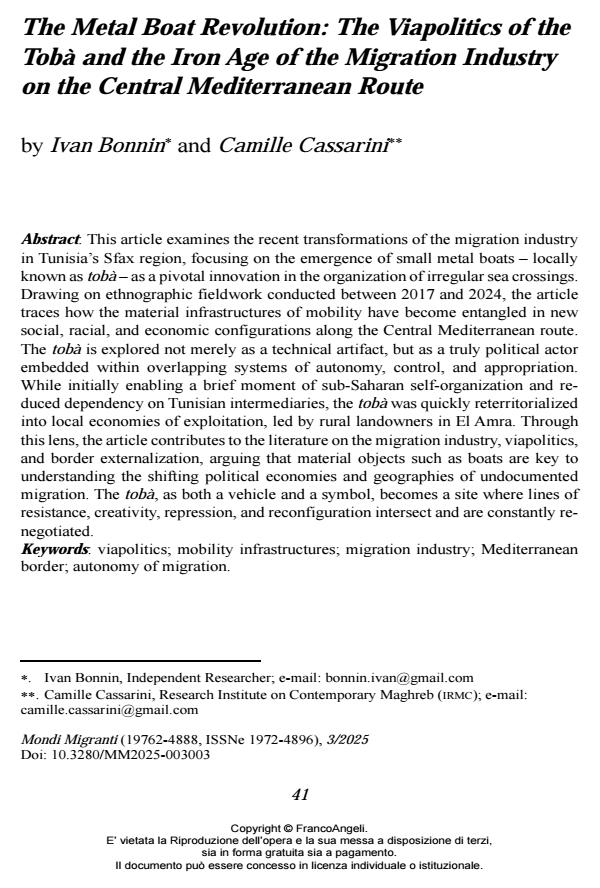
This article examines the recent transformations of the migration industry in Tunisia’s Sfax region, focusing on the emergence of small metal boats - locally known as tobà - as a pivotal innovation in the organization of irregular sea crossings. Drawing on ethnographic fieldwork conducted between 2017 and 2024, the article traces how the material infrastructures of mobility have become entangled in new social, racial, and economic configurations along the Central Mediterranean route. The tobà is explored not merely as a technical artifact, but as a truly political actor embedded within overlapping systems of autonomy, control, and appropriation. While initially enabling a brief moment of sub-Saharan self-organization and reduced dependency on Tunisian intermediaries, the tobà was quickly reterritorialized into local economies of exploitation, led by rural landowners in El Amra. Through this lens, the article contributes to the literature on the migration industry, viapolitics, and border externalization, arguing that material objects such as boats are key to understanding the shifting political economies and geographies of undocumented migration. The tobà, as both a vehicle and a symbol, becomes a site where lines of resistance, creativity, repression, and reconfiguration intersect and are constantly renegotiated.
Questo articolo esamina le trasformazioni recenti dell’industria della migrazione nella regione di Sfax, in Tunisia, concentrandosi sull’emergere delle piccole imbarcazioni metalliche – localmente note come tobà – come snodo centrale nell’organizzazione delle traversate marittime irregolari. Basandosi su un lavoro etnografico condotto tra il 2017 e il 2024, l’articolo ricostruisce come le infrastrutture materiali della mobilità siano state inglobate in nuove configurazioni sociali, razziali ed economiche lungo la rotta del Mediterraneo centrale. Il tobà viene analizzato non solo come artefatto tecnico, ma come un vero e proprio attore politico, inserito in sistemi sovrapposti di autonomia, controllo e appropriazione. Se inizialmente ha reso possibile un breve momento di auto-organizzazione da parte dei migranti subsahariani e una riduzione della dipendenza dagli intermediari tunisini, il tobà è stato rapidamente riterritorializzato all’interno di economie locali di sfruttamento, guidate da proprietari terrieri rurali nella zona di El Amra. In questa prospettiva, l’articolo contribuisce alla letteratura sull’industria della migrazione, sulla viapolitica e sull’esternalizzazione delle frontiere, sostenendo che oggetti materiali come le barche siano fondamentali per comprendere le trasformazioni delle economie politiche e delle geografie della migrazione irregolarizzata. Il tobà, in quanto veicolo e simbolo, diventa uno spazio in cui si intrecciano linee di resistenza, creatività, repressione e riconfigurazione.
Parole chiave:viapolitica; infrastrutture della mobilità; industria della migrazione; confine mediterraneo; autonomia della migrazione
- Amigoni L. and Bonnin I. (2025). Who are the Smugglers? Ethnography on Mobility Facilitation Practices at the Sfax and Ventimiglia Borders. Critical Criminology, pp. 1-20; https://doi.org/10.1007/s10612-025-09825-4
- Andersson R. (2014). Illegality, Inc. – Clandestine Migration and the Business of Bordering Europe, 1st ed. Oakland: University of California Press.
- Bennasr A., Megdiche T. and Verdeil E. (2013). Sfax, laboratoire du développement urbain durable en Tunisie? Environnement urbain / Urban Environment, 7: a83-a98; https://doi.org/10.7202/1027728ar /.
- Bennett J. (2010). Vibrant Matter: A Political Ecology of Things. Durham: Duke University Press.
- Bonnin I. (2021). The Infrastructure Environment of the Ventimiglia Borderland and Underground Border Crossings. In: Amigoni L., Aru S., Bonnin I., Proglio G. and Vergnano C., eds., Debordering Europe. Migration, Diasporas and Citizenship. Cham: Palgrave Macmillan; https://doi.org/10. 1007/978-3-030-56518-3_5 /.
- Bonnin I. and Oubad I. (2025). Solidarity Among People on the Move: Migrants and Refugees as a Key Feature of Border Abolitionism. English Language Notes, 63, 1: 47-66.
- Bonnin I., Cassarini C., Cuttitta P., Queirolo Palmas L., Oubad I. and Rahola F. (2024). Unsettling Solidarity: Towards a Materialistic Approach to Border Transgressions. Soft Power, 21: 21; http://dx.doi.org/10.14718/ SoftPower.2024.11.1.16 /.
- Boubakri H. and Mazzella S. (2005). La Tunisie entre transit et immigration : politiques migratoires et conditions d’accueil des migrants africains à Tunis. Autrepart, 36, 4: 149; https://doi.org/10.3917/autr.036.0149 /.
- Bredeloup S. (2014). Migrations d’aventures. Terrains africains. CTHS; https://hal-amu.archives-ouvertes.fr/hal-01473409 [Accessed 5th February 2020].
- Brotherton D., Dines N. and Lovato M. (2023). Between the sea and a hard place. VILMOUV; https://vilmouv.cnrs.fr/sfax/between-the-sea-and-a-hard-place/ [Accessed 23rd September 2024].
- Cassarini C. (2026). De la « ville accueillante » au lieu-frontière : Sfax et les réajustements du régime des frontières au Maghreb central. Tunis, Marseille: IRMC–IRD (p. 12).
- Cassarini C. (2022a). L’immigration ivoirienne en Tunisie : une géographie politique du contrôle social en mobilité. Thèse de doctorat, Aix-Marseille Université; https://www.theses.fr/s186493 [Accessed 27 January 2023].
- Cassarini C. (2022b). Dynamiques socio-politiques et territorialités de l’immigration ivoirienne en Tunisie. L’Année du Maghreb, 27: 201-221; https://doi.org/10.4000/anneemaghreb.10925 /.
- Cassarini C. and Geisser V. (2023). Une politisation en devenir ? L’immigration subsaharienne dans les tourments d’une xénophobie stratégique. Afrique(s) en mouvement, 6, 2: 72-8; https://doi.org/10.3917/aem. 006.0072 /.
- Cassarini C. and Queirolo Palmas L. (2025). Inside the pushback apparatus in Tunisia: countering mobility, extracting its value and manufacturing infrastructures of solidarity. Critical Criminology, 33, 33-52; https://doi.org/10.1007/s10612-025-09822-7.
- De Genova N. (2017). The Borders of ‘Europe’: Autonomy of Migration, Tactics of Bordering. Durham, NC: Duke University Press.
- Freeman C. (2020). Viapolitics and the emancipatory possibilities of abortion mobilities. Mobilities, 15, 6: 896-910; https://doi.org/10.1080/ 17450101.2020.1803588 /.
- Geisser V. (2022). Enquêter en contexte sécuritaire, la « paradoxale » liberté du chercheur : retour sur expérience tunisienne. Colloque international Terrains et chercheurs sous surveillance, CHERPA (Sciences Po Aix), IREMAM et LAMES (CNRS/AMU), 17-18 mai 2018; https://shs.hal. science/halshs-03550468 [Accessed 21 October 2025].
- Ghione L. (2025). Tra continuità e rottura: verso un’analisi critica dell’esternalizzazione delle frontiere europee in Tunisia (2011–2024). Afriche e Orienti, 28, 1: 83-121; https://doi.org/10.23810/AEOXXVIII202515 /.
- Giusa C. (2022). Harga as Politics. Parcours Migratoires, Rencontres et Mobilisations des ‘Tunisiens de Lampedusa’. Paris: Université Sorbonne Paris Nord.
- Harvey P. and Knox H. (2012). The Enchantments of Infrastructure. Mobilities, 7, 4: 521-536; https://doi.org/10.1080/17450101. 2012.718935 /.
- Heller C. and Pezzani L. (2019). Contentious Crossings: Struggles and Alliances for Freedom of Movement across the Mediterranean Sea. South Atlantic Quarterly, 118, 3: 644-653; https://doi.org/10.1215/00382876-7616200 /.
- Hernández-León R. (2013). Conceptualizing the migration industry. In: Gammeltoft-Hansen T. and Sorensen N.N., eds., The Migration Industry and the Commercialization of International Migration (pp. 42-62). London: Routledge.
- Larkin B. (2013). The Politics and Poetics of Infrastructure. Annual Review of Anthropology, 42: 327-343; https://doi.org/10.1146/ annurev-anthro-092412-155522 /.
- Latour B. (2005). Reassembling the Social: An Introduction to Actor-Network-Theory. Oxford: Oxford University Press; https://sciencespo.hal.science/hal-02057191 [Accessed 10th June 2025].
- Marcus G.E. (1995). Ethnography in/of the World System: The Emergence of Multi-Sited Ethnography. Annual Review of Anthropology, 24: 95-117.
- Mbembé J.-A. and Meintjes L. (2003). Necropolitics. Public Culture, 15, 1: 11-40.
- Meddeb H. (2012). Courir ou mourir : course à el khobza et domination au quotidien dans la Tunisie de Ben Ali. (thesis). Paris, Institut d’études politiques; http://www.theses.fr/2012IEPP0030 [Accessed 16th May 2019].
- Mezzadra S. and Neilson B. (2013). Border as Method, or, the Multiplication of Labor. Durham: Duke University Press.
- No Borders Morocco (2019). Violence, Resistance, and Bozas at the Spanish-Moroccan Border. In: Open Borders: In Defense of Free Movement (pp. 296-310). Athènes.
- Queirolo Palmas L. and Rahola F. (2022). Underground Europe: Along Migrant Routes. Cham: Palgrave Macmillan; https://doi.org/10.1007/978-3-031-16151-3 /.
- Schapendonk J. (2018). Navigating the migration industry: Migrants moving through an African–European web of facilitation/control. Journal of Ethnic and Migration Studies, 44, 4: 663-679.
- Schapendonk J. (2011). Turbulent Trajectories: Sub-Saharan African Migrants Heading North; http://repository.ubn.ru.nl/bitstream/2066/91326/1/91326.pdf [Accessed 28 May 2019].
- Souiah F. (2013) Les politiques migratoires restrictives: une fabrique de harraga. Hommes & Migrations, 1304, 4: 95-101; https://doi.org/10.4000/ hommesmigrations.2652 /.
- Teunissen P. (2020). Border Crossing Assemblages: Differentiated Travelers and the Viapolitics of FlixBus. Journal of Borderlands Studies, 35, 3: 385-401; https://doi.org/10.1080/08865655.2018.1452165 /.
- Walters W. (2015) Migration, vehicles, and politics: Three theses on viapolitics. European Journal of Social Theory, 18, 4: 469-488; https://doi.org/ 10.1177/1368431014554859 /.
- Walters W., Heller C. and Pezzani L., eds. (2022). Viapolitics: Borders, Migration, and the Power of Locomotion. Durham: Duke University Press.
- Walters W., Heller C. and Pezzani L. (2021). Viapolitics: An Introduction; https://doi.org/10.1215/9781478021599-001 /.
Ivan Bonnin, Camille Cassarini, The Metal Boat Revolution: The Viapolitics of the Tobà and the Iron Age of the Migration Industry on the Central Mediterranean Route in "MONDI MIGRANTI" 3/2025, pp 41-63, DOI: 10.3280/MM2025-003003