“A permit to stay, but no place to stay”: Former unaccompanied minors experiences of rental racism as ‘adults’ in Bologna
Titolo Rivista MONDI MIGRANTI
Autori/Curatori Sarah Walker
Anno di pubblicazione 2025 Fascicolo 2025/3
Lingua Inglese Numero pagine 22 P. 191-214 Dimensione file 187 KB
DOI 10.3280/MM2025-003009
Il DOI è il codice a barre della proprietà intellettuale: per saperne di più
clicca qui
Qui sotto puoi vedere in anteprima la prima pagina di questo articolo.
Se questo articolo ti interessa, lo puoi acquistare (e scaricare in formato pdf) seguendo le facili indicazioni per acquistare il download credit. Acquista Download Credits per scaricare questo Articolo in formato PDF
FrancoAngeli è membro della Publishers International Linking Association, Inc (PILA), associazione indipendente e non profit per facilitare (attraverso i servizi tecnologici implementati da CrossRef.org) l’accesso degli studiosi ai contenuti digitali nelle pubblicazioni professionali e scientifiche.
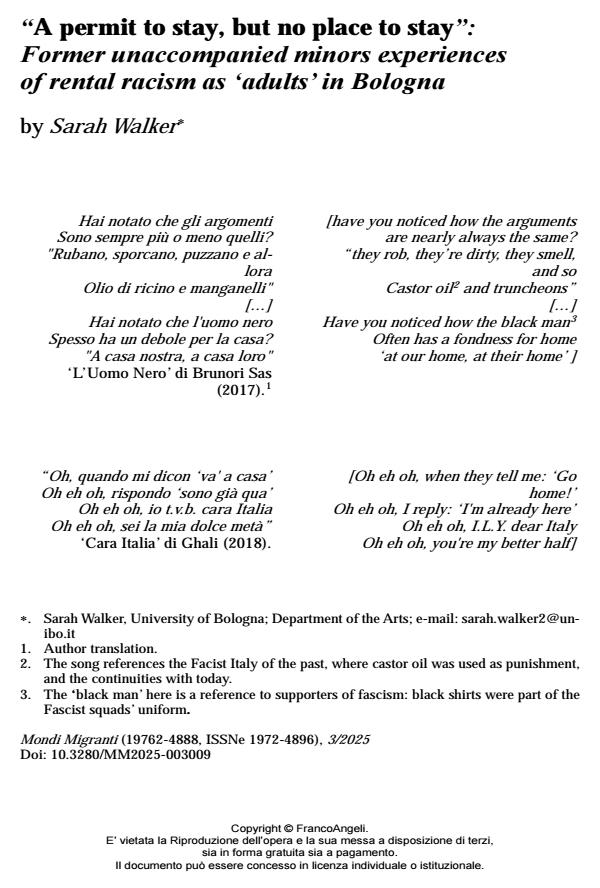
This paper places focus on the little explored space of the transition to adulthood and beyond for young African men who sought asylum in Italy as ‘unaccompanied minors’. Empirical data is drawn from over five years’ ethnographic research (2017 – 2023) with the young men, housed originally in a reception centre for minors in Bologna. The paper traces the young men’s experiences both within and beyond the reception system that housed them as minors. Once outside the reception system, when the young men must access the private rental market as ‘adults’, they find their mobility within the city constrained by their racialisation and marginalization. This paper places attention on the housing crisis that is afflicting Bologna and how, for the young men, as racialized migrants, the effects of the crisis are worse. It evidences how the borders of race continue to create problems for these young men as they seek to make claims to space and belonging, to find a home in Bologna as ‘adults’.
Questo articolo pone l’attenzione sulla transizione verso l’età adulta e oltre per i giovani africani che hanno chiesto asilo in Italia come “minori non accompagnati”. I dati empirici provengono da oltre cinque anni di ricerca etnografica (2017 – 2023) con i giovani, originariamente ospitati in un centro di accoglienza per minori a Bologna. Il contributo ripercorre le esperienze dei ragazzi dentro e fuori il sistema di accoglienza. Una volta fuori, quando si trovano a dover accedere da “adulti” al mercato privato degli affitti, emerge che la loro mobilità all’interno della città è vincolata dalla loro razzializzazione ed emarginazione. L’articolo mette luce sulla crisi abitativa che sta affliggendo Bologna e su come, per questi giovani, in quanto migranti razzializzati, gli effetti della crisi siano peggiori. Ciò evidenzia come i confini razziali continuino a creare problemi a questi giovani che cercano di reclamare un senso di appartenenza, per trovare casa a Bologna da “adulti”.
Parole chiave:minori stranieri non accompagnati; neomaggiorenni; migrazioni, transizione alla maggiore età; razzismo.
- Ahmed S. (2000). Strange Encounters: Embodied Others in Post-coloniality. London: Routledge.
- Ahmed S. et al. (2003). Uprootings/Regroundings: Questions of Home and Migration: London: Berg.
- Allsopp J. (2022). English “iron rod” welfare versus Italian “colander” welfare: understanding the intra-European mobility strategies of unaccompanied young migrants and refugees. Journal of European Social Policy, 32, 4: 436-451: DOI: 10.1177/0958928722109505
- Ambrosini M., ed. (2023). Rifugiati e solidali. L’accoglienza dei richiedenti asilo in Italia (pp. 9-42). Bologna: il Mulino.
- Ambrosini M. (2023). Introduzione. L’asilo come campo di battaglia e la sfida della solidarietà. In: Ambrosini M., ed., cit.: 9-42.
- Anderson B. (2013). Us and Them?: The Dangerous Politics of Immigration Control. OUP: Oxford.
- Back L., Sinha S. and Bryan C. (2012). New hierarchies of belonging. European Journal of Cultural Studies, 15, 2: 139-154; DOI: 10.1177/1367549411432030
- Bazurli R. and Campomori F. (2023). Oltre la «crisi dei rifugiati»: quali lezioni da un decennio di governance dell’asilo? I casi di Bologna e Venezia. In: Ambrosini M., ed., cit.: 43-68.
- Bergamaschi M., Lomonaco A. and Maggio M. (2022). Diseguaglianze e discriminazioni nell’accesso alla casa della popolazione straniera. In: Barba B. and Santaniello M.G., eds., Migrazioni: la chance della diversità (pp. 174-196). Alessandria: Falsopiano.
- Boas G. (1990). The cult of childhood. U.S.: Spring Publications.
- Boccagni P. (2023). Introduction: home and migration - setting the terms of belonging and place-making on the move. In: Handbook on Home and Migration (pp. 1-28). Edward Elgar Publishing.
- Cappi V. et al. (2021). L’Africa immaginata dai giovani. Il ruolo delle narrazioni mediali nella costruzione di un continente altro. Problemi dell’informazione, 3: 303-326; DOI: 10.1445/102510
- Castellano V. (2023). ‘Not yet Babylon’. Pensare il sistema di asilo e la gestione delle migrazioni attraverso le soggettività politiche di migranti gambiani. Antropologia, 10, 1: 21-40:
- CERD (2023). Concluding observations on the 21st periodic report of Italy. UN Committee on the Elimination of Racial Discrimination; https://www.asgi.it/wp-content/uploads/2023/09/CERD_C_ITA_CO_21-22_55642_E.pdf /.
- Chase E. (2019). Transitions, capabilities and wellbeing: how Afghan unaccompanied young people experience becoming “adult” in the UK and beyond. Journal of Ethnic and Migration Studies, 0, 0: 1-18: DOI: 10.1080/1369183X.2019.1584704
- Chase E., Allsopp J. (2020). Youth Migration and the Politics of Wellbeing: Stories of Life in Transition. Bristol: Policy Press.
- Chase E., Sigona N. and Chatty D., eds. (2023). Becoming Adult on the Move: Migration Journeys, Encounters and Life Transitions. Cham: Springer International Publishing.
- Cociña, C. et al. (2019). Editorial: Interrogating structures, struggles and subjectivities of rentl. Radical Housing Journal, 1, 2: pp. 1-7.
- Colombo E. and Rebughini P. (2012). Children of Immigrants in a Globalized World: A Generational Experience. London: Palgrave Macmillan.
- Colombo F. (2019). L’autonomia abitativa di richiedenti asilo e titolari di protezione internazionale in Italia. Argomenti, 13: 141-168; DOI: 10.14276/1971-8357.186
- Crowell A.R. (2022). Renting under racial capitalism: residential segregation and rent exploitation in the United States. Sociological Spectrum, 42, 2: 95-118; DOI: 10.1080/02732173.2022.2068101/
- Curcio A. (2024). L’Italia è un paese razzista. Rome: DeriveApprodi.
- Curcio A. (2011). Il management della razza in Italia. Mondi Migranti, 3: 91-120; DOI: 10.3280/MM2011-003005/
- Curcio A. and Mellino M. (2010). Editorial: Race at work – the rise and challenge of Italian racism. darkmatter Journal [Preprint]; http://www.darkmatter101.org/site/2010/10/10/editorial-race-at-work-the-rise-and-challenge-of-italian-racism/ .
- Dal Lago A. (2010). La porta stretta. L’Italia e “l’altra riva” tra colonialismo e politiche migratorie. California Italian Studies, 1, 1; https://escholarship.org/uc/item/7dj185zp ./.
- Danewid I. (2019). The fire this time: Grenfell, racial capitalism and the urbanisation of empire. European Journal of International Relations, p. 1354066119858388; DOI: 10.1177/1354066119858388
- D’Angelo A. (2018). Italy: the “illegality factory”? Theory and practice of refugees’ reception in Sicily. Journal of Ethnic and Migration Studies, 0, 0: 1-14; DOI: 10.1080/1369183X.2018.1468361
- De Genova N. (2018). The “migrant crisis” as racial crisis: do Black Lives Matter in Europe?. Ethnic and Racial Studies, 41, 10: 1765-1782; DOI: 10.1080/01419870.2017.1361543
- De Genova N. (2015). Border Struggles in the Migrant Metropolis. Nordic Journal of Migration Research, 5, 1: 3-10.
- De Genova N. (2013). Spectacles of migrant “illegality”: the scene of exclusion, the obscene of inclusion. Ethnic and Racial Studies, 36, 7: 1180-1198; DOI: 10.1080/01419870.2013.783710
- Della Puppa F. and Sanò G., eds. (2021). Stuck and Exploited: Refugees and Asylum Seekers in Italy between Exclusion, Discrimination and Struggles. Venezia: Edizioni Ca’ Foscari.
- de Noronha L. (2019). Deportation, racism and multi-status Britain: immigration control and the production of race in the present. Ethnic and Racial Studies, 42, 14: 2413-2430; DOI: 10.1080/01419870.2019.1585559
- Derrida J. (2000). Hostipitality. Angelaki, 5, 3: 3-18; DOI: 10.1080/09697250020034706/
- Dotsey S. and Lumley-Sapanski A. (2021). Temporality, refugees, and housing: The effects of temporary assistance on refugee housing outcomes in Italy. Cities, 111, p. 103100;
- Dotsey S. and Artero M. (2022). Housing uncertainty among Sub-Saharan African refugees in Italy. Etnografia e ricerca qualitativa [Preprint], (2/2022); DOI: 10.3240/104668/
- Fass P.S. (2005). Children in Global Migrations. Journal of Social History, 38, 4: 937-953.
- Frankenberg R. (2000). White Women, Race Matters: The social construction of whiteness. In: Back L. and Solomos J., eds., Theories of Race and Racism: A Reader (pp. 447-461). 1st edn. London: Routledge.
- Fravega E. (2022). L’ abitare migrante. Racconti di vita e percorsi abitativi di migranti in Italia. Milan: Meltemi editore (DeviAzioni).
- Fravega E. (2018). L’abitare migrante: aspetti teorici e prospettive di ricerca. Mondi Migranti, 1: 199-223; DOI: 10.3280/MM2018-001010
- Gainsforth S. (2020) Airbnb città merce. Roma: DeriveApprodi.
- Ghebremariam Tesfau’ M. and Picker G. (2021). The Italian postracial archive. Ethnic and Racial Studies, 44, 2: 195-214; DOI: 10.1080/01419870.2020.1730924
- Giacomelli E. (2021). Gli operatori di accoglienza: competenze di una professione in divenire: un’indagine etnografica di una ricercatrice-operatrice. Mondi Migranti, 2/2021: 187-210; DOI: 10.3280/MM2021-002011/
- Gibson S. (2003). Accommodating strangers: British hospitality and the asylum hotel debate. Journal for Cultural Research, 7, 4: 367-386; DOI: 10.1080/1479758032000165039/
- Giuliani G. and Lombardi-Diop C. (2013). Bianco e nero: storia dell’identità razziale degli italiani. Firenze: Le Monnier Università.
- Grosfoguel R., Oso L. and Christou A. (2015). ‘Racism’, intersectionality and migration studies: framing some theoretical reflections. Identities, 22, 6: 635-652; DOI: 10.1080/1070289X.2014.95097
- Hawthorne C. (2022). Contesting Race and Citizenship: Youth Politics in the Black Mediterranean. Ithaca New York: Cornell Univ Pr.
- ISMU Foundation (2019). At a crossroads: Unaccompanied and separated children in their transition to adulthood in Italy. Rome: UNICEF, UNHCR and IOM; http://www.ismu.org/wp-content/uploads/2018/10/191108_Report_SHORT_ING.pdf /.
- Jones H. et al. (2017). Go home?: The politics of immigration controversies. Manchester University Press.
- Lancione M. (2023). For a Liberatory Politics of Home. Durham, NC: Duke University Press.
- Lomonaco A. <1983> (2020). Discriminazione e diseguaglianza nell’accesso alla casa della popolazione straniera a Bologna. Doctoral Thesis. Alma Mater Studiorum - Università di Bologna;
- Luibhéid E. (2023). Sexual citizenship, pride parades, and queer migrant Im/Mobilities. Ethnic and Racial Studies, 46, 9: 1877-1897; DOI: 10.1080/01419870.2022.2046842/
- Mai N. (2014). Between Embodied Cosmopolitism and Sexual Humanitarianism. In: Baby-Collins V., Anteby-Yemini L. and Mazzella S., eds., Borders, Mobilities and Migrations, Perspectives from the Mediterranean in the 21st Century (pp. 175-192). Brussels: Peter Lang.
- Malkki L. (1995). Refugees and Exile: From “Refugee Studies” to the National Order of Things. Annual Review of Anthropology, 24, 1: 495-523;
- Mauro E. (2018). L’uomo bianco. Milano: Feltrinelli.
- Meloni F. (2019). The limits of freedom: migration as a space of freedom and loneliness among Afghan unaccompanied migrant youth. Journal of Ethnic and Migration Studies, 0, 0: 1-16; DOI: 10.1080/1369183X.2019.1584703/
- Mellino M. (2011). De-provincializzare l’Italia: note su colonialità, razza e razzializzazione nel contesto italiano. Mondi Migranti, 3/2011: 57-90; DOI: 10.3280/MM2011-003004
- Membretti A. and Quassoli F. (2016). Discriminare in tempo di crisi: la relazione tra immigrati e agenzie immobiliari a Milano e Pavia. Mondi Migranti, 3/2015: 169-189; DOI: 10.3280/MM2015-003009/
- Midulla F. (2024). La segregazione abitativa nelle città del Sud Europa: il Selam Palace: un insediamento informale a Roma. Mondi Migranti, 1/2024: 117-143; DOI: 10.3280/MM2024-001008
- Ní Laoire C. et al. (2010). Introduction: Childhood and migration - mobilities, homes and belongings. Childhood, 17, 2: 155-162; DOI: 10.1177/0907568210365463
- Parmiggiani P. and Musarò P. (2022). Ospitalità mediatica. Milano: FrancoAngeli.
- Pastore F. (2023). Migramorfosi: apertura o declino. Torino: Vele.
- Pesarini A. (2023). Biopolitiche di razza, genere e cittadinanza nel discorso politico italiano. From The European South - a transdisciplinary journal of postcolonial humanities, 12, 0: 39-58.
- Pesarini A. and Tintori G. (2020). La grammatica della razza. Identità e Cittadinanza. Zapruder. Storie in movimento. Rivista di storia della conflittualità sociale, 52: 89-98.
- Petti G. (2004). Il male minore: la tutela dei minori stranieri come esclusione. Verona, Italy: Ombre Corte.
- Queens Day Obasuyi O. (2020). Corpi estranei. Il razzismo rimosso che appiattisce le diversità. Busto Arsizio: People.
- Queirolo Palmas L. and Rahola F. (2012). Introduzione. Nominare la razza. Mondi Migranti [Preprint], (2011/3), 21-27; DOI: 10.3280/MM2011-003002
- Riccio B. (2011). Second Generation Associations and the Italian Social Construction of Otherness. In: Bonjour S., Rea A. and Jacobs D., eds., The Others in Europe. Bruxelles: Editions de l’Université de Bruxelles.
- Rodney W. (1972). How Europe underdeveloped Africa. London; Bogle-L’Ouverture; Dar es Salaam: Tanzania Publishing House.
- Rossi A. (2017). Male Adulthood and ‘Self - Legalizing Practices among Young Moroccan Migrants in Turin, Italy. In: Decimo F., Gribaldo A., eds., Boundaries within: Nation, Kinship and Identity among Migrants and Minorities (pp. 139-159). Cham: Springer (IMISCOE Research Series).
- Rozzi E. et al. (2018). MSNA in Italia: tra tutela dei diritti dei minori e politiche migratorie repressive, Intersos; https://www.intersos.org/msna-italia-tutela-dei-diritti-dei-minori-politiche-migratorie-repressive /.
- Sayad A. (2004). The Suffering of the Immigrant. 1 edition. Translated by D. Macey. Cambridge, UK ; Malden, MA, USA: Polity Press.
- Sharma N. (2020). Home Rule: National Sovereignty and the Separation of Natives and Migrants. Durham, NC: Duke University Press.
- Sheller M. (2018). Theorising mobility justice. Tempo Social, 30, 2: 17-34;
- Sirriyeh (2008). Young Asylum Seekers’ Conceptions of “Home” at a Time of Transition to Adulthood. International Journal of Migration, Health and Social Care, 4, 1: 12-27; DOI: 10.1108/17479894200800003/
- Spada S. (2021). The Capability of “Models” to Withstand Change. In: Della Puppa F. and Sanò G., eds., Stuck and Exploited: Refugees and Asylum Seekers in Italy between Exclusion, Discrimination and Struggles (pp. 117-146). Venezia: Edizioni Ca’ Foscari.
- Taylor K.-Y. (2016). From #BlackLivesMatter to Black Liberation. Chicago: Haymarket Books.
- Tudor A. (2018). Cross-fadings of racialisation and migratisation: the postcolonial turn in Western European gender and migration studies. Gender, Place & Culture, 25, 7: 1057-1072; DOI: 10.1080/0966369X.2018.1441141/
- Vianelli L. (2022). Warehousing asylum seekers: The logistification of reception. Environment and Planning D: Society and Space, 40, 1: 41-59; DOI: 10.1177/02637758211056339/
- Walker S. (2023a). Challenging the Antipolitics of Regimes of Care: Young African Men in Italy Resist Precarious Futures. Signs: Journal of Women in Culture and Society, 49, 1: 89-114; DOI: 10.1086/725835/
- Walker S. (2023b). The (unaccompanied) minor as mobility: the tactics of young African migrants in Italy to contest spatio-temporal control. Children’s Geographies, 0, 0: 1-13; DOI: 10.1080/14733285.2023.2195045/
- Walker S. (2022). Weathering the Ill Wind: The Affective and Embodied Dimensions of Anti-Immigrant Political Discourses on Young African Men in Italy. Antipode, online(n/a);
- Walker S. and Gunaratnam Y. (2021). Young, unauthorised and Black: African unaccompanied minors and becoming an adult in Italy. Journal of Sociology, 57, 3, p. 1440783321993918; DOI: 10.1177/1440783321993918/
- Walters W. (2004). Secure borders, safe haven, domopolitics. Citizenship Studies, 8, 3: 237-260; DOI: 10.1080/1362102042000256989/
- Wernesjö U. (2020). Across the threshold: negotiations of deservingness among unaccompanied young refugees in Sweden. Journal of Ethnic and Migration Studies, 46, 2: 389-404; DOI: 10.1080/1369183X.2019.1584701/
- White A. et al. (2011). Children’s Roles in Transnational Migration. Journal of Ethnic and Migration Studies, 37, 8: 1159-1170; DOI: 10.1080/1369183X.2011.590635/
- Yuval-Davis N. (2011). The Politics of Belonging: Intersectional Contestations. 1st ed. London: SAGE Publications Ltd.
Sarah Walker, “A permit to stay, but no place to stay”: Former unaccompanied minors experiences of rental racism as ‘adults’ in Bologna in "MONDI MIGRANTI" 3/2025, pp 191-214, DOI: 10.3280/MM2025-003009