Attitudes over loneliness: explaining artificial intimacy in human-AI communication
Titolo Rivista SOCIOLOGIA E RICERCA SOCIALE
Autori/Curatori Sermin Astl
Anno di pubblicazione 2026 Fascicolo 2026/139
Lingua Italiano Numero pagine 15 P. 103-117 Dimensione file 212 KB
DOI 10.3280/SR2026-139005
Il DOI è il codice a barre della proprietà intellettuale: per saperne di più
clicca qui
Qui sotto puoi vedere in anteprima la prima pagina di questo articolo.
Se questo articolo ti interessa, lo puoi acquistare (e scaricare in formato pdf) seguendo le facili indicazioni per acquistare il download credit. Acquista Download Credits per scaricare questo Articolo in formato PDF
FrancoAngeli è membro della Publishers International Linking Association, Inc (PILA), associazione indipendente e non profit per facilitare (attraverso i servizi tecnologici implementati da CrossRef.org) l’accesso degli studiosi ai contenuti digitali nelle pubblicazioni professionali e scientifiche.
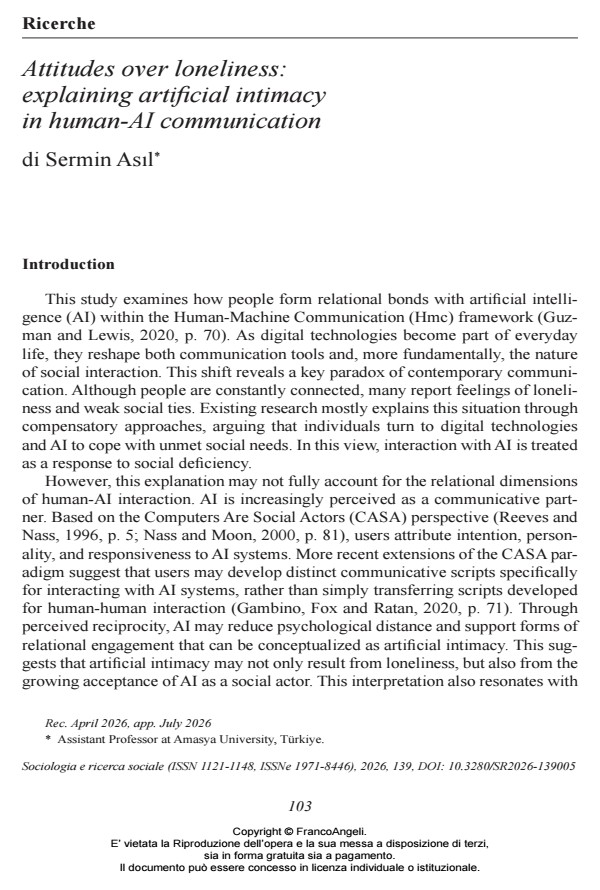
The ontological transformation of artificial intelligence (AI) has repositioned machines as communicative actors, placing artificial intimacy at the center of HumanMachine Communication (Hmc) research. This study investigates the relationships among university students’ loneliness, attitudes toward AI (Satai), and artificial intimacy. Based on data from 200 participants, the findings show that loneliness has a weak positive association with artificial intimacy (r = .169) but becomes nonsignificant when attitudinal factors are included in the hierarchical regression model; the final model explains 49.9% of the variance, with the addition of attitudes toward AI producing a large incremental effect (f² = .88). Affective and behavioral attitudes emerge as the strongest predictors, suggesting that artificial intimacy is more closely associated with attitudinal acceptance than with loneliness. Among the university students studied, AI appears to function as an increasingly familiar component of everyday communication practices. Overall, the findings contribute to understanding artificial intimacy as a communicative orientation embedded in digitally mediated interaction, highlighting the role of attitudinal and relational processes alongside deficitbased explanations within Hmc.
- P.B. Brandtzaeg, M. Skjuve, A. Følstad (2022), «My AI friend: How users of a social chatbot understand their humanAI friendship», Human Communication Research, 48, 3, pp. 40429,
- Q. Dang, G. Li (2026), «Unveiling trust in AI: The interplay of antecedents, consequences, and cultural dynamics», AI & Society, 41, pp. 66992,
- J. De Freitas, A.K. OguzUguralp, Z.O. Uguralp, S. Puntoni (2026), «AI companions reduce loneliness», Journal of Consumer Research, 52, 6, pp. 112648,
- A. Dorigoni, P.L. Giardino (2025), «The illusion of empathy: Evaluating AIgenerated outputs in moments that matter», Frontiers in Psychology, 16, article 1568911,
- H. Elbi, A. Çetinkaya, S. Cambaz Ulas, E. Atay, Ö. Aydemir (2025), «Ucla Yalnizlik Ölçegi 6 maddelik kisa formu’nun Türkçe’ye uyarlanmasi», Türk Psikiyatri Dergisi, 36, 2,
- J.S. Elson, E.M. Kearns, C. Vitro, T. Nguyen, R. Schuetzler (2026), «Familiarity with and attitudes towards chatbots: Findings from a threewave national surveys of US adults before and after ChatGPT», Proceedings of the Annual Hawaii International Conference on System Sciences, pp. 4526534, https://scholarspace.manoa.hawaii.edu (Hicss Proceedings).
- C.M. Fang, A.R. Liu, V. Danry, E. Lee, S.W.T. Chan, P. Pataranutaporn, P. Maes, J. Phang, M. Lampe, L. Ahmad, S. Agarwal (2025), «How AI and human behaviors shape psychosocial effects of extended chatbot use: A longitudinal randomized controlled study», arXiv,
- A. Gambino, J. Fox, R.A. Ratan (2020), «Building a stronger CASA: Extending the computers are social actors paradigm», HumanMachine Communication, 1, pp. 7186,
- D. Gursoy, O.H. Chi, L. Lu, R. Nunkoo (2019), «Consumers’ acceptance of artificially intelligent (AI) device use in service delivery», International Journal of Information Management, 49, pp. 15769,
- A.L. Guzman, S.C. Lewis (2020), «Artificial intelligence and communication: A HumanMachine Communication research agenda», New Media & Society, 22, 1, pp. 7086, DOI: 10.1177/1461444819858691
- A. Hepp, G. Bolin, A.L. Guzman, W. Loosen (2024), «Mediatization and humanmachine communication: Trajectories, discussions, perspectives», HumanMachine Communication, 7, pp. 721
- H.I. KalayciKirlioglu, M. Kirlioglu (2021), «Allophilia Ölçegi’nin degerlendirilmesi: Türkçe geçerlik ve güvenirlik çalismasi», Türkiye Sosyal Hizmet Arastirmalari Dergisi, 5, 2, pp. 15671, https://dergipark.org.tr/tr/download/articlefile/2133049.
- X. Li, Y. Sung (2021), «Anthropomorphism brings us closer: The mediating role of psychological distance in userAI assistant interactions», Computers in Human Behavior, 118, article 106680,
- J. Meng, M. Rheu, Y. Zhang, Y. Dai, W. Peng (2023), «Mediated social support for distress reduction: AI chatbots vs. human», Proceedings of the ACM on HumanComputer Interaction, 7, CSCW1, article 72, DOI: 10.1145/3579505
- K. Merrill Jr, S.D. Mikkilineni, M. Dehnert (2025), «Artificial intelligence chatbots as a source of virtual social support: Implications for loneliness and anxiety management», Annals of the New York Academy of Sciences, 1549, 1, pp. 14859,
- C. Nass, Y. Moon (2000), «Machines and mindlessness: Social responses to computers», Journal of Social Issues, 56, 1, pp. 81103, DOI: 10.1111/00224537.00153
- S. Natale, I. Depounti (2024), «Artificial sociality», HumanMachine Communication, 7, pp. 8398,
- P.C.J. Otermans, C. Roberts, S. Baines (2025), «Unveiling AI perceptions: How student attitudes towards AI shape AI awareness, usage, and conceptions», International Journal of Technology in Education, 8, 1, pp. 88103,
- S. D. Østergaard (2025), «Emotion contagion through interaction with generative artificial intelligence chatbots may contribute to development and maintenance of mania», Acta Neuropsychiatrica, 37, article e79,
- C. Peng, S. Zhang, F. Wen, K. Liu (2025), «How loneliness leads to the conversational AI usage intention: The roles of anthropomorphic interface and parasocial interaction», Current Psychology, 44, pp. 8177189,
- I. Pentina, T. Hancock, T. Xie (2023), «Exploring relationship development with social chatbots: A mixedmethod study of Replika», Computers in Human Behavior, 140, article 107600,
- T. Petricini (2024), «Special issue introduction: AI and media ecology», Explorations in Media Ecology, 23, 2, pp. 93103,
- M. Pinski, A. Benlian (2023), «AI literacy: Towards measuring human competency in artificial intelligence», Hawaii International Conference on System Sciences, 56, pp. 16877, DOI: 10.24251/HICSS.2023.021
- Y. Qian, X. Wan (2025), «Coexperiencing with AI: Effects on social bonding and empathy in humanAI relationships», Technology in Society, 83, article 103009,
- B. Reeves, C. Nass (1996), The Media Equation: How People Treat Computers, Television, and New Media Like Real People and Places, Stanford, Csli Publications.
- D. Turgut, F. Kunuroglu (2025), «Adaptation of the Student Attitudes toward Artificial Intelligence Scale (Satai) to the Turkish context: A sample of emerging adults», International Journal of HumanComputer Interaction, advance online publication, DOI: 10.1080/10447318.2025.2474474
- J. Wu (2024), «Social and ethical impact of emotional AI advancement: The rise of pseudointimacy relationships and challenges in human interactions», Frontiers in Psychology, 15, article 1410462,
- M. Zappavigna, Y.J. Doran (2025), «Emoji as interpersonal resources in LLM chatbot conversations: A social semiotic analysis of tenor and affiliation in humanAI interaction», Social Semiotics, DOI: 10.1080/10350330.2025.2570317
- A. Zhang, P.L.P. Rau (2023), «Tools or peers? Impacts of anthropomorphism level and social role on emotional attachment and disclosure tendency towards intelligent agents», Computers in Human Behavior, 138, article 107415,
Sermin Astl, Attitudes over loneliness: explaining artificial intimacy in human-AI communication in "SOCIOLOGIA E RICERCA SOCIALE " 139/2026, pp 103-117, DOI: 10.3280/SR2026-139005