The sedentary lifestyle in old age. An enemy to beat
Journal title RICERCHE DI PSICOLOGIA
Author/s Aldo E. Tàmmaro
Publishing Year 2013 Issue 2012/2-3
Language Italian Pages 12 P. 357-368 File size 192 KB
DOI 10.3280/RIP2012-002014
DOI is like a bar code for intellectual property: to have more infomation
click here
Below, you can see the article first page
If you want to buy this article in PDF format, you can do it, following the instructions to buy download credits
FrancoAngeli is member of Publishers International Linking Association, Inc (PILA), a not-for-profit association which run the CrossRef service enabling links to and from online scholarly content.
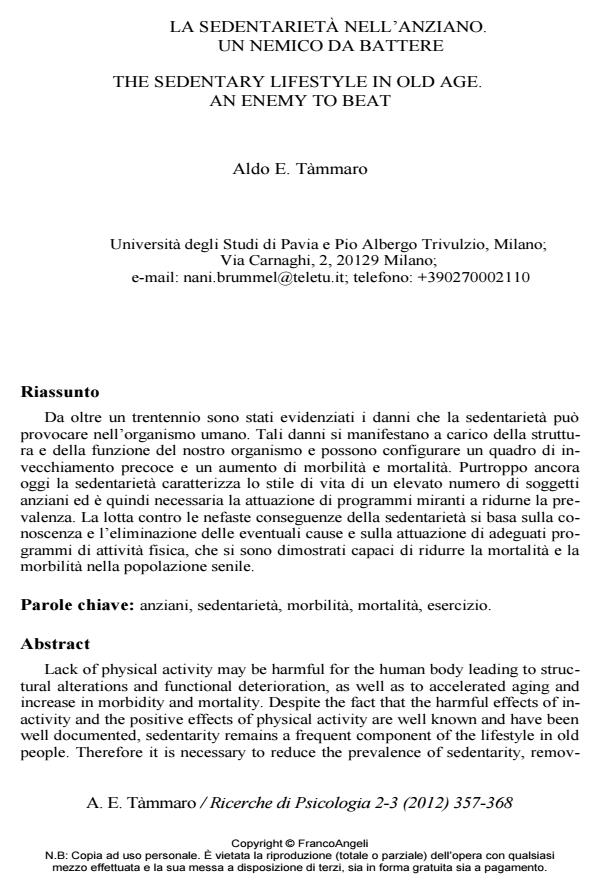
Lack of physical activity may be harmful for the human body leading to structural alterations and functional deterioration, as well as to accelerated aging and increase in morbidity and mortality. Despite the fact that the harmful effects of inactivity and the positive effects of physical activity are well known and have been well documented, sedentarity remains a frequent component of the lifestyle in old people. Therefore it is necessary to reduce the prevalence of sedentarity, remov- ing its causes if present and implementing programs of physical activity, which has proven capable of reducing the risk of mortality and favourably influencing the course of many chronic disease.
Keywords: Elderly, sedentarity, morbility, mortality, exercise
- Tsubota-Utsugi, M., Ito-Sato, R., Ohkubo, T., Kikuya, M., & Asayama, K. (2011). Health behaviors as predictors for decline in higher-level functional Capacity in older adults: the Ohasama Study. Journal of the American Geriatrics Society, 59, 1993-2000
- Varo, J.J., Martinez-Gonzalez, M.A., de Iralia-Estévez, J., Kearney, J., Gibney, M., & Martinez, J.A. (2003). Distribution and determinants of sedentary lifestyles in the European Union. International Journal of Epidemiology, 32, 138- 146.
- Vitulli, P., Femminella, G.D., Ciccarelli, A.L., Rengo, F., Lombardi, A., Cellurale, M., Arutà, S.F., Kamici, K., Allocca, E., De Lucia, C., & Rengo, F. (2012). Attività fisica e invecchiamento. Giornale di Gerontologia, 60, 172-181
- Wahl, H.-W., & Lehr, U. (1998). Elderly people and their environment. Heidelberg, DZFA
- Wahl, H.-W., & Weisman, G.D. (2003). Environmental gerontology at the beginning of the new millennium: Reflections on the historical, empirical, and theoretical development. The Gerontologist, 43, 616-627.
- Waller, K., Kuiala, U.M., Rantanen, T., Kauppinen, M., Silventoinen, K., Koskenvuo, M., & Kaprio, J. (2010). Physical activity, morbidity and mortality in twins: a 24- year prospective follow-up. European Journal of Epidemiology, 25, 731-739.
- Wilcox, S., & King, A.C. (1998). Health behaviors and aging. In W.R. Hazzard, J.P. Blass, W.H.jr. Ettinger, J.B. Halter & J.G. Ouslander (Eds.), Principles of Geriatric Medicine and Gerontology. (4th Edition, pp 287-302). New York: McGraw-Hill.
- Yorston, L.C., Kolt, G.S., & Rosenkranz, R.R. (2012). Physical activity and physical function in older adults: the 45 and up Study. Journal of the American Geriatrics Society, 60, 719-725.
- Goodrick, C.L. (1980). Effect of long-term voluntary wheel exercise on male and female Wistar rats – I. Longevity, body weight, and metabolic rate. Gerontologia, 26, 22-23.
- Iwasa, H., Yoshida, Y., & Kumagai, S. (2009). Depression status as a reliable predictor of functional decline among Japanese community dwelling older adults: A 12-year population-based prospective cohort study. International Journal of Geriatric Psychiatry, 24, 1192-1200
- Lawton, M.P., Windley, P.G., & Byerts, T.O. (Eds.) (1982). Aging and the environment Theoretical approaches. New York: Springer
- Lee, I.M., & Skerrett, P.J. (2001). Physical activity and all-cause mortality: what is the dose-response relation? Medicine & Science in Sports & Exercise, 33(6), S459-S471
- Leinonen, R., Heikkinen, E., & Hirvansalo, M. (2007). Customer-oriented counseling for physical activity in older people: study protocol and selected baseline results of a randomized-controlled trial (ISRCTN07330512). Scandinavian Journal of Medicine & Science in Sports, 17, 156-164
- Li, F., Fisher, K.J, Bauman, A., Ory, M.G., Chodzko-Zajko, W., Harmer, P., Bosworth, M., & Cleveland, M. (2005). Neighborhood influences on physical activity in middle-aged and older adults: a multilevel perspective. Journal of Aging and Physical Activity,13, 87-114.
- Macera, C.A., & Powell, K.E. (2001). Population attributable risk: implications of physical activity dose. Medicine & Science in Sports & Exercise, 33(6), S635- S639
- Marks, R., & Allegrante, J.P. (2005). Chronic osteoarthritis and adherence to exercise: a review of the literature. Journal of Aging and Physical Activity, 13, 434-600.
- McGuire, D.K., Levine, B.D., & Williamson, J.W. (2001). A 30 year follow-up of the Dallas Bed Rest and Training Study: 1. Effect of Age on the cardiovascular Response to Exercise. Circulation, 104, 1350-1357
- Moore, S.C., Patel Alpa, V., Matthews, C.E., Berrington de Gonzales, A., Park, Y., Katki, H.A., Linet, M.S., Weiderpass, E., Visvanathan, K., Helzisouer, K.J., Thun, M., Gapstur, S.M., Hartge, P., & Lee, I-M. (2012). Leisere time physical activity of moderate to vigorous intensity and mortality: a large pooled cohort analysis. PLoS Medicine, 9, 826-840.
- Paganini-Hill, A., Kawas, C.H., & Corrada, M.M. (2011). Activities and mortality in the elderly: the leisure world cohort study. Journal of Gerontology: Medical Sciences, 66A, 559-567
- Paine, R. (1973). Animal as capital – Comparison among northern nomadic herders and hunters. In B. Cox (Ed.), Cultural ecology. Toronto: McClelland & Stewart
- Parslow, R.A., Lewis, V.J., & Nay, R. (2011). Successful aging: development and testing of a multidimensional model using data from a large sample of older Australians. Journal of the American Geriatrics Society, 59, 2077-2083
- Rantakokko, M., Iwarsson, S., Hirvansalo, M., Leinonen, R., Heikkinen, F., & Rantanen, T. (2010). Unmet physical activity need in old age. Journal of the American Geriatrics Society, 58, 507-512
- Saelens, B. E., Sallis, J .F., Black, J., & Chen, D. (2003). Neighborhood-based differences in physical activity: an environment scale evaluation. American Journal of Public Health, 93, 1552-1558
- Sanford, J.A., & Butterfield, T. (2005). Using remote assessment to provide home modification services to underserved elders. The Gerontologist, 45, 389-398
- Tàmmaro, A.E. (2011). Promozione e recupero della capacità motoria per la tutela della salute. In C. Cristini, A. Porro, & M. Cesa-Bianchi (Eds.), Le capacità di recupero dell’anziano (pp. 317-339). Milano: FrancoAngeli.
- Ackermann, R.T., Deyo, R.A., & LoGerlo, J.P. (2005). Prompting primary providers to increase community exercise referral for older adults: A randomized trial. Journal of the American Geriatrics Society, 53, 283-289
- Birren, J.E. (1959). Handbook of aging and the individual. Chicago: University of Chicago Press
- Blair, S.N., Kohl, H.W.3rd, Barlow, C.E., Paffenbrger, R.S.jr., Gibbons, L.W., & Macera, C.A. (1995). Changes in physical fitness and all-cause mortality: a prospective study of healthy and unhealthy men. JAMA, 273, 1093-1098.
- Bortz, W.M. (1982). Disuse and Aging. JAMA, 248, 1203-1208
- Bortz, W.M. (1984). The Disuse Syndrome. The Western Journal of Medicine,141, 691-694.
- Bortz, W. (2009). Disuse and Aging, 2009. Journal of Gerontology: Medical Sciences, 64A, 382-385
- Brownson, R.C., Boehmer, T.K., & Luke, D.A. (2005). Declining rates of Physical activity in the United States: What are the contributors? Annual Revue of Public Health, 26, 421-443.
- Cairney, J., Faulkner, G., & Veldhuizen, S. (2009). Changes over time in physical activity and psychological distress among older adults. Canadian Journal of Psychiatry, 54, 160-169.
- DiPietro, L. (2001). Physical inactivity in aging: changes in patterns and their relations to health and function. Journal of Gerontology: Medical Sciences, 56A (spec. issue 2), 13-22
- Dishman, R.K. (1994). Advances in exercise adherence. Champaign: Human Kinetics.
- Dunstan, D.W., & Owen, N. (2012). New exercise prescription: don’t just sit there: stand up and move more. Archives of Internal Medicine, 172, 500-501
- Evans, W.H. (2002). Astrofit. New York, NY: Free Press.
- Fone, S., & Lundgren-Lindquist, B. (2003). Health status and functional capacity in a group of successful aging 65-85 years olds. Disability and Rehabilitation, 25, 1044-1055
Aldo E. Tàmmaro, La sedentarietà nell’anziano. Un nemico da battere in "RICERCHE DI PSICOLOGIA " 2-3/2012, pp 357-368, DOI: 10.3280/RIP2012-002014