Migration prohibition at the Tunisian-Italian border: stratification of sea journeys and (in)visibilisation of migrants
Journal title MONDI MIGRANTI
Author/s Filippo Torre, Luca Giliberti
Publishing Year 2025 Issue 2025/3
Language English Pages 26 P. 93-118 File size 308 KB
DOI 10.3280/MM2025-003005
DOI is like a bar code for intellectual property: to have more infomation
click here
Below, you can see the article first page
If you want to buy this article in PDF format, you can do it, following the instructions to buy download credits
FrancoAngeli is member of Publishers International Linking Association, Inc (PILA), a not-for-profit association which run the CrossRef service enabling links to and from online scholarly content.
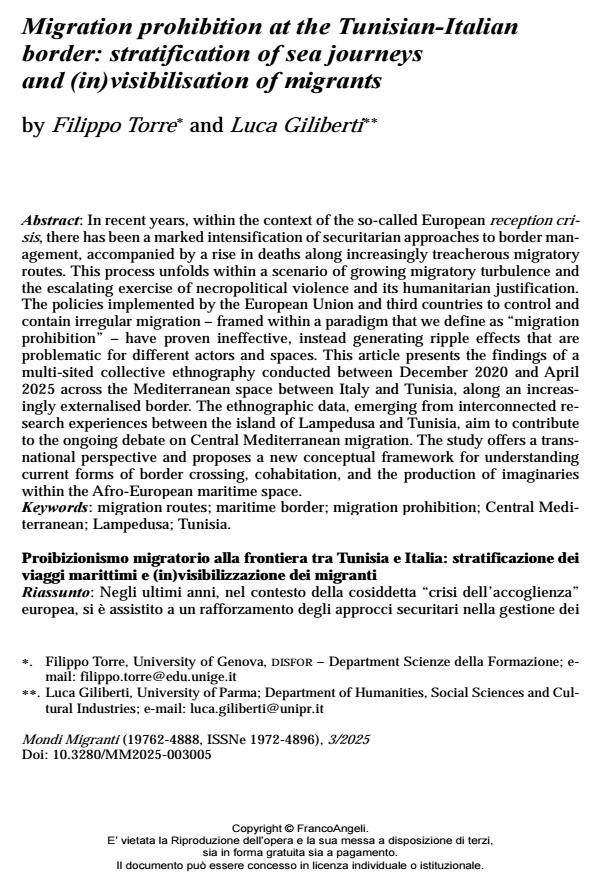
In recent years, within the context of the so-called European reception crisis, there has been a marked intensification of securitarian approaches to border management, accompanied by a rise in deaths along increasingly treacherous migratory routes. This process unfolds within a scenario of growing migratory turbulence and the escalating exercise of necropolitical violence and its humanitarian justification. The policies implemented by the European Union and third countries to control and contain irregular migration – framed within a paradigm that we define as “migration prohibition” – have proven ineffective, instead generating ripple effects that are problematic for different actors and spaces. This article presents the findings of a multi-sited collective ethnography conducted between December 2020 and April 2025 across the Mediterranean space between Italy and Tunisia, along an increasingly externalised border. The ethnographic data, emerging from interconnected research experiences between the island of Lampedusa and Tunisia, aim to contribute to the ongoing debate on Central Mediterranean migration. The study offers a transnational perspective and proposes a new conceptual framework for understanding current forms of border crossing, cohabitation, and the production of imaginaries within the Afro-European maritime space.
Keywords: migration routes; maritime border; migration prohibition; Central Mediterranean; Lampedusa; Tunisia.
- Albera D. (2025). Lampedusa. Una Storia Mediterranea. Roma: Carocci.
- Altin R. (2021). The floating karst flow of migrants as a rite of passage through the Eastern European border Journal of Modern Italian Studies, 26, 5: 589-607; DOI: 10.1080/1354571X.2021.1963560
- Ambrosini M. (2018). Irregular Immigration in Southern Europe. Actors, Dynamics and Governance. Cham: Springer International Publishing.
- Amigoni L., Ghaffari R. and Jano D. (2025). Solidarity in motion: exploring unauthorized movements, routes and solidarity networks across Europe at large. Genova: Genova University Press.
- Anderlini J. (2024). Humanitarian Border: Reprise. Anti-Human Trafficking Discourses and Security Practices at the Southern Italian Border. Environment and Planning C: Politics and Space, 43, 3: 1-18; DOI: 10.1177/23996544241259576
- Anderlini J., Filippi D. and Giliberti L., eds. (2022). Borderland Italia. Regime di frontiera e autonomia delle migrazioni. Roma: DeriveApprodi.
- Aris Escarcena J.P. (2022). Ceuta: The Humanitarian and the Fortress EUrope. Antipode, 54: 64-85.
- Aris Escarcena J.P. (2020). Punishing solidarity. The crime of solidarity at the land and sea borders of the European Union. DPCE Online, 45, 4;
- ASGI (2021). Hotspot Di Lampedusa: Sempre Più Un Luogo Di Confinamento, Chiuso Anche Il “Buco Nella Recinzione”.
- Ben-Yehoyada N. (2017). The Mediterranean Incarnate: Region Formation between Sicily and Tunisia since World War II. Chicago: Univ.Chic.Pr.
- Boccagni P. (2019). Multi-sited ethnography. In: Sage Encyclopedia of Research Methods. New York: Sage.
- Borden D. (2013). Drug prohibition and poverty. The Brown Journal of World Affairs, 20, 1: 219-243.
- Casas-Cortes M., Cobarrubias S., Pickles J. (2016). ‘Good neighbours make good fences’: Seahorse operations, border externalisation, and extra-territoriality. European Urban and Regional Studies, 23, 3: 231-251.
- Chambliss W.J. (1995). Another lost war: The costs and consequences of drug prohibition. Social Justice, 22, 60: 101-124.
- Chemlali A. (2023). Rings in the Water: Felt Externalisation and its Rippling Effect in the Extended EU Borderlands. Geopolitics, 29, 3: 873-896.
- Coleman S. and Von Hellermann P., eds. (2011). Multi-sited ethnography: Problems and possibilities in the translocation of research methods. New York: Routledge.
- Colombini J. (2023). Transnational Lampedusa: Representing Migration in Italy and Beyond. Cham: Springer International Publishing.
- Colucci M. (2018). Storia Dell’immigrazione Straniera in Italia. Dal 1945 ai Giorni Nostri. Roma: Carocci.
- Corso A. and Mookherjee N. (2024). The presence of abandonment: Left to live at the borderland of Lampedusa American Anthropologist, 126, 4: 622-634;
- Cuttitta P. (2012). Lo Spettacolo Del Confine. Lampedusa Tra Produzione e Messa in Scena Della Frontiera. Meltemi. Sesto San Giovanni.
- De Genova N. (2013). Spectacles of migrant ‘illegality’: the scene of exclusion, the obscene of inclusion. In Ethnic and Racial Studies, 36, 7: 1180-1198; DOI: 10.1080/01419870.2013.783710
- Denaro C. and Boccagni P. (2024). Migration, Borders and “De-Bordering” in Pandemic Times: Voices as Interlocution from Quarantine Ships in Italy. Journal of Borderlands Studies, 39, 2: 351-376; DOI; 10.1080/08865655.2022.2108110.
- Dino A. (2006). Clandestini a Lampedusa. Isolati, Segregati, Invisibili. Meridiana, 56: 129-145.
- Emerson R.M., Fretz R.I. and Shaw L.L. (1995). Writing Ethnographic Fieldnotes. Chicago, London: The University of Chicago Press.
- Equipaggio della Tanimar, Anderlini J. and Fravega E., eds. (2022). Crocevia Mediterraneo. Milano: Elèuthera.
- Fassin D. and Defossez A.C. (2025). Umanità in esilio: Cronache dalla frontiera alpina. Roma: Feltrinelli.
- Filippi D., Giliberti L. and Queirolo Palmas L. (2021). From Lampedusa to the Susa Valley: solidarity networks in two border battlegrounds. Journal of Modern Italian Studies, 26, 5: 608-626.
- Fleri G.B. (2022). The (Re)Birth of a Mediterranean Migration System. The Case of Tunisian Migration in Sicily. Journal of Modern Italian Studies, 27, 4: 623-642; DOI: 10.1080/1354571X.2021.1965743
- Fontanari E. (2016). Soggettività en transit. (Im)mobilità dei rifugiati in Europa tra sistemi di controllo e pratiche quotidiane di attraversamento dei confini. Mondi Migranti, 1/2016: 39-60.
- Garnaoui W. (2022). Harga et Désir d’occident : Etude Psychanalytique Des Migrants Clandestins Tunisiens. Tunis: Edition Nirvana.
- Gatta G. (2011). Come in Uno Specchio. Il Gioco Delle Identità a Lampedusa. In: Chelati Dirar U., Palma S., Triulzi A., Volterra A., eds., Colonia e postcolonia come spazi diasporici. Attraversamenti di memorie, identità e confini nel Corno d’Africa. Roma: Carocci.
- Giglioli I. (2017). Producing Sicily as Europe: Migration, Colonialism and the Making of the Mediterranean Border between Italy and Tunisia. Geopolitics, 22, 2: 407-428; DOI: 10.1080/14650045.2016.1233529
- Giliberti L. and Fravega E. (2024). Contested Time. Migrants’ Temporal Practices and Agency in Institutional Reception and Grassroots Solidarity at the Canary Islands. Italian Sociological Review, 14, 9s: 299-320.
- Giliberti L. and Potot S. (2021). Verso i solidarity studies: nuove prospettive di ricerca su migrazioni e frontiere. Mondi Migranti, 3/2021: 25-41; DOI: 10.3280/MM2021-003002
- Giliberti L. and Queirolo Palmas L. (2022). The hole, the corridor and the landings: reframing Lampedusa through the COVID-19 emergency. Ethnic and Racial Studies, 45, 9: 1760-1781.
- Giliberti L. and Queirolo Palmas L. (2024). Boza! Diari dalla frontiera. Milano: Elèuthera.
- Godenau D. and Zapata V. (2022). Las regiones insulares fronterizas en las rutas de la migracion maritima irregular. Las islas caarias (Espana) en el transito africano hacia Eropa. REMHU, 30, 64: 43-58; http://dx.doi.org/10.1590/1980-85852503880006404 ./.
- Herbert M. (2022). Losing Hope. Why Tunisians Are Leading the Surge in Irregular Migration to Europe. Global Initiative Against Transnational Organized Crime; https://globalinitiative.net/analysis/tunisia-migration-europe ./.
- Mabrouk M. (2010). Voiles et Sel : Culture, Foyers et Organisation de La Migration Clandestine En Tunisie. Carthage: Éditions Sahar.
- Maldusa (2025). Insights from Lampedusa: Arrivals, Frontex and the political tool of Criminalization of Boat Drivers; https://www.maldusa.org/l/insights-from-lampedusa-arrivals-frontex-and-the-political-tool-of-criminalization-of-drivers/.
- Marcus G.E. (1995). Ethnography in/of the Wolrd System:The Emergence of Multi-Sited Ethnography. Annual Review of Anthropology, 24: 95-117.
- Mainwaring C. and De Bono D. (2021). Criminalizing solidarity: Search and rescue in a neo-colonial sea. Environment and Planning C: Politics and Space, 39, 5: 1030-1048; DOI: 10.1177/2399654420979314
- Mbembe A. (2019). Necropolitics. Durham: Duke University Press.
- Meddeb H. (2023). Leveraging Lives: Serbia and Illegal Tunisian Migration to Europe. Malcolm H. Kerr Carnegie Middle East Center; https://carnegieendowment.org/research/2023/03/leveraging-lives-serbia-and-illegal-tunisian-migration-to-europe?lang=en /.
- Mountz A. (2015). In/Visibility and the Securitization of Migration: Shaping Publics through Border Enforcement on Islands. Cultural Politics 11, 2: 184-200; DOI: 10.1215/17432197-2895747
- Orsini G. (2015). Lampedusa: From a Fishing Island in the Middle of the Mediterranean to a Tourist Destination in the Middle of Europe’s External Border. Italian Studies, 70, 4: 521-536; DOI: 10.1080/00751634.2015.1120945
- Orsini G. (2014). ‘Un’isola in Mezzo al Confine: Oltre Il Razzismo Istituzionale e Ritorno. Storie Di Pesca e Migrazioni a Lampedusa’. In: Grasso M., eds. Razzismi, Discriminazioni, Confinamenti (pp. 347-358). Roma: Ediesse.
- Oubad I. and Ghaffari R. (2025). The Digital Infrastructures of Illegal Border Crossings: Solidarity Actors and Networks in the Arabic and Persian Speaking Virtual Spheres Critical Criminology;
- Papastergiadis N. (2000). The turbulence of migration: globalization, deterritorialization and hybridity. New Jersey: Wiley.
- Pellegrino V. (2024). Postfazione. Un modo di intendere l’etnografia multisituata. In: Giliberti L., Queirolo Palmas L. Boza! Diari dalla frontiera. Milano: Elèuthera.
- Queirolo Palmas L. and Rahola R. (2022). Turismi di frontiera. In: Anderlini J., Filippi D., Giliberti L., eds., Borderland Italia. Regime Di Frontiera e Autonomia Delle Migrazioni. Roma: DeriveApprodi.
- Queirolo Palmas L. and Rahola R. (2020). Underground Europe. Lungo le rotte migranti. Milano: Meltemi.
- Rr(x) (2025). State Trafficking. Expulsion and Sale of Migrants from Tunisia to Libya; https://statetrafficking.net/StateTrafficking_EN_21012025_light.pdf.
- Sacco R. (2025). Mobility through sound: methodological notes on the use of sound in mobility studies, Etnografia e Ricerca Qualitativa, 2: 391-411; DOI: 10.3240/117999
- Schapendonk J. (2015) African Passages through Istanbul. In: Van der Velde M., Van Naerssen T., eds., Mobility and Migration Choices. Thresholds to Crossing Borders. New York: Routledge.
- Surico G. (2020). Lampedusa: dall’agricoltura, alla Pesca, al Turismo. Firenze: Firenze University Press.
- Tamburini F. (2023). ‘How I Learned to Stop Worrying and Love Autocracy’: Kais Saied’s “Constitutional Self-Coup” in Tunisia. Journal of Asian and African Studies, 58, 6: 904-921.
- Torre F. (2025a). Bruciare la frontiera. Rotte, confini e solidarietà della migrazione marocchina in Europa. Milano: Meltemi.
- Torre F. (2025b). Transnationalism Despite the Border Regime: (De)Bordering Processes and Multiscalar Solidarities Among Moroccan Irregularized Travelers Critical Criminology;
- Torre F., Sacco R. and Giliberti L. (2025, forthcoming). The Anti-Geographical Routes of Maghreb Migration to Europe: Between Border Restrictions and Solidarity Encounters. Southeastern Europe.
- Triulzi A. (1971). Italian-Speaking Communities in Early Nineteenth Century Tunis. Revue de l’Occident Musulman et de La Méditerranée, 9: 153-184;
- Vietti F. (2019). Turisti a Lampedusa. Note sul nesso tra mobilità e patrimonio nel Mediterraneo. Archivio antropologico mediterraneo, 21, 1;
- Zagaria V. (2019). The Morally Fraught Harga. Migration Blame Games in a Tunisian Border Town. The Cambridge Journal of Anthropology, 37, 2: 57-73;
- Ziadia I. (2022). La frontière serbe : l’espoir renouvelé des jeunes de Tataouine. Inkyfada; https://inkyfada.com/fr/2022/09/05/frontiere-serbe-espoir-des-jeunes-de-tataouine/.
Filippo Torre, Luca Giliberti, Migration prohibition at the Tunisian-Italian border: stratification of sea journeys and (in)visibilisation of migrants in "MONDI MIGRANTI" 3/2025, pp 93-118, DOI: 10.3280/MM2025-003005