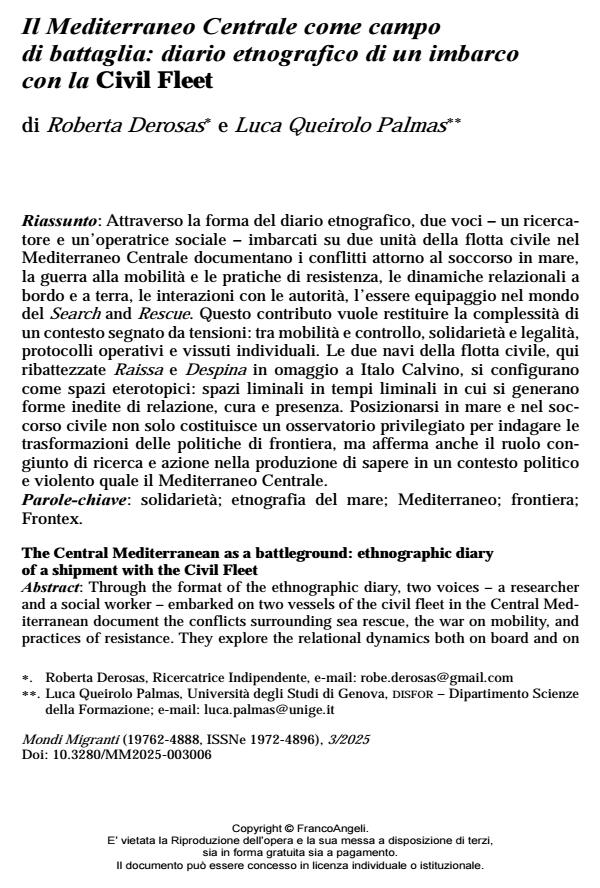
The Central Mediterranean as a battleground: ethnographic diary of a shipment with the Civil Fleet
Journal title MONDI MIGRANTI
Author/s Roberta Derosas, Luca Queirolo Palmas
Publishing Year 2025 Issue 2025/3
Language Italian Pages 21 P. 119-139 File size 216 KB
DOI 10.3280/MM2025-003006
DOI is like a bar code for intellectual property: to have more infomation
click here
Below, you can see the article first page
If you want to buy this article in PDF format, you can do it, following the instructions to buy download credits
FrancoAngeli is member of Publishers International Linking Association, Inc (PILA), a not-for-profit association which run the CrossRef service enabling links to and from online scholarly content.
Through the format of the ethnographic diary, two voices – a researcher and a social worker – embarked on two vessels of the civil fleet in the Central Mediterranean document the conflicts surrounding sea rescue, the war on mobility, and practices of resistance. They explore the relational dynamics both on board and on land, interactions with authorities, and what it means to be part of a crew in the world of search and rescue. This contribution seeks to convey the complexity of a context marked by tensions: between mobility and control, solidarity and legality, operational protocols and personal experiences. The two ships of the civil fleet, here renamed Raissa and Despina in homage to Italo Calvino, emerge as heterotopic spaces: liminal places in liminal times where new forms of relationship, care, and presence are generated. Positioning oneself at sea and within civil rescue operations not only offers a privileged vantage point to investigate the evolving landscape of border policies, but also affirms the joint role of research and action in producing knowledge within the politically charged and violent setting of the Central Mediterranean.
Keywords: solidarity; maritime ethnography; Mediterranean; border; Frontex.
- Abulafia D. (2023). Il mare tra le terre. Mediterraneo. “The Passenger”. Iperborea: 13-34.
- Alunni V. (2025). Le cicatrici di Ulisse. Corpi e frontiere nel Mediterraneo. Milano: Meltemi.
- Anderlini J. e Fravega E., a cura di (2022). Crocevia Mediterraneo. Milano: Eleuthera.
- Ambrosini M. (2021). The battleground of asylum and immigration policies: a conceptual inquiry. Ethnic and Racial Studies, 44, 3: 374-395; https://doi.org/10.1080/01419870.2020.1836380 /.
- Aria M., Iozzelli J. e Settembrini C. (2023). Le rotte di Ermenautica: per un’antropologia dei mari dal mare. Introduzione. Archivio antropologico mediterraneo, 25, 1; http://journals.openedition.org/aam/7226; https://doi.org/10.4000/aam.7226 /.
- Ben-Yehoyada N. (2019). Incorporare il Mediterraneo. Formazione ragionale fra Sicilia e Tunisia nel secondo dopoguerra. Milano: Meltemi.
- Bonnin I., Fravega E. e Queirolo Palmas L. (2025). Mobilità e immaginari del Canale di Sicilia. Uno sguardo dal Mare. Quaderni di Sociologia, LXIX, 98 (2/2025): Online first.
- Calvino I. (1972). Le città invisibili. Torino: Einaudi.
- Camilli A.L. (2019). La legge del mare. Cronache dei soccorsi nel Mediterraneo. Milano: Rizzoli.
- Cassarini C. e Queirolo Palmas L. (2025). Inside the pushback apparatus in Tunisia: countering mobility, extracting its value and manufacturing infrastructures of solidarity. Critical Criminology, 33, 33-52; https://doi.org/10.1007/s10612-025-09822-7 /.
- Derosas R. (2025a). Migrating body and border – Progetto Melting Pot Europa.
- Derosas R. (2025b). La frontiera attraverso la parola di chi attraversa – Progetto Melting Pot Europa.
- Glissant É. (2007). Poetica della relazione. Macerata: Quodlibet.
- Giglioli I. (2025). Unbounding Europe. Bordering and the Politics of Mediterranean Solidarity in Sicily and Tunisia. Ithaca : Cornell University Press.
- Fravega E. e Queirolo Palmas L. (2023). Trasformazioni Mediterranee. Migrazioni, incontri e barriere. Dialoghi Mediterranei, 60.
- Garnaoui A. (2025). Harraga. Bruciare per l'Europa. Indagine e psicanalisi dei migranti nel Mediterraneo. Per un pensiero decolonizzato delle frontiere. Ancona: Poiesis.
- Gariglio L. (2025). Autoetnografia. Un metodo di ricerca fra scienze sociali, arte, letteratura. Roma: Carocci.
- Foucault M. (1967). Des Espace Autres. Empan, 12-19; https://shs.cairn.info/revue-empan-2004-2-page-12?lang=fr /.
- Giliberti L. e Queirolo Palmas L. (2024). Boza. Diari della frontiera. Milano: Elèuthera.
- Glissant É. (2007). Poetica della relazione. Macerata: Quodlibet.
- Lucchesi D. e Cerase A. (2023). Da ‘angeli del mare’ a ‘complici dei trafficanti’: la politicizzazione del discorso sovranista contro le ONG umanitarie. Mondi Migranti, 2: 153-190; DOI: 10.3280/MM2023-002009
- Matera V. (2015). La scrittura etnografica. Esperienza e rappresentazione nella produzione di conoscenze antropologiche. Milano: Elèuthera.
- Mezzadra S. (2002). Diritto alla fuga. Verona: Ombre Corte.
- RR. X. (2025). The Tunisian state as a human trafficker. Evidence from the report: ‘State Trafficking: Expulsion and sale of migrants from Tunisia to Libya’; https://blogs.law.ox.ac.uk/border-criminologies-blog/blog-post/2025/04/tunisian-state-human-trafficker-evidence-report-state.
- Queirolo Palmas L. e Rahola F. (2020). Underground Europe. Lungo le rotte migranti. Milano: Meltemi.
- Schmoll C. (2023). Le dannate del mare. Donne e frontiere nel Mediterraneo. Pisa: Astarte
- Taussig M. (2007). Cocaina. Per antropologia della polvere bianca. Milano: Mondadori.
- Tanimar, Equipaggio (2025). Contro-dizionario del confine. Parole alla deriva nel Mediterraneo centrale. Tamu: Napoli.
- Mobilità e immaginari del Canale di Sicilia: uno sguardo dal mare Ivan Bonnin, Enrico Fravega, Luca Queirolo Palmas, in Quaderni di Sociologia /2025 pp.27
DOI: 10.4000/163kf - Le tante sfaccettature e la complessità del fenomeno migratorio Vittorio Lannutti, in PRISMA Economia - Società - Lavoro 2/2026 pp.5
DOI: 10.3280/PRI2025-002001
Roberta Derosas, Luca Queirolo Palmas, Il Mediterraneo Centrale come campo di battaglia: diario etnografico di un imbarco con la Civil Fleet in "MONDI MIGRANTI" 3/2025, pp 119-139, DOI: 10.3280/MM2025-003006