Fostering quality and well-being: remote work strategies in italian SMEs
Journal title STUDI ORGANIZZATIVI
Author/s Marino Pezzolo, Ugo Ascoli
Publishing Year 2025 Issue 2025/2
Language English Pages 31 P. 59-89 File size 941 KB
DOI 10.3280/SO2025-002003
DOI is like a bar code for intellectual property: to have more infomation
click here
Below, you can see the article first page
If you want to buy this article in PDF format, you can do it, following the instructions to buy download credits
FrancoAngeli is member of Publishers International Linking Association, Inc (PILA), a not-for-profit association which run the CrossRef service enabling links to and from online scholarly content.
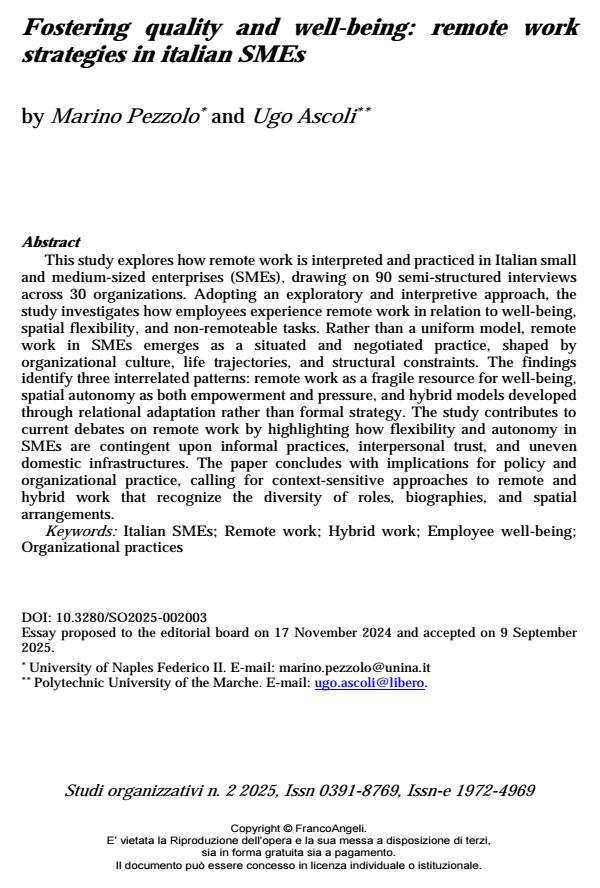
This study explores how remote work is interpreted and practiced in Italian small and medium-sized enterprises (SMEs), drawing on 90 semi-structured interviews across 30 organizations. Adopting an exploratory and interpretive approach, the study investigates how employees experience remote work in relation to well-being, spatial flexibility, and non-remoteable tasks. Rather than a uniform model, remote work in SMEs emerges as a situated and negotiated practice, shaped by organizational culture, life trajectories, and structural constraints. The findings identify three interrelated patterns: remote work as a fragile resource for well-being, spatial autonomy as both empowerment and pressure, and hybrid models developed through relational adaptation rather than formal strategy. The study contributes to current debates on remote work by highlighting how flexibility and autonomy in SMEs are contingent upon informal practices, interpersonal trust, and uneven domestic infrastructures. The paper concludes with implications for policy and organizational practice, calling for context-sensitive approaches to remote and hybrid work that recognize the diversity of roles, biographies, and spatial arrangements.
Keywords: Italian SMEs; Remote work; Hybrid work; Employee well-being; Organizational practices
- Beyond active ageing: pension reforms, segmentation and intersectionality in the Italian labour market Marino Pezzolo, Giustina Orientale Caputo, in International Journal of Sociology and Social Policy /2026 pp.1
DOI: 10.1108/IJSSP-02-2026-0126
Marino Pezzolo, Ugo Ascoli, Fostering quality and well-being: remote work strategies in italian SMEs in "STUDI ORGANIZZATIVI " 2/2025, pp 59-89, DOI: 10.3280/SO2025-002003