The territorial explanation of populism: the Veneto region and the Bassano area
Journal title ARCHIVIO DI STUDI URBANI E REGIONALI
Author/s Davide Gualerzi, Davide Lunardon
Publishing Year 2026 Issue 2025/143
Language English Pages 28 P. 83-110 File size 441 KB
DOI 10.3280/ASUR2025-143005
DOI is like a bar code for intellectual property: to have more infomation
click here
Below, you can see the article first page
If you want to buy this article in PDF format, you can do it, following the instructions to buy download credits
FrancoAngeli is member of Publishers International Linking Association, Inc (PILA), a not-for-profit association which run the CrossRef service enabling links to and from online scholarly content.
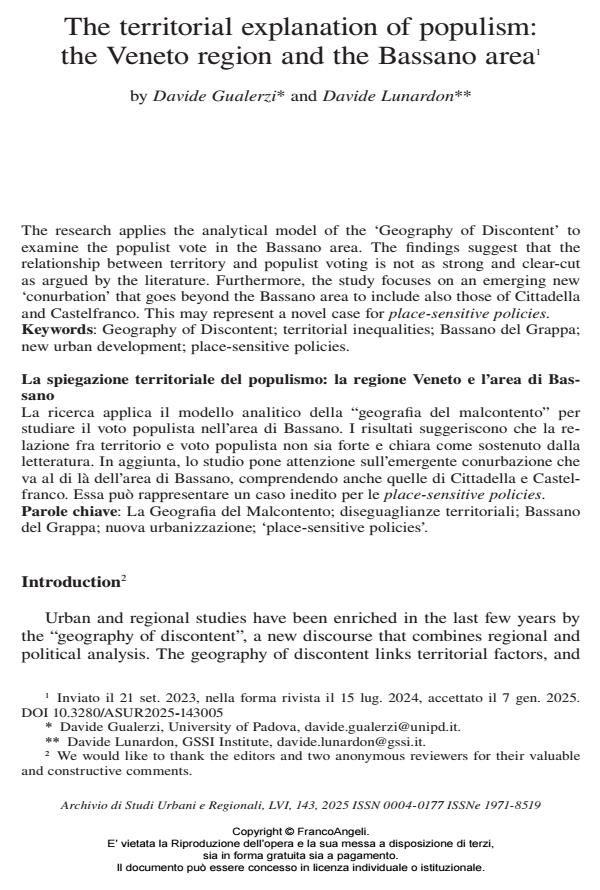
The research applies the analytical model of the ‘Geography of Discontent’ to examine the populist vote in the Bassano area. The findings suggest that the relationship between territory and populist voting is not as strong and clearcut as argued by the literature. Furthermore, the study focuses on an emerging new ‘conurbation’ that goes beyond the Bassano area to include also those of Cittadella and Castelfranco. This may represent a novel case for placesensitive policies.
Keywords: Geography of Discontent; territorial inequalities; Bassano del Grappa; new urban development; placesensitive policies.
- Arana A.G. (2021). Politics of discontent in Spain: The case of Vox and the Catalonian independence movement. Cambridge Journal of Regions, Economy and Society, 14(3): 439456.
- Bagnasco A. (1977). Tre Italie. Bologna: il Mulino.
- Bagnasco A. and Trigilia C. (1984). Società e politica nelle aree di piccola impresa. Il caso di Bassano. Venezia: Arsenale.
- Becattini G. (1979). Dal settore industriale al distretto industriale. Alcune riflessioni sull’unità di indagine nell’economia industriale. Rivista di Economia e politica industriale, 1: 123135.
- Becattini G. (2002). Industrial Sectors and Industrial Districts: Tools for Industrial Analysis. European Planning Studies, 10(4): 483493. DOI: 10.1080/0965431022013019
- Bianchini F. (1991). The Third Italy: Model or myth? Ekistics, 58(350/351): 336345.
- Bourdin S. and Torre A. (2023). Geography of contestation: A study on the Yellow Vest movement and the rise of populism in France. Journal of Regional Science, 63(1): 214235.
- Buciuni G. and Corò G. (2023). Periferie competitive. Lo sviluppo dei territori nell’economia della conoscenza. Bologna: il Mulino.
- Calafati A.G. (2008). Urban Sprawl Italian Style. Scienze Regionali, 7(3): 99108.
- Calafati A.G. and Mazzoni F. (2008). Città in nuce nelle Marche. Coalescenza territoriale e sviluppo economico. Milano: FrancoAngeli.
- Camagni R., Capello R. and Caragliu A. (2015). The Rise of SecondRank Cities: What Role for Agglomeration Economies?. European Planning Studies, 23(6): 10691089. DOI: 10.1080/09654313.2014.90499
- CGIA (2020). Coronavirus, VenetoCina ed Export. Rivista di cultura socioeconomica della CGIA di Mestre, 57: 79141.
- Di Matteo D. and Mariotti I. (2021). Italian discontent and rightwing populism: determinants, geographies, patterns. Regional Science Policy & Practice, 13(2): 371396.
- Dijkstra L., Garcilazo E. and McCann P. (2013). The Economic Performance of European Cities and City Regions: Myths and Realities. European Planning Studies, 21(3): 334354. DOI: 10.1080/09654313.2012.71624
- Dijkstra L., Poelman H. and RodríguezPose A. (2020). The geography of EU discontent. Regional Studies, 54(6): 737753. DOI: 10.1080/00343404.2019.165460
- Essletzbichler J., Disslbacher F. and Moser M. (2018). The victims of neoliberal globalisation and the rise of the populist vote: a comparative analysis of three recent electoral decisions. Cambridge Journal of Regions, Economy and Society, 11(1): 7394.
- EUROSTAT (2011). Gisco. Available at: https://ec.europa.eu/eurostat/web/gisco/ geodata/referencedata/populationdistributiondemography/geostat.
- Faggian A. et al. (2021). One country, two populist parties: Voting patterns of the 2018 Italian elections and their determinants. Regional Science Policy & Practice, 13(2): 397413.
- Fondazione NordEst (2019). Il pentagono dello sviluppo. Venezia. Available at: www.fnordest.it/gate/contents/pubblicazioni/pubblicazioni/elenco?openform&r estricttocategory=Pubblicazioni%C2%BBRapporti.
- Fregolent L. and Vettoretto L. (2017). Land use regulation and social regulation: an unexplored link. Some reflections on the origins and evolution of sprawl in the Veneto ‘città diffusa’. Land Use Policy, 69: 149159.
- Frick S.A. and RodríguezPose A. (2018). Big or Small Cities? On city size and economic growth: City Size and Economic Growth. Growth and Change, 49(1): 432.
- Fujita M. and Thisse J.F. (2013). Economics of Agglomeration, Cities, Industrial Location and Gobalization. Cambridge: Cambridge University Press.
- Gordon I.R. (2018). In what sense left behind by globalisation? Looking for a less reductionist geography of the populist surge in Europe. Cambridge Journal of Regions, Economy and Society, 11(1): 95113.
- Gualerzi D. (2017). Crisis in the Eurozone: Austerity and Economic Transformation. Review of Radical Political Economics, 49(3): 394409. DOI: 10.1177/048661341770397
- Iammarino S., RodríguezPose A. and Storper M. (2019). Regional inequality in Europe: evidence, theory and policy implications. Journal of Economic Geography, 19(2): 273298.
- ISTAT (2015a). I distretti industriali nel 2011. Roma. Available at: www.istat.it/it/ informazioniterritorialiecartografiche/sistemilocalidellavoro.
- ISTAT (2015b). La nuova geografia dei sistemi locali del lavoro. Roma (Letture statisticheTerritorio). Available at: www.istat.it/it/informazioniterritorialiecartografiche/sistemilocalidellavoro.
- ISTAT (2017). Forme, livelli e dinamiche dell’urbanizzazione in Italia. Roma. ISTAT (2022a). Atlante statistico dei comuni. Roma. Available at: https://asc.istat.it/ASC/.
- ISTAT (2022b). Popolazione e famiglie. Roma. Available at: http://dati.istat.it/.
- ISTAT (2022c). Occupati residenti e persone in cerca di occupazione nei Sistemi locali del lavoro 20062018 e Scambi con l’Estero. Roma. Available at: www. istat.it/it/informazioniterritorialiecartografiche/sistemilocalidellavoro.
- ISTAT (2022d). Struttura Imprese. Roma. Available at: http://dati.istat.it/.
- ISTAT (2022e). Coeweb: performance export. Available at: www.coeweb.istat.it/. ITA (2017). Italia nell’economia internazionale: rapporto ICE 20162017. Roma:
- Marchesi grafiche editoriali. Available at: www.ice.it/it/studierapporti/ archiviorapportiannuali/rapporto2017.
- Koceva M.M. et al., eds. (2016). Urban Europe: statistics on cities, towns and suburbs. 2016 edition. Luxembourg: Publications Office of the European Union. DOI: 10.2785/59467
- Krugman P.R. (1991). Geography and Trade. Leuven/Cambridge: Leuven University Press/MIT Press.
- Lee N., Morris K. and Kemeny T. (2018). Immobility and the Brexit vote. Cambridge Journal of Regions, Economy and Society, 11(1): 143163.
- Los B., McCann P., Springford J. and Thissen M. (2017). The mismatch between local voting and the local economic consequences of Brexit. Regional Studies, 51(5): 786799. DOI: 10.1080/00343404.2017.128735
- Lunardon D. and Caporali C. (2024). Polycentric Urban Regions in Italy. A Novel Assessment. In: Modica M. and Piacentino D., eds., Conflict scenarios and transitions. Milano: FrancoAngeli, 99119.
- Marangoni G. and Solari S. (2006). Flexible Specialisation 20 Years On: How the ‘Good’ Industrial Districts in Italy Have Lost Their Momentum. Competition & Change, 10(1): 7387. DOI: 10.1179/102452906X9201
- McCann P. (2018). The trade, geography and regional implications of Brexit. Papers in Regional Science, 97(1): 38.
- McCann P. (2020). Perceptions of regional inequality and the geography of discontent: insights from the UK. Regional Studies, 54(2): 256267. DOI: 10.1080/00343404.2019.161992
- Messina P. (1998). Opposition in Italy in the 1990s: Local Political Cultures and the Northern League. Government and Opposition, 33(4): 462478.
- Ottaviano G. (2020). Geogra?a economica dell’Europa scontenta. Rivista di Politica Economica, 2: 101123.
- Paba S., Solinas G., Bonacini L. and Fareri S. (2020). Robot, ICT e globalizzazione: gli effetti sui sistemi locali del lavoro in Italia. L’industria, 41(1): 71100. DOI: 10.1430/9717
- Perulli P. (2012). Nord. Una cittàregione globale. Bologna: il Mulino.
- Rickardsson J., Mellander C. and Bjerke L. (2021). The Stockholm Syndrome: The view of the capital by the ‘Places Left Behind’. Cambridge Journal of Regions, Economy and Society, 14(3): 601617. Available at: https://doi. org/10.1093/cjres/rsab013
- Rodrik D. and Sabel C. (2020). Building a good jobs economy. Cambridge: Harvard Kennedy School, John F. Kennedy School of Government.
- RodríguezPose A. (2018). The revenge of the places that don’t matter (and what to do about it). Cambridge Journal of Regions, Economy and Society, 11(1): 189209.
- RodríguezPose A., Dijkstra L. and Poelman H. (2024). The geography of EU discontent and the regional development trap. Luxembourg: Publications Office of the European Union.
- Storrie D.W. (2019) The future of manufacturing in Europe. Luxembourg: Publications Office of the European Union (Future of manufacturing/ Eurofound). DOI: 10.2806/91256
- Trigilia C. (1986). Smallfirm development and political subcultures in Italy. European Sociological Review, 2(3): 161175.
- Turri E. (2005). La Megalopoli Padana. Venezia: Marsilio.
- Viesti G. (2021). Centri e Periferie. Europa, Italia, Mezzogiorno dal XX al XXI secolo. BariRoma: Laterza.
- World Bank (2009). Reshaping economic geography. Washington, DC: World.
Davide Gualerzi, Davide Lunardon, The territorial explanation of populism: the Veneto region and the Bassano area in "ARCHIVIO DI STUDI URBANI E REGIONALI" 143/2025, pp 83-110, DOI: 10.3280/ASUR2025-143005