Dialogo e patient-centred approach nelle visite in ambito oncologico: il punto di vista del personale medico

Journal title SALUTE E SOCIETÀ
Author/s Elisa Rossi, Daniele Urlotti
Publishing Year 2026 Issue 2025/3 Suppl.
Language Italian Pages 15 P. 160-174 File size 281 KB
DOI 10.3280/SES2025-003-S001011
DOI is like a bar code for intellectual property: to have more infomation click here
Article preview

FrancoAngeli is member of Publishers International Linking Association, Inc (PILA), a not-for-profit association which run the CrossRef service enabling links to and from online scholarly content.

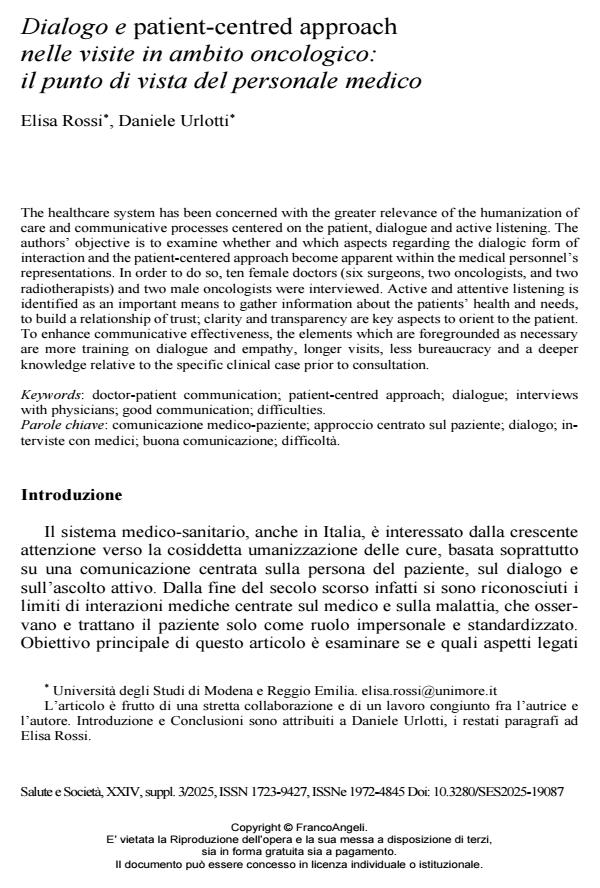
The healthcare system has been concerned with the greater relevance of the humanization of care and communicative processes centered on the patient, dialogue and active listening. The authors’ objective is to examine whether and which aspects regarding the dialogic form of interaction and the patientcentered approach become apparent within the medical personnel’s representations. In order to do so, ten female doctors (six surgeons, two oncologists, and two radiotherapists) and two male oncologists were interviewed. Active and attentive listening is identified as an important means to gather information about the patients’ health and needs, to build a relationship of trust; clarity and transparency are key aspects to orient to the patient. To enhance communicative effectiveness, the elements which are foregrounded as necessary are more training on dialogue and empathy, longer visits, less bureaucracy and a deeper knowledge relative to the specific clinical case prior to consultation.

Keywords: doctorpatient communication; patientcentred approach; dialogue; interviews with physicians; good communication; difficulties.

  1. Abramovitch H., Schwartz E. (1996). Three stages of medical dialogue. Theoretical Medicine and Bioethics, 17: 175187.
  2. Baraldi C. (2023). Agency in and for Mediating in Public Service Interpreting. In: Gavioli L. and Wadensjö C., eds., The Routledge Handbook of Public Service Interpreting. London: Routledge.
  3. Bohm D. (2004). On dialogue. London: Routledge.
  4. Busch I.M., Moretti F., Travaini G., Wu A.W., Rimondini M. (2019). Humanization of care: Key elements identified by patients, caregivers, and healthcare providers. A systematic review. Patient, 12: 461474.
  5. Cadeddu A., D’Aloja E., Faa G., Fanos V., Granese A., Rutelli P., a cura di (2007). Qualità e sanità: un dialogo per l'umanizzazione. Filosofia, pedagogia, medicina e psicologia. Milano: FrancoAngeli.
  6. Cocco G., Tiberio A. (2005). Lo sviluppo delle competenze relazionali in ambito sociosanitario. Milano: FrancoAngeli.
  7. Corbetta P. (2014). Metodologia e tecniche della ricerca sociale. Bologna: il Mulino. De Panfilis L., Di Leo S., Peruselli C., Ghirotto L., Tanzi S. (2019). “I go into crisis when …”: Ethics of care and moral dilemmas in palliative care. BMC Palliative Care, 18: 18.
  8. Epstein R.M., Street R.L.Jr. (2007). PatientCentered Communication in Cancer Care: Promoting Healing and Reducing Suffering. Bethesda, MD: National Cancer Institute.
  9. Fatigante M., Heritage J., Alby F., Zucchermaglio C. (2020). Presenting treatment options in breast cancer consultations: Advice and consent in Italian medical care. Soc Sci Med., 266: 113175.
  10. Flick U. (2009). An introduction to qualitative research. London: Sage.
  11. Gergen K.J., McNamee S., Barrett, F. (2001). Towards transformative dialogue. International Journal of Public Administration, 24: 697707. DOI: 10.1081/PAD10010477
  12. Heritage J., Raymond G. (2005). The terms of agreement: Indexing epistemic authority and subordination in talkininteraction. Social Psychology Quarterly, 68: 1538. DOI: 10.1177/01902725050680010
  13. Hopf C. (2004). Qualitative interviews: An overview. In: Flick U., von Kardoff E., Steinke I., eds., A companion to qualitative research. London: Sage.
  14. Jefferson G. (1996). A case of transcriptional stereotyping. Journal of Pragmatics, 26: 159170. DOI: 10.1016/03782166(96)00010
  15. Littlejohn S.W. (2004). The transcendent communication project: Searching for a practice of dialogue. Conflict Resolution Quarterly, 21: 337359.
  16. Littlejohn S.W., Domenici K. (2001). Engaging communication in conflict: Systemic practice. Thousand Oaks: Sage.
  17. Luhmann N. (1990). Sistemi sociali. Fondamenti di una teoria generale. Bologna: il Mulino.
  18. Malatesta M., a cura di (2021). L’invenzione della fiducia. Roma: Viella Libreria Editrice.
  19. Manghi S. (2005). Il medico, il paziente e l’altro. Milano: FrancoAngeli.
  20. Marano P. (2014). Formare un medico oggi. Salute, malattia e assistenza sanitaria in Italia. Milano: FrancoAngeli.
  21. Moja E., Vegni E. (2000). La visita medica centrata sul paziente. Milano: Raffello Cortina Editore.
  22. Pasero G., Ravazzi P.A. (2006). Per un sistema sanitario centrato sulla persona. La riforma Bindi e la sua applicazione nella Regione Piemonte. Milano: FrancoAngeli.
  23. Pearce B.W. (1993). Comunicazione e condizione umana. Milano: FrancoAngeli. Pearce W.B., Pearce K.A. (2003). Taking a communication perspective on dialogue.
  24. In: Anderson R., Baxter L.A., Cissna K.N., eds., Dialogue: Theorizing difference in communication studies. Thousand Oaks, CA: Sage.
  25. Robieux L., Karsenti L., Pocard M., Flahault C. (2018). Let’s talk about empathy! Patient Education and Counseling, 101: 5966.
  26. Rogers C.R., Farsons R.E. (2015). Active Listening. Eastford, CT: Martino Fine Books. Rossi E. (2021). The social construction of gender in medical interactions: a case for the perpetuation of stereotypes? Health Communication, 36: 11251135. DOI: 10.1080/10410236.2020.173569
  27. Rossi E. (2022). Il dialogo medico nelle interazioni pediatriche. Azioni comunicative per promuovere la partecipazione attiva e l'approccio centrato sul paziente. Salute e Società, 21: 165179. DOI: 10.3280/SES202200201
  28. Roter D.L., Hall J.A. (2006). Doctors talking with patients/Patients talking with doctors: Improving communication in medical visits. Westport, ConnecticutLondon: Praeger.
  29. Ruggeri F. (2010). Quale salute per chi. Sulla dimensione sociale della salute. Milano: FrancoAngeli.
  30. von RafflerEngler W. (1989). Doctorpatient interaction. Amsterdam/Philadelphia: John Benjamins.
  31. Wadensjö C. (1998). Interpreting as interaction. London: Routledge.
  32. Zandbelt L., Smets E., Oort F., de Haes H. (2005). Coding patientcentred behaviour in the medical encounter. Social Science & Medicine, 61: 661671.

Elisa Rossi, Daniele Urlotti, Dialogo e patient-centred approach nelle visite in ambito oncologico: il punto di vista del personale medico in "SALUTE E SOCIETÀ" 3 Suppl./2025, pp 160-174, DOI: 10.3280/SES2025-003-S001011