L’Accademia allo specchio. Uno studio sulle policy adottate dalle università italiane per riconoscere, prevenire e contrastare la violenza di genere al proprio interno

Journal title WELFARE E ERGONOMIA
Author/s Tindara Addabbo, Carlotta Barra, Ester Cois, Ilenia Picardi
Publishing Year 2026 Issue 2025/2
Language Italian Pages 18 P. 121-138 File size 95 KB
DOI 10.3280/WE2025-002009
DOI is like a bar code for intellectual property: to have more infomation click here

Below, you can see the article first page

If you want to buy this article in PDF format, you can do it, following the instructions to buy download credits
Article preview

FrancoAngeli is member of Publishers International Linking Association, Inc (PILA), a not-for-profit association which run the CrossRef service enabling links to and from online scholarly content.

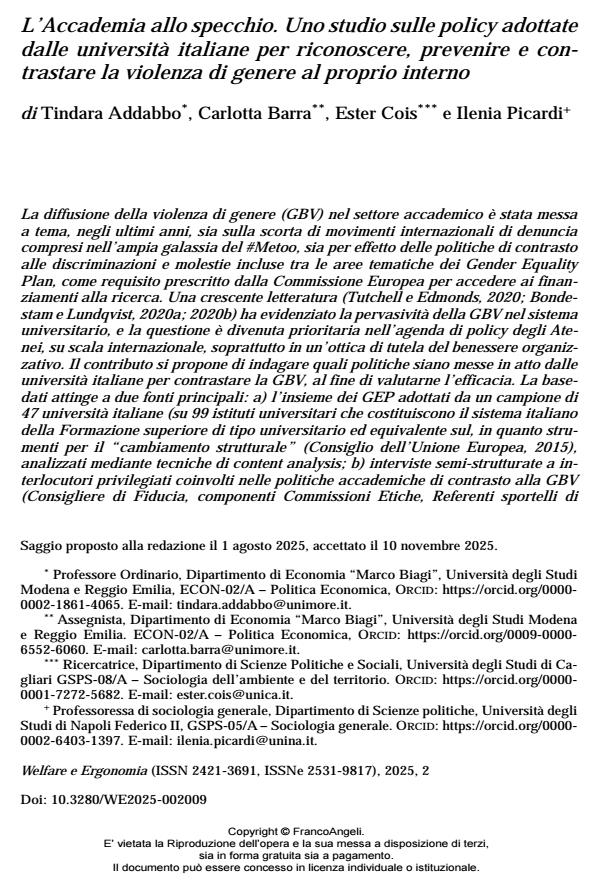
The incidence of gender-based violence (GBV) in the academic sector has increasingly come under scrutiny in recent years, both as a result of international denunciation movements within the broad constellation of #MeToo, and due to anti-discrimination and anti-harassment policies included among the thematic areas of Gender Equality Plans (GEPs), now required by the European Commission for access to research funding. A growing body of literature (Tutchell and Edmonds, 2020; Bondestam and Lundqvist, 2020a; 2020b) has highlighted the pervasiveness of GBV in the university system, and the issue has become a policy priority for higher education institutions globally, particularly in terms of ensuring organisational well-being. This paper aims to investigate the policies implemented by Italian universities to combat GBV, with the goal of assessing their effectiveness. The dataset draws on two primary sources: a) the full set of GEPs adopted by a sample of 47 Italian universities (out of the 99 institutions that make up the Italian higher education system, including universities and equivalent institutions), analysed through content analysis techniques, in light of their role as tools for “structural change” (Council of the European Union, 2015); b) semi-structured interviews with key stakeholders involved in academic GBV prevention and response policies (such as Confidential Advisors, members of Ethics Committees, representatives of listening and anti-violence centres, members of Equal Opportunities Committees, student representatives, and the Rector’s delegates for gender equality, among others).

Keywords: Gender-based Violence; Universities; Welfare; Gender Equality Plan; Organizational Wellbeing.

  1. Ahmed S. (2023). The Feminist Killjoy Handbook: The Radical Potential of Getting in the Way. London, UK: Allen Lane, Penguin. DOI: 10.1080/0966369X.2024.2325744.
  2. Ahmed S. (2021). Complaint! Durham, NC: Duke University Press.
  3. Ahmed S. (2012). On Being Included: Racism and Diversity in Institutional Life. Durham, NC: Duke University Press.
  4. Barra C. and Addabbo T. (2025). Preventing and contrasting gender-based violence and sexual harassment. The role of universities and their equal opportunities bodies. Working paper, DEMB WORKING PAPER SERIES, Dipartimento di Economia Marco Biagi. -- Testo disponibile sul sito https://hdl.handle.net/11380/1381696.
  5. Blazyte G. and Pilinkaite Sotirovic V. (2023). Individual experiences and observation of gender-based violence in academia. Executive summary of the analysis of interviews with researchers at higher risk of gender-based violence.
  6. Bondestam F. and Lundqvist M. (2020a). Efforts to prevent sexual harassment in academia. Aninternational research review. Stockholm: Swedish Council for Higher Education. -- Testo disponibile al sito https://www.uhr.se/globalassets/_uhr.se/publikationer/2020/uhr-efforts-to-prevent-sexual-Harassment-in-academia.pdf.
  7. Bondestam F. and Lundqvist M. (2020b). Sexual harassment in higher education. A systematic review. European Journal of Higher Education, 10(4): 397-419. DOI: 10.1080/21568235.2020.1729833
  8. Boyatzis R.E. (1998). Transforming qualitative information. Thematic analysis and code development. Thousand Oaks, CA: Sage.
  9. CRUI (2021). Vademecum per l’elaborazione del Gender Equality Plan negli Atenei Italiani. -- Testo disponibile al sito https://www.crui.it/documenti/54/New- category/854/VademecumGEP_CRUI.pdf.
  10. European Commission: Directorate-General for Research and Innovation (2024). Zero-tolerance code of conduct. Counteracting gender-based violence, including sexual harassment, in the EU research and innovation system. Publications Office of the European Union. -- Testo disponibile al sito https://data.europa.eu/doi/10.2777/044501.
  11. Kekana L., Mudau K.C., Munzhelele D., Rakgwata P.A. and Sikhitha T. (2025). Breaking the silence: Tackling gender-based violence in higher education, with a focus on LGBTQI+ Communities. International Journal of Research in Business & Social Science, 14(4): 274-283.
  12. Lipinsky A., Schredl C., Baumann H., Humbert A. and Tanwar J. (2022). Gender- based violence and its consequences in European Academia, Summary results from the UniSAFE survey. Report, November 2022. UniSAFE project no.101006261. -- Testo disponibile al sito: https://unisafe-gbv.eu/wp-content/uploads/2022/11/UniSAFE-survey_prevalence-results_2022.pdf.
  13. Mergaert L., Linková M. and Strid S. (2023). Theorising Gender-Based Violence Policies: A 7P Framework. Social Sciences, 12(7): 385.
  14. Murgia A. and Poggio B. (2018). Gender and precarious research careers: A comparative analysis. London, UK: Taylor and Francis. DOI: 10.4324/9781315201245
  15. Gaiaschi C. and Musumeci R. (2020). Just a Matter of Time? Women’s Career Advancement in Neo-Liberal Academia. An Analysis of Recruitment Trends in Italian Universities. Social Sciences, 9(9), 163.
  16. Ginocchio D., Binik O., Lausi G. et al. (2025). Sustainable Measures to End Gender-based Violence in Academia: What Lies between the ERA Policy Paradigm and Reality?. European Journal on Criminal Policy and Research.
  17. Naldini M. e Poggio B. (2024). Genere e accademia: carriere, culture e politiche. Bologna: il Mulino.
  18. Nocenzi M. and Crespi I. (2025). The Sociology of Gender in Italy: From Marginal to Mainstream. The American Sociologist, 56: 101-128.
  19. Picardi I. (2020). Labirinti di cristallo. Strutture di genere nell’accademia e nella ricerca. Milano: FrancoAngeli.
  20. Picardi I., Addabbo T. and Cois E. (2023). Lost in translation: Integrating the gender dimension in research and teaching in Universities through Gender Equality Plans. AG About Gender-International Journal of Gender Studies, 12(24): 30-72. DOI: 10.15167/2279-5057/AG2023.12.24.2242
  21. Pritchard E. and Edwards D., a cura di (2023). Sexual misconduct in academia. Informing an ethics of care in the university. London: Routledge. DOI: 10.4324/9781003289944
  22. Schreier M. (2012). Qualitative Content Analysis in Practice. London: SAGE Publications. DOI: 10.4135/9781529682571
  23. Standing Working Group on Gender in Research and Innovation. (2020). Sexual Harassment in the Research and Higher Education Sector: National Policies and Measures in EU Member States and Associated Countries. ERAC 1205/1/20. -- Available at https://data.consilium.europa.eu/doc/document/ST-1205-2020-REV-1/en/pdf.
  24. Strid S. and Hearn J. (2025). Gender-based violence in academic and research workplaces Socialmedicinsk Tidskrift, 102(1): 80-93.
  25. Tutchell E. and Edmonds J. (2020). Unsafe Spaces: Ending Sexual Abuse in Universities. Leeds, UK: Emerald Publishing Limited. DOI: 10.1108/978-1-78973-059-320201009

Tindara Addabbo, Carlotta Barra, Ester Cois, Ilenia Picardi, L’Accademia allo specchio. Uno studio sulle policy adottate dalle università italiane per riconoscere, prevenire e contrastare la violenza di genere al proprio interno in "WELFARE E ERGONOMIA" 2/2025, pp 121-138, DOI: 10.3280/WE2025-002009