The experience of Ukrainian refugees: Notes for a new reception model from field research

Journal title WELFARE E ERGONOMIA
Author/s Patrizia Laurano, Barbara Sonzogni, Dario Germani
Publishing Year 2026 Issue 2025/2
Language Italian Pages 15 P. 217-231 File size 105 KB
DOI 10.3280/WE2025-002015
DOI is like a bar code for intellectual property: to have more infomation click here

Below, you can see the article first page

If you want to buy this article in PDF format, you can do it, following the instructions to buy download credits
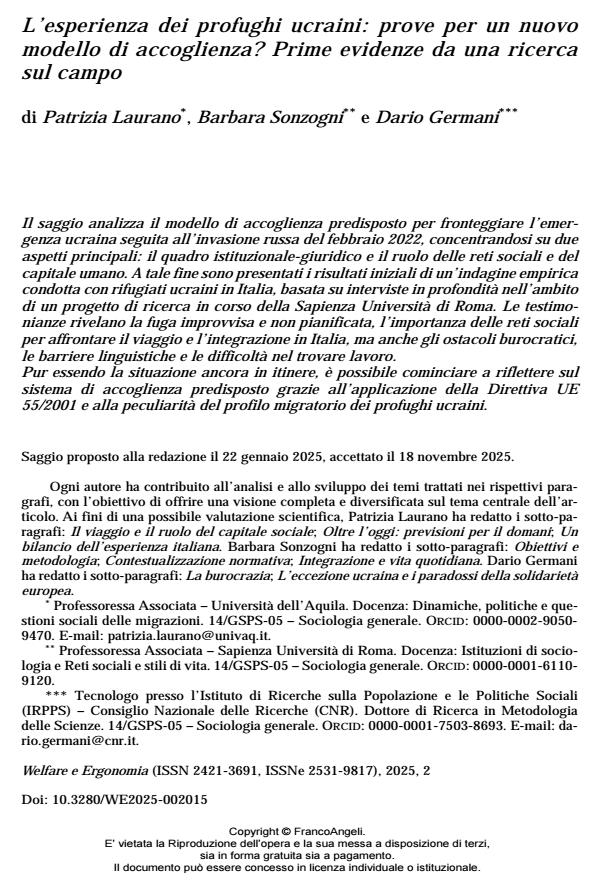
Article preview

FrancoAngeli is member of Publishers International Linking Association, Inc (PILA), a not-for-profit association which run the CrossRef service enabling links to and from online scholarly content.

This essay analyzes the reception model for the Ukrainian emergency following the Russian invasion of February 2022, focusing on two main aspects: the institutional-legal framework and the role of social networks and human capital. To achieve this, the paper introduces the initial findings of an empirical survey on Ukrainian refugees in Italy, drawing on in-depth interviews conducted as part of an ongoing research project at Sapienza University of Rome. The testimonies reveal the sudden and unplanned nature of the escape, the importance of social networks in facilitating the journey and integration in Italy, as well as the bureaucratic obstacles, language barriers, and difficulties in finding employment. Although the situation is still unfolding, it is possible to begin reflecting on the reception system implemented through the application of EU Directive 55/2001 and the migratory profile of Ukrainian refugees.

Keywords: refugees; Ukraine; integration; interview; social capital; EU Directive.

  1. Ambrosini M. (2025). The populist far right paradox: the identification of the enemy and its exceptions in the immigration policies of the Meloni government in Italy. Comparative Migration Studies, 13(17).
  2. Ambrosini M. (2023). Stato d’assedio. Come la paura dei rifugiati ci sta rendendo peggiori. Milano: Egea.
  3. Anthias F. (2012). Transnational mobilities, migration research and intersectionality: Towards a translocational frame. Nordic Journal of Migration Research, 2(2): 102-110.
  4. Bertaux D. (1999). Les récits de vie: perspective ethnosociologique. Paris: Nathan.
  5. Castles S. and Miller M.J. (1993). The age of migration: International population movements in the modern world. London: Palgrave Macmillan (trad.it.: L’era delle migrazioni. Popoli in movimento nel mondo contemporaneo. Città di Castello (PG): Odoya, 2012).
  6. Cervesato L.P. e Vindigni G. (2022, 4 marzo). Guerra in Ucraina: prima applicazione della Direttiva n. 55 del 2001. Lexacivis; testo disponibile al sito: -- https://lexacivis.com/2022/03/04/guerra-in-ucraina-prima-applicazione-della-direttiva-n-55-del-2001/ (30/03/2024).
  7. Crowley H. and Hickman M.J. (2008). Migration, Post-Industrialism and the Globalized Nation-State: Social Capital and Social Closure Among Irish Migrants in Britain. Irish Studies Review, 16(2): 123-140. DOI: 10.1080/09670880801976592
  8. Donato K.M., Gabaccia D., Holdaway J., Manalansan IV M. and Pessar P.R. (2006). A glass half full? Gender in migration studies. International migration review, 40(1): 3-26.
  9. Esser H. (2004). Does the “new” immigration require a “new” theory of intergenerational integration?. International Migration Review, 38(3): 1126-1159.
  10. Evergeti V. and Zontini E. (2006). Introduction: Some critical reflections on social capital, migration and transnational families. Ethnic and Racial Studies, 29(6): 1025-1039. DOI: 10.1080/01419870600960208
  11. Faist T. (2000). The Volume and Dynamics of International Migration and Transnational Social Spaces. Oxford: Oxford University Press.
  12. Haug S. (2008). Migration networks and migration decision-making. Journal of Ethnic and Migration Studies, 34(4): 585-605. DOI: 10.1080/13691830801961605
  13. Hollifield J.F. (2004). The Emerging Migration State. International Migration Review, 38(3): 885-912.
  14. Ineli-Ciger M. (2016). Time to Activate the Temporary Protection Directive. European Journal of Migration and Law, 18: 1-33. DOI: 10.1163/15718166-12342088
  15. Istat (2023). Stranieri residenti al 1° gennaio – Cittadinanza; testo disponibile al sito: http://dati.istat.it/Index.aspx?QueryId=34216# (11/04/2024).
  16. Jacobs D. and Tillie J. (2004). Introduction: Social capital and political integration of migrants. Journal of Ethnic and Migration Studies, 30(3): 419-427. DOI: 10.1080/13691830410001682016
  17. Kofman E., Phizacklea A., Raghuram P. and Sales R. (2000). Gender and international migration in Europe: Employment, welfare and politics. London: Routledge.
  18. Mahler S.J. and Pessar P.R. (2006). Gender matters: Ethnographers bring gender from the periphery toward the core of migration studies. International Migration Review, 40(1): 27-63.
  19. Morgese G. (2022, 9 marzo). L’attivazione della protezione temporanea per gli sfollati provenienti dall’Ucraina: Old but Gold?. BlogDUE; testo disponibile al sito: -- https://www.aisdue.eu/giuseppe-morgese-lattivazione-della-protezione-temporanea-per-gli-sfollati-provenienti-dallucraina-old-but-gold/ (13/04/2024).
  20. Morokvasic M. (1984). Birds of passage are also women…. International migration review, 18(4): 886-907. DOI: 10.1177/019791838401800402
  21. Natter K. (2023). The il/liberal paradox: conceptualising immigration policy trade-offs across the democracy/autocracy divide. Journal of Ethnic and Migration Studies, 50(3): 680-70. DOI: 10.1080/1369183X.2023.2269784
  22. Parreñas R.S. (2001). Servants of Globalization: Women, Migration, and Domestic Work. Stanford: Stanford University Press.
  23. Patulny R. and Svendsen G.L.H. (2007). Exploring the social capital grid: Bonding, bridging, qualitative, quantitative. International Journal of Sociology and Social Policy, 27(1/2): 32-51. DOI: 10.1108/01443330710722742
  24. Piperno F. (2012). The impact of female emigration on families and the welfare state in countries of origin: The case of Romania. International Migration, 50(5): 189-204.
  25. Porchia M. (2022). L’attuazione della Direttiva 55/2001 sulla protezione temporanea: verso un nuovo concetto di solidarietà?. AdiM Blog, 1-8; testo disponibile al sito: -- https://www.adimblog.com/wp-content/uploads/2022/03/SodaPDF-processed-4-2.pdf (12/04/2024).
  26. Portes A. (1998). Social Capital: Its Origins and Applications in Modern Sociology. Annual Review of Sociology, 24: 1-24.
  27. Schiavone G. (2022, 6 marzo). La triste storia della Direttiva europea che dà protezione agli ucraini in fuga. Altreconomia; testo disponibile al sito: -- https://altreconomia.it/la-triste-storia-della-direttiva-europea-che-da-protezione-agli-ucraini-in-fuga/ (12/04/2024).
  28. Scissa C. (2022a). La protezione temporanea per le persone in fuga dall’Ucraina in Ue e in Italia: alcuni profili critici. Questione Giustizia, 1; testo disponibile al sito: -- https://www.questionegiustizia.it/rivista/articolo/la-protezione-temporanea-per-le-persone-in-fuga-dall-ucraina-in-ue-e-in-italia-alcuni-profili-critici (12/04/2024).
  29. Scissa C. (2022b, 22 marzo). On the State’s duty to protect anyone fleeing Ukraine (and other conflict zones). EUBlog; testo disponibile al sito: -- www.eublog.eu/articolo/34962/On-the-State’s-duty-to-protect-anyone-fleeing-Ukraine-(and-other-conflict-zones)/Scissa (12/04/2024).
  30. Skordas A. (2022). Temporary Protection Directive 2001/55/EC. In: Thym D., Hailbronner K., editors, EU Immigration and Asylum Law. Article-by-Article Commentary. München: C.H. Beck.
  31. UNHCR (2024). Lives on hold: profiles and intentions of refugees from Ukraine; testo disponibile al sito: -- https://data.unhcr.org/en/documents/details/106738 (14/04/2024).
  32. Vianello F.A. (2016). Migration of Ukrainian nationals to Italy: Women on the move. In: O. Fedyuk and M. Kindler, editors, Ukrainian migration to the European Union: lessons from migration studies. Cham: Springer International Publishing.

Patrizia Laurano, Barbara Sonzogni, Dario Germani, L’esperienza dei profughi ucraini: prove per un nuovo modello di accoglienza? Prime evidenze da una ricerca sul campo^ in "WELFARE E ERGONOMIA" 2/2025, pp 217-231, DOI: 10.3280/WE2025-002015