The palliative care network in modena province: Care settings and social implications of end-of-life
Journal title ECONOMIA E SOCIETÀ REGIONALE
Author/s Fabjola Kodra, Paolo Vacondio
Publishing Year 2026 Issue 2026/1
Language Italian Pages 13 P. 81-93 File size 256 KB
DOI 10.3280/ES2026-001006
DOI is like a bar code for intellectual property: to have more infomation
click here
Below, you can see the article first page
If you want to buy this article in PDF format, you can do it, following the instructions to buy download credits
FrancoAngeli is member of Publishers International Linking Association, Inc (PILA), a not-for-profit association which run the CrossRef service enabling links to and from online scholarly content.
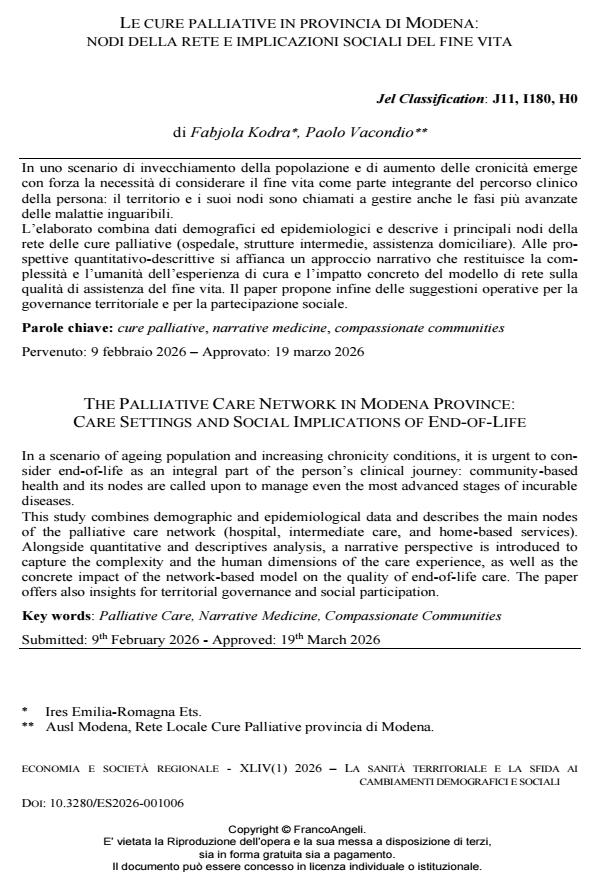
In a scenario of ageing population and increasing chronicity conditions, it is urgent to consider endoflife as an integral part of the person’s clinical journey: communitybased health and its nodes are called upon to manage even the most advanced stages of incurable diseases. This study combines demographic and epidemiological data and describes the main nodes of the palliative care network (hospital, intermediate care, and homebased services). Alongside quantitative and descriptives analysis, a narrative perspective is introduced to capture the complexity and the human dimensions of the care experience, as well as the concrete impact of the networkbased model on the quality of endoflife care. The paper offers also insights for territorial governance and social participation.
Keywords: Palliative Care, Narrative Medicine, Compassionate Communities
- Ascoli U., Ranci C. (2002). Dilemmas of the Welfare Mix: The New Structure of Welfare in an Era of Privatization. Kluwer Academic Publishers. DOI: 10.1007/9781475749922
- Ambrosini M. (2013). Immigrazione irregolare e welfare invisibile. Il lavoro di cura attraverso le frontiere. Bologna: il Mulino.
- Billari F.C., Cecilia Tomassini, a cura di (2024). Rapporto sulla popolazione: l’Italia e le sfide della demografia. Bologna: il Mulino.
- EspingAndersen G. (1999). Social Foundations of Postindustrial Economies. Oxford: Oxford University Press.
- European Commission (2023). State of Health in the EU: Companion Report 2023. Brussels: European Commission. DOI: 10.2875/458883
- Glaser B., Strauss A. (1965). Awareness of Dying. London: Routledge. DOI: 10.4324/9781351327923
- Hochschild A.R. (2014). Global Care Chains and Emotional Surplus Value, da Libro Justice, Politics and the Family. Engster D, Mets T. Routledge.
- Murray C.J.L. et al. (2012). Disabilityadjusted life years (DALYs) for 291 diseases and injuries in 21 regions, 1990–2010: a systematic analysis for the Global Burden of Disease. The Lancet. DOI: 10.1016/S01406736(12)616894
- Oecd (2021). Health at a Glance: OECD indicators. Oecd Publishing.
- Sallnow L., Smith R., Ahmedzai S. et al. (2022). Report of The Lancet Commission on the Value of Death: bringing death back into life. The Lancet, 399: 837884. DOI: 10.1016/S01406736(21)02314X
- Tronto J.C. (1993). Moral Boundaries. A Political Argument for an Ethic of Care. Routledge. DOI: 10.4324/9781003070672
- Vacondio P. (2019). Sediamoci qui. Introduzione alle cure palliative. Sassuolo (MO): Incontri Editrice.
- Wagner E.H. (1998). Chronic disease management: what will it take to improve care for chronic illness?. Eff Clin Pract, 1(1): 24. PMID: 10345255.
- Wagner E.H., Austin B.T., Von Korff M. (2001). Improving chronic illness care: Translating evidence into action. Health Affairs, November/December: 64 78.
- Who (2020). Noncommunicable diseases: Key facts. Geneva: World Health Organization.
Fabjola Kodra, Paolo Vacondio, Le cure palliative in provincia di modena: nodi della rete e implicazioni sociali del fine vita in "ECONOMIA E SOCIETÀ REGIONALE " 1/2026, pp 81-93, DOI: 10.3280/ES2026-001006