Beyond economic remittances: memory, mobilization, and political-cultural remittances of the Ukrainian diaspora
Journal title MONDI MIGRANTI
Author/s Ivana Acocella, Chiara Carbone, Brunella Casalini, Costanza Gasparo
Publishing Year 2026 Issue 2026/1
Language Italian Pages 24 P. 155-178 File size 252 KB
DOI 10.3280/MM2026-001008
DOI is like a bar code for intellectual property: to have more infomation
click here
Below, you can see the article first page
If you want to buy this article in PDF format, you can do it, following the instructions to buy download credits
FrancoAngeli is member of Publishers International Linking Association, Inc (PILA), a not-for-profit association which run the CrossRef service enabling links to and from online scholarly content.
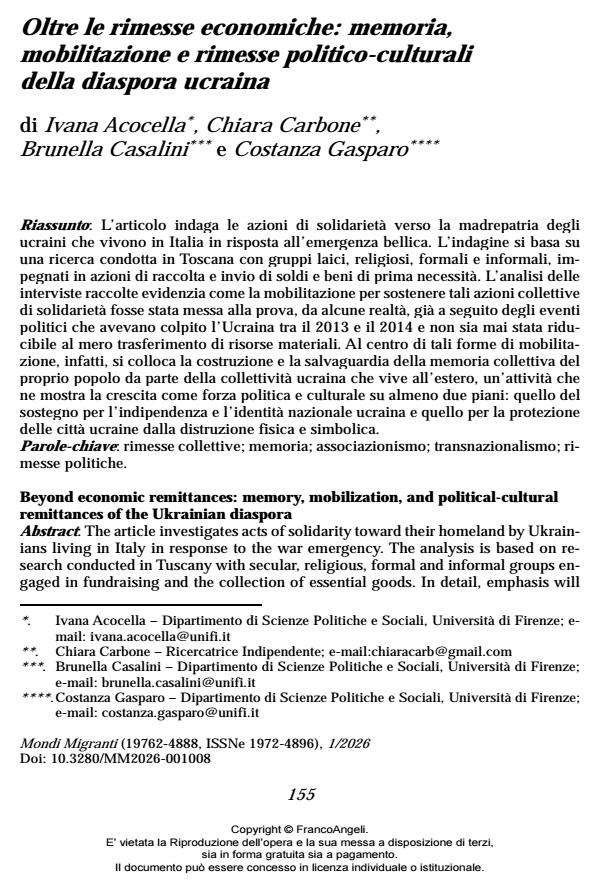
The article investigates acts of solidarity toward their homeland by Ukrainians living in Italy in response to the war emergency. The analysis is based on research conducted in Tuscany with secular, religious, formal and informal groups engaged in fundraising and the collection of essential goods. In detail, emphasis will be placed on how the mobilization to support such collective solidarity actions cannot be reduced to the mere transfer of material resources and, at least in part, had already been tested following the political events that affected Ukraine between 2013 and 2014. At the core of these forms of mobilization is the construction and safeguarding of the collective memory of their people by the Ukrainian community living abroad, emphasizing its growth as a political and cultural force on two levels: supporting Ukraine’s independence and national identity and protecting Ukrainian cities from both physical and symbolic destruction.
Keywords: collective remittances; memory; associationism; transnationalism; political remittances.
- Adamson F. (2012). Constructing the diaspora: diaspora identity politics and transnational social movements. In: Kofman E.F. e Raghuram P., a cura di, Politics from afar: Transnational diasporas and networks. London & New York: Routledge.
- Ahmadov A.K. e Sasse G. (2016). A voice despite exit: The role of assimilation, emigrant networks, and destination in emigrants’ transnational political engagement. Comparative Political Studies, 49, 1: 78-114; DOI: 10.1177/0010414015600468/.
- Ambrosini M. (2007). Prospettive transnazionali. Un nuovo modo di pensare le migrazioni?. Mondi Migranti, 2/2007: 1-48; DOI: 10.1400/81148/.
- Amiot H. (2020). Une action politique pour des enjeux distants: spatialités des mobilisations ukrainiennes en France depuis le Maïdan. L’Espace Politique. Revue en ligne de géographie politique et de géopolitique, 40, 1: 1-23;
- Amiot H. (2024). Framing the present through the past: Ukrainian diaspora in France, Holodomor memory and the 2014 critical juncture. Ethnic and Racial Studies, 47, 2: 367-390; DOI: 10.1080/01419870.2023.2261291/
- Ampah G.A. (2023). Reverse remittances. In: de Laiglesia S.C.R. e Escobar A.M., a cura di, Handbook on Alternative Global Development. Cheltenham, UK: Edward Elgar Publishing.
- Anderson B. (1983). Imagined communities: Reflections on the origin and spread of nationalism. London: Verso Books.
- Babacan K. e Tam M.S. (2022). The information warfare role of social media: Fake news in the Russia-Ukraine war. Erciyes Iletisim Dergisi, 3: 75-92.
- Bellezza S.A. (2024). Identità ucraina: storia del movimento nazionale dal 1800 a oggi. Roma-Bari: Editori Laterza.
- Brubaker R. (2005). The ‘diaspora’ diaspora. Ethnic and racial studies, 28, 1: 1-19; DOI: 10.1080/0141987042000289997/
- Campomori F. (2022). La crisi ucraina e la (ri)organizzazione del sistema di accoglienza: tra lodevoli aperture e preoccupanti disparità di trattamento dei profughi. Politiche Sociali, 2: 325-332; DOI: 10.7389/104623/
- Carling J. (2014). Scripting Remittances: Making Sense of Money Transfers. Transnational. Relationships, IMR, 48, 1: 218-262;
- Carment D., Nikolko M. e MacIsaac S. (2021). Mobilizing diaspora during crisis: Ukrainian diaspora in Canada and the intergenerational sweet spot. Diaspora Studies, 14, 1: 22-44; DOI: 10.1080/09739572.2020.1827667.
- Coward M. (2008). Urbicide: The politics of urban destruction. London: Routledge.
- Erll A. (2011). Traumatic pasts, literary afterlives, and transcultural memory: new directions of literary and media memory studies. Journal of Aesthetics & Culture, 3, 1: 71-86;
- Felgentreff C. (1996). Migration and Remittances in the Eastern Periphery of Fiji: The Case of Naikeleyaga Village. Asian Migrant, 9, 1: 21-27.
- Ferrari S.G., Mezentsev K., Provotar N., Iliadi M. e Kartalou N. (2024). Displaced public spaces in Ukrainian cities: Increasing diversity and inclusion in urban reconstruction through temporary occupation. Zarch, 22: 76-89;
- Frego C. (2024). The Russian-Speaking Minority in Ukraine and the Russian Invasion. De Europa, 7, 2: 91-108; DOI: 10.13135/2611-853X/11423
- Galstyan N. e Ambrosini M. (2023). Diasporas and collective remittances: From state-driven to unofficial forms of diaspora engagement.International Migration Review, 57, 2: 652-680; DOI: 10.1177/01979183221103572/
- Goldring L. (2004). Family and collective remittances to Mexico: a multi-dimensional typology. Development & Change, 35, 4: 799-840;
- Halbwachs M. (2020). On collective memory. University of Chicago press.
- Hoskins A., a cura di (2018). Digital memory studies: media pasts in transition. New York: Routledge.
- Hudkova V. (2018). Why Allowing Multiple Citizenship in Ukraine Will Be Win-win for Ukrainians and Others. Zaborona; https://zaborona.com/en/why-allowing-multiple-citizenship-in-ukraine-will-be-a-win-win-for-ukrainians-and-others/.
- Koziura K. (2024). Toward the transnational memory of Holodomor: The famine commemorative genre and the Ukrainian diaspora. Memory Studies, 18, 1: 1-22; DOI: 10.1177/17506980241247270/.
- Koinova M. (2017). Beyond Statist Paradigms: Sociospatial Positionality and Diaspora Mobilization in International Relations. International Studies Review, 19, 4: 597-621;
- Krawatzek F. e Müller-Funk L. (2020). Two centuries of flows between ‘here’ and ‘there’: political remittances and their transformative potential. Journal of Ethnic and Migration Studies, 46, 6: 1003-1024; DOI: 10.1080/1369183X.2018.1554282/
- Krindatch A. (2003). Religion in postsoviet Ukraine as a factor in regional, ethno-cultural and political diversity, Religion, State & Society, 31, 1: 37-73; DOI: 10.1080/0963749032000045846/
- Kudela-Swiatek W. (2021). Eternal memory: monuments and memorials of the Holodomor. Toronto: Canadian Institute of Ukrainian Studies Press.
- Kudlenko A. (2023). Roots of Ukrainian resilience and the agency of Ukrainian society before and after Russia’s full-scale invasion. Contemporary Security Policy, 44, 4: 513-529; DOI: 10.1080/13523260.2023.2258620/.
- Lacroix T., Levitt P. and Vari-Lavoisier I. (2016). Social remittances and the changing transnational political landscape. Comparative migration studies, 4: 1-5;
- Le De L., Gaillard J.C. e Friesen W. (2013). Remittances and disaster: a review. International Journal of Disaster Risk Reduction, 4: 34-43;
- Levitt P. and Lamba-Nieves D. (2011). Social Remittances Revisited. Journal of Ethnic and Migration Studies, 37, 1: 1-22; DOI: 10.1080/1369183X.2011.521361/
- Levitt P. (1998). Social Remittances: Migration Driven Local-Level Forms of Cultural Diffusion. International Migration Review, 32, 4: 926-948; DOI: 10.1177/019791839803200404/.
- Mazzucchelli F. (2010). Urbicidio. Il senso dei luoghi tra distruzioni e ricostruzioni nella ex Jugoslavia. Bologna: Bologna University Press.
- Østergaard-Nielsen E. (2003). The politics of migrants' transnational political practices. International migration review, 37, 3: 760-786;
- Özgür E.M. e Deniz A. (2024). Diaspora mobilization and identity construction of Ukrainian immigrants in Turkey: “Ukrainians started to become more Ukrainian”. Nationalities Papers, 52, 6: 1393-1412;
- Pheiffer C.F. (2013). The role of remittances in post-conflict reconstruction: the Case of Liberia. In: Brinkerhoff J., a cura di, Remittance flows to post-conflict states: perspectives on human security and development (pp. 71-88). London & New York: Routledge.
- Riabchuk M. (2012). Ukraine’s ‘muddling through’: National identity and postcommunist transition. Communist and Post-Communist Studies, 45, 3-4: 439-446;
- Riedlmayer A. (1995). Killing Memory: The Targeting of Bosnia’s Cultural Heritage. Washington: US Government Printing Office.
- Samokhvalov V. (2015). Ukraine between Russia and the European Union: triangle revisited. Europe-Asia Studies, 67, 9: 1371-1393; DOI: 10.1080/09668136.2015.1088513/
- Shapovalova N. e Burlyuk O. (2018). Civil Society and Change in Ukraine Post-Euromaidan: An Introduction. In: Burlyuk O e Shapovalova N., a cura di, Civil society in post Euromaidan Ukraine: From revolution to consolidation. Stuttgart: Ibidem Press.
- Smith A.D. (1999). Myths and Memories of the Nation. Oxford: Oxford University Press.
- Smoor l. (2017). Understanding the Narratives Explaining the Ukrainian Crisis: Identity Divisions and Complex Diversity in Ukraine. Acta Universitatis Sapientiae, European and Regional Studies, 11, 1: 63-96;
- Trigg D. (2012). The memory of place: A phenomenology of the uncanny. Athens: Ohio University Press.
- Wilson A. (2009). The Ukrainians: Unexpected Nation. New Haven: Yale University Press.
Ivana Acocella, Chiara Carbone, Brunella Casalini, Costanza Gasparo, Oltre le rimesse economiche: memoria, mobilitazione e rimesse politico-culturali della diaspora ucraina in "MONDI MIGRANTI" 1/2026, pp 155-178, DOI: 10.3280/MM2026-001008