The hotspot approach in Italy: a genealogy of border exceptionalism
Titolo Rivista MONDI MIGRANTI
Autori/Curatori Jacopo Anderlini
Anno di pubblicazione 2025 Fascicolo 2025/3
Lingua Inglese Numero pagine 29 P. 64-92 Dimensione file 252 KB
DOI 10.3280/MM2025-003004
Il DOI è il codice a barre della proprietà intellettuale: per saperne di più
clicca qui
Qui sotto puoi vedere in anteprima la prima pagina di questo articolo.
Se questo articolo ti interessa, lo puoi acquistare (e scaricare in formato pdf) seguendo le facili indicazioni per acquistare il download credit. Acquista Download Credits per scaricare questo Articolo in formato PDF
FrancoAngeli è membro della Publishers International Linking Association, Inc (PILA), associazione indipendente e non profit per facilitare (attraverso i servizi tecnologici implementati da CrossRef.org) l’accesso degli studiosi ai contenuti digitali nelle pubblicazioni professionali e scientifiche.
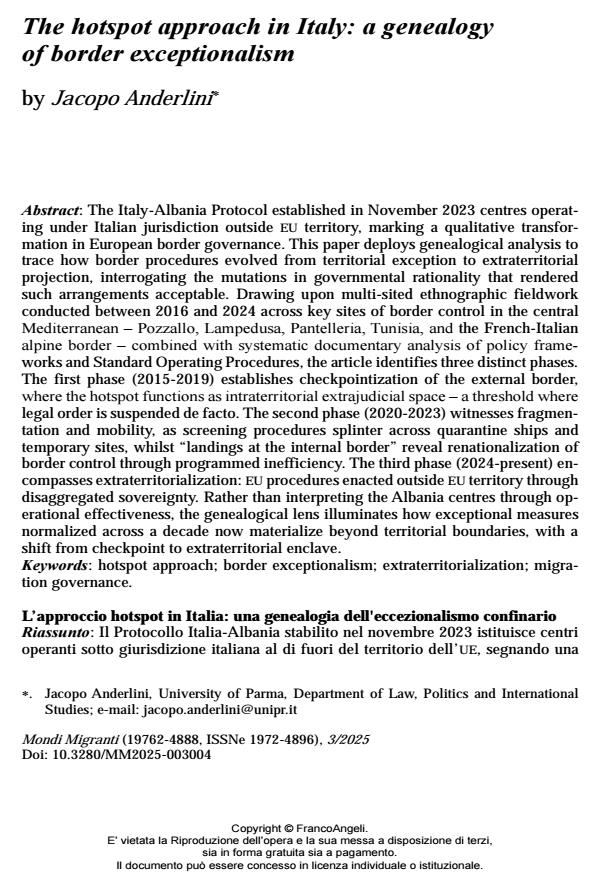
The Italy-Albania Protocol established in November 2023 centres operating under Italian jurisdiction outside EU territory, marking a qualitative transformation in European border governance. This paper deploys genealogical analysis to trace how border procedures evolved from territorial exception to extraterritorial projection, interrogating the mutations in governmental rationality that rendered such arrangements acceptable. Drawing upon multi-sited ethnographic fieldwork conducted between 2016 and 2024 across key sites of border control in the central Mediterranean - Pozzallo, Lampedusa, Pantelleria, Tunisia, and the French-Italian alpine border - combined with systematic documentary analysis of policy frameworks and Standard Operating Procedures, the article identifies three distinct phases. The first phase (2015-2019) establishes checkpointization of the external border, where the hotspot functions as intraterritorial extrajudicial space - a threshold where legal order is suspended de facto. The second phase (2020-2023) witnesses fragmentation and mobility, as screening procedures splinter across quarantine ships and temporary sites, whilst “landings at the internal border” reveal renationalization of border control through programmed inefficiency. The third phase (2024-present) encompasses extraterritorialization: EU procedures enacted outside EU territory through disaggregated sovereignty. Rather than interpreting the Albania centres through operational effectiveness, the genealogical lens illuminates how exceptional measures normalized across a decade now materialize beyond territorial boundaries, with a shift from checkpoint to extraterritorial enclave.
Il Protocollo Italia-Albania stabilito nel novembre 2023 istituisce centri operanti sotto giurisdizione italiana al di fuori del territorio dell’UE, segnando una trasformazione qualitativa nella governance della frontiera europea. Attraverso l’analisi genealogica, l’articolo rintraccia come le procedure di frontiera si siano evolute dall’eccezione territoriale alla proiezione extraterritoriale, interrogando le mutazioni nella razionalità governamentale che hanno reso accettabili tali dispositivi. Attingendo a un lavoro etnografico multi-situato condotto tra il 2016 e il 2024 presso i principali siti del controllo di frontiera del Mediterraneo centrale ‒ Pozzallo, Lampedusa, Pantelleria, Tunisia e il confine alpino franco-italiano ‒ combinato con l'analisi documentale delle politiche e delle Procedure Operative Standard, l’articolo identifica tre fasi distinte. La prima fase (2015-2019) stabilisce la checkpointizzazione del confine esterno, dove l’hotspot funziona come spazio extragiudiziale intraterritoriale ‒ una soglia dove l'ordine legale viene sospeso de facto. La seconda fase (2020-2023) testimonia frammentazione e mobilità, mentre le procedure di screening si frantumano attraverso navi-quarantena e siti temporanei, e gli “sbarchi al confine interno” rivelano la rinazionalizzazione del controllo di frontiera attraverso l’inefficienza programmata. La terza fase (2024-presente) comprende lextraterritorializzazione: procedure dell’UE attuate al di fuori del territorio dell’UE attraverso sovranità disaggregata. Piuttosto che interpretare i centri in Albania attraverso l’efficacia operativa, la lente genealogica illumina come misure eccezionali normalizzate nell'arco di un decennio si materializzino ora oltre i confini territoriali, con un passaggio dal checkpoint all’enclave extraterritoriale.
Parole chiave:approccio hotspot; eccezionalismo di frontiera; extraterritorializzazione; governance migratoria.
- ActionAid and Openpolis (2025). Accoglienza al collasso. Centri d’Italia 2024.
- Agamben G. (2005). State of Exception. University of Chicago Press.
- Anderlini J. (2024). Humanitarian Border: Reprise. Anti-Human Trafficking Discourses and Security Practices at the Southern Italian Border. Environment and Planning C: Politics and Space, June 13, 23996544241259576; https://doi.org/10.1177/23996544241259576.
- Anderlini J. (2022). Fitful Circulations: Unauthorized Movements in the Sicilian Transit Zone. International Migration, ahead of print; https://doi.org/10.1111/imig.12996 /.
- Anderlini J. (2020). Border Troubles: Medical Expertise in the Hotspots. In: Ambrosini M., Cinalli M. and Jacobson D., eds., Migration, Borders and Citizenship: Between Policy and Public Spheres. Migration, Diasporas and Citizenship. Palgrave Macmillan; https://doi.org/10.1007/978-3-030-22157-7_7 /.
- Anderlini J. and Di Meo S. (2021). Approccio Hotspot e Navi Quarantena. Rivista Il Mulino, Società migranti, vol. 1 (November); https://www.rivistailmulino.it/a/approccio-hotspot-e-navi-quarantena /.
- ASGI (2020). Rights in Route. The 'Quarantine Ships' between Risks and Criticisms. Inlimine. Associazione per gli Studi Giuridici sull’Immigrazione; https://inlimine.asgi.it/rights-in-route-the-quarantine-ships-between-risks-and-criticisms/.
- ASGI (2023). Analisi Giuridica Del Protocollo Italia-Albania.
- Balibar E. (2009). Europe as Borderland. Environment and Planning D: Society and Space, 27, 2: 190-215; https://doi.org/10.1068/d13008 /.
- Bourdieu P. (2000). Pascalian Meditations. Stanford University Press.
- Burawoy M. (2003). Revisits: An Outline of a Theory of Reflexive Ethnography. American Sociological Review, 68, 5: 645-679; https://doi.org/ 10.2307/1519757 /.
- Casaglia A. (2021). Borders and Mobility Injustice in the Context of the Covid-19 Pandemic. Journal of Borderlands Studies, 36, 4: 695-703; https://doi.org/10.1080/08865655.2021.1918571 /.
- Casajuana E. and Pintus J. (2023). Oltre i confini, oltre i limiti. Analisi critica del sostegno finanziario dell’UE per il controllo delle frontiere in Tunisia e in Libia. Profundo Research Advice.
- Casas-Cortes M., Cobarrubias S., De Genova N. et al. (2015). New Keywords: Migration and Borders. Cultural Studies, 29, 1: 55-87.
- Coleman S. and Von Hellermann P., eds. (2011). Multi-Sited Ethnography: Problems and Possibilities in the Translocation of Research Methods. Routledge Advances in Research Methods 3. Routledge.
- Collyer M. and Shahani U. (2023). Offshoring Refugees: Colonial Echoes of the UK-Rwanda Migration and Economic Development Partnership. Social Sciences, 12, 8: 451.
- Cuttitta P. (2012). Lo Spettacolo Del Confine: Lampedusa Tra Produzione e Messa in Scena Della Frontiera. Sesto San Giovanni (Milano): Mimesis, collana Eterotopie, n. 144.
- Daminelli L. (2022). Aspettare a Ventimiglia. La Frontiera Italo-Francese Fra Militarizzazione, Crisi Dell’accoglienza e Solidarietà. REMHU: Revista Interdisciplinar Da Mobilidade Humana, 64.
- Daminelli L. and Cometti M. (2024). ‘Struggling for Time on Lesvos: The Impact of EU and National Legislation and Procedures on Refugee Temporalities. Borders in Globalization Review, 6, 1: 143-157.
- Darling J. (2016). Privatising Asylum: Neoliberalisation, Depoliticisation and the Governance of Forced Migration. Transactions of the Institute of British Geographers, March 1, n/a-n/a; https://doi.org/ 10.1111/tran.12118 /.
- De Genova N.P. (2013). Spectacles of Migrant “Illegality”: The Scene of Exclusion, the Obscene of Inclusion. Ethnic and Racial Studies, 36, 7: 1180-1198; https://doi.org/10.1080/01419870.2013.783710 /.
- Denaro C. and Boccagni P. (2022). Migration, Borders and “De-Bordering” in Pandemic Times: Voices as Interlocution from Quarantine Ships in Italy. Journal of Borderlands Studies, 0, 0: 1-26; https://doi.org/ 10.1080/08865655.2022.2108110 /.
- European Agenda on Migration, COM/2015/0240 final (2015). Bruxelles.
- European Commission (2025). EU Emergency Trust Fund for Africa: 2024 Annual Report. Publications Office; https://data.europa.eu/doi/10.2841/ 9152535 /.
- European Commission (2015). Explanatory Note on the ‘Hotspot’ Approach.
- Fargues P. and Fandrich C. (2012). Migration after the Arab Spring. Migration Policy Centre - European University Institute; https://migrationpolicycentre.eu/wp-content/uploads/2024/11/MPC-2012-EN-09.pdf /.
- Foucault M. (2009). Security, Territory, Population: Lectures at the Collège de France 1977-78. Lectures at the Collège de France. Palgrave Macmillan.
- Foucault M. (1978) [2024]. “What Is Critique?” And “The Culture of the Self”; https://press.uchicago.edu/ucp/books/book/chicago/W/bo208 378666.html /.
- Frontex Risk Analysis Network (2016). Annual Risk Analysis 2016. Warsaw.
- Frontex Risk Analysis Network (2015). Annual Risk Analysis 2015. Warsaw.
- Geddes A. and Hadj-Abdou L. (2019). Changing the Path? EU Migration Governance after the 'Arab Spring'. In: The EU in the Mediterranean after the Arab Uprisings. London: Routledge.
- Herbert S. (2000). For Ethnography. Progress in Human Geography 24, 4: 550-568; https://doi.org/10.1191/030913200100189102 /.
- Hess S. (2012). De-Naturalising Transit Migration. Theory and Methods of an Ethnographic Regime Analysis. Population, Space and Place, 18, 4: 428-440; https://doi.org/10.1002/psp.632 /.
- Hull M.S. (2012). Documents and Bureaucracy. Annual Review of Anthropology, 41, 1: 251-267; https://doi.org/10.1146/annurev.anthro.012809.104953 /.
- Interior Ministry (2016). Standard Operating Procedures (SOP) Applicable to Italian Hotspots. May 17; http://www.libertaciviliimmigrazione.dlci.interno.gov.it/sites/default/files/allegati/hotspots_sops_-_versione_italiana.pdf /.
- Interior Ministry (2015). Italian Roadmap. September 28; http://www.meltingpot.org/IMG/pdf/roadmap-2015.pdf /.
- Jeandesboz J. and Pallister-Wilkins P. (2016). Crisis, Routine, Consolidation: The Politics of the Mediterranean Migration Crisis. Mediterranean Politics, 21, 2: 316-320; https://doi.org/10.1080/13629395.2016.1145825 /.
- Marcus G.E. (2010). Ethnography through Thick and Thin. Nachdr. Princeton, NJ 08540-5237 USA: Princeton Univ. Press.
- Mathur N. (2015). Paper Tiger: Law, Bureaucracy and the Developmental State in Himalayan India. Cambridge Studies in Law and Society. Cambridge University Press; https://doi.org/10.1017/CBO9781316227367 /.
- Mezzadra S. and Neilson B. (2013). Border as Method, or, the Multiplication of Labor. Durham: Duke University Press.
- Sahin-Mencutek Z., Barthoma S., Gökalp-Aras N.E., and Triandafyllidou A. (2022). A Crisis Mode in Migration Governance: Comparative and Analytical Insights. Comparative Migration Studies, 10, 1/2022, 12; https://doi.org/10.1186/s40878-022-00284-2 ./.
- Schmitt C. (1950). Der Nomos der Erde: im Völkerrecht des Jus Publicum Europaeum. Greven.
- Schmitt C. (1934). Politische Theologie. Berlin: Duncker & Humblot.
- Silva S. Marques da and Parker Webster J. (2018). Positionality and Standpoint. In: The Wiley Handbook of Ethnography of Education. John Wiley & Sons, Ltd; https://doi.org/10.1002/9781118933732.ch22 ./.
- Strik T. and Robbesom R. (2024). Compliance or Complicity? An Analysis of the EU-Tunisia Deal in the Context of the Externalisation of Migration Control. Netherlands International Law Review, 71, 1: 199-225; https://doi.org/10.1007/s40802-024-00251-x ./.
- Tsianos V.S., Hess S. and Karakayali S. (2009). Transnational Migration. Theory and Method of an Ethnographic Analysis of Border Regimes. Sussex Centre for Migration Research Working Paper, 55; http://www.academia.edu/download/31178322/sussespaper.pdf ./.
- Vaughan-Williams N. (2015). Europe’s Border Crisis: Biopolitical Security and Beyond. First edition. Oxford University Press.
- Vedsted-Hansen J. (2025). European Governance of Deterrence and Containment. A Legal Perspective on Novelties in European and Danish Asylum Policy. Journal of Ethnic and Migration Studies, January 21, 1-18; https://doi.org/10.1080/1369183X.2024.2441599 ./.
- Walters W. (2008). ‘Anti-Policy and Anti-Politics: Critical Reflections on Certain Schemes to Govern Bad Things’. European Journal of Cultural Studies, 11, 3: 267-288; https://doi.org/10.1177/1367549408091844 ./.
- Zampagni F. (2016). Unpacking the Schengen Visa Regime. A Study on Bureaucrats and Discretion in an Italian Consulate. Journal of Borderlands Studies, 31, 2: 251-266; https://doi.org/10.1080/08865655.2016.1174605
- Italy as a "key case" in the reform of the European Union's migration and asylum policy (2015-2024) Sharon Elizabeth Ortega Machado, in Конфликтология / nota bene /2026 pp.14
DOI: 10.7256/2454-0617.2026.2.78970 - The criminalisation of freedom of movement: an abolition feminist analysis Deanna Dadusc, Aila Spathopoulou, Anna Carastathis, Camille Gendrot, in Mobilities /2026 pp.1
DOI: 10.1080/17450101.2026.2720046
Jacopo Anderlini, The hotspot approach in Italy: a genealogy of border exceptionalism in "MONDI MIGRANTI" 3/2025, pp 64-92, DOI: 10.3280/MM2025-003004