Nuove mappe per nuovi territori. Festival per la cultura, la cittadinanza, lo sviluppo
Journal title PRISMA Economia - Società - Lavoro
Author/s Cristiana Colli
Publishing Year 2013 Issue 2012/1
Language Italian Pages 14 P. 56-69 File size 621 KB
DOI 10.3280/PRI2012-001007
DOI is like a bar code for intellectual property: to have more infomation
click here
Below, you can see the article first page
If you want to buy this article in PDF format, you can do it, following the instructions to buy download credits
FrancoAngeli is member of Publishers International Linking Association, Inc (PILA), a not-for-profit association which run the CrossRef service enabling links to and from online scholarly content.
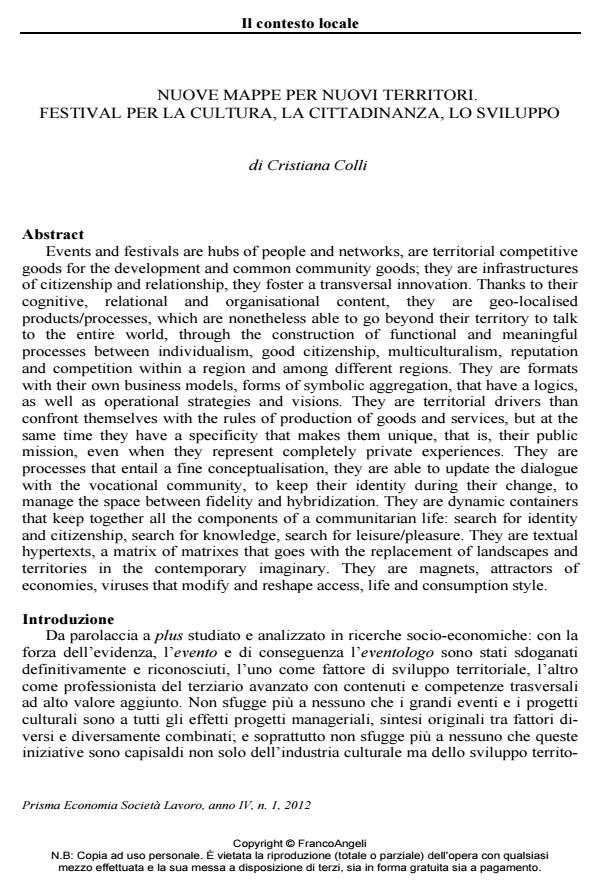
Events and festivals are hubs of people and networks, are territorial competitive goods for the development and common community goods; they are infrastructures of citizenship and relationship, they foster a transversal innovation. Thanks to their cognitive, relational and organisational content, they are geo-localised products/processes, which are nonetheless able to go beyond their territory to talk to the entire world, through the construction of functional and meaningful processes between individualism, good citizenship, multiculturalism, reputation and competition within a region and among different regions. They are formats with their own business models, forms of symbolic aggregation, that have a logics, as well as operational strategies and visions. They are territorial drivers than confront themselves with the rules of production of goods and services, but at the same time they have a specificity that makes them unique, that is, their public mission, even when they represent completely private experiences. They are processes that entail a fine conceptualisation, they are able to update the dialogue with the vocational community, to keep their identity during their change, to manage the space between fidelity and hybridization. They are dynamic containers that keep together all the components of a communitarian life: search for identity and citizenship, search for knowledge, search for leisure/pleasure. They are textual hypertexts, a matrix of matrixes that goes with the replacement of landscapes and territories in the contemporary imaginary. They are magnets, attractors of economies, viruses that modify and reshape access, life and consumption style.
- Agamben G., (2008) Che cos’è il contemporaneo? I sassi nottetempo, Roma
- Anselmi S., (1996) Storie di Adriatico, il Mulino, Bologna
- Bonami F., (2010) Si crede Picasso, Mondadori, Milano
- Bonomi A., (2010) Il distretto del piacere, Bollati Boringhieri, Torino
- Caliandro C., Sacco P., (2011) Italia Reloaded, il Mulino, Bologna
- Cattelan M., (2011) Un salto nel vuoto, Rizzoli, Milano
- Ciorra P., (2011) Senza architettura, Laterza, Roma-Bari
- Ciorra P., Marini S., (2011) Re-cycle, Electa-Fondazione Maxxi, Milano
- Codeluppi V., (2008) Il biocapitalismo, Bollati Boringhieri, Torino
- Communitas 42, (2010) Dal distretto del piacere alla notte rosa, Editoriale Vita, Milano
- De Botton A., (2009) Una settimana all’aeroporto, Guanda, Parma
- De Luca E., (2008) Pianoterra, nottetempo, Roma
- Dini A., (2006) Le professioni della comunicazione, Il Sole 24 Ore-Iulm, Milano
- Federculture, (2011) Rapporto Annuale
- Gezzi M., Ruggeri A., (2008) Porta Marina, Pequod, Ancona
- Giancarli D., (2009) Storie al margine, Exorma, Roma
- Koolhaas R., (2010) Singapore Songlines, Quodlibet, Macerata
- Pollarini A., (2010) “I turismi vocazionali”, Rivista di Scienze del Turismo, n. 1, http://www.ledonline.it/Rivista-Scienze-Turismo/
- Symbola-Unioncamere, (2012) L’Italia che verrà. Industria culturale, made in Italy e territori, www.symbola.net
- Taddia F., Ceroni C., (2010) Fuori luogo, Feltrinelli, Milano
- Venturi R., Scott Brown D., Izenour S., (2010) Imparare da Las Vegas, Quodlibet Abitare, Macerata
Cristiana Colli, Nuove mappe per nuovi territori. Festival per la cultura, la cittadinanza, lo sviluppo in "PRISMA Economia - Società - Lavoro" 1/2012, pp 56-69, DOI: 10.3280/PRI2012-001007