Democrazia e territorio nell’epoca del liberalismo post-democratico: alla ricerca di un framework di riferimento
Journal title PRISMA Economia - Società - Lavoro
Author/s Ottavio Marzocca
Publishing Year 2013 Issue 2012/2
Language Italian Pages 14 P. 14-27 File size 222 KB
DOI 10.3280/PRI2012-002003
DOI is like a bar code for intellectual property: to have more infomation
click here
Below, you can see the article first page
If you want to buy this article in PDF format, you can do it, following the instructions to buy download credits
FrancoAngeli is member of Publishers International Linking Association, Inc (PILA), a not-for-profit association which run the CrossRef service enabling links to and from online scholarly content.
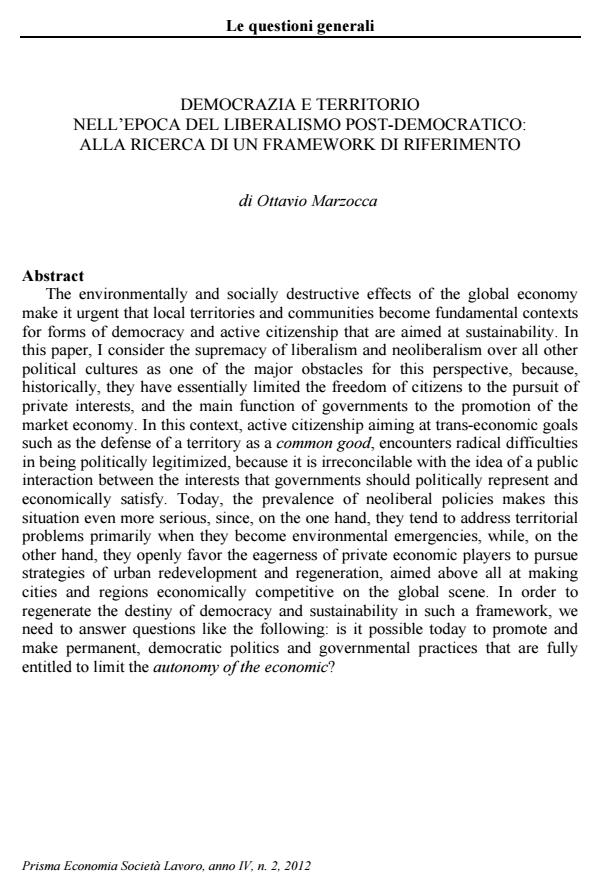
The environmentally and socially destructive effects of the global economy make it urgent that local territories and communities become fundamental contexts for forms of democracy and active citizenship that are aimed at sustainability. In this paper, I consider the supremacy of liberalism and neoliberalism over all other political cultures as one of the major obstacles for this perspective, because, historically, they have essentially limited the freedom of citizens to the pursuit of private interests, and the main function of governments to the promotion of the market economy. In this context, active citizenship aiming at trans-economic goals such as the defense of a territory as a common good, encounters radical difficulties in being politically legitimized, because it is irreconcilable with the idea of a public interaction between the interests that governments should politically represent and economically satisfy. Today, the prevalence of neoliberal policies makes this situation even more serious, since, on the one hand, they tend to address territorial problems primarily when they become environmental emergencies, while, on the other hand, they openly favor the eagerness of private economic players to pursue strategies of urban redevelopment and regeneration, aimed above all at making cities and regions economically competitive on the global scene. In order to regenerate the destiny of democracy and sustainability in such a framework, we need to answer questions like the following: is it possible today to promote and make permanent, democratic politics and governmental practices that are fully entitled to limit the autonomy of the economic?
- Agamben G., (2010) “Nota preliminare a ogni discussione sul concetto di democrazia”, in G. Agamben et al., In che stato è la democrazia?, nottetempo, Roma, pp. 9-13
- Bateson G., (1972, 2008) Verso un’ecologia della mente, Adelphi, Milano
- Beck U., (2001) La società globale del rischio (1999), trad. it. di F. Pagano, Asterios, Trieste
- Berlin I., (2010) “Due concetti di libertà” (1958), in Id., Libertà, a cura di H. Hardy, trad. it. di G. Rigamonti e M. Santambrogio, Feltrinelli, Milano, pp. 169-222
- Constant B., (2001) La libertà degli antichi, paragonata a quella dei moderni (1820), trad. it. a cura di G. Paoletti, Einaudi, Torino
- della Porta D., (2011) Democrazie, il Mulino, Bologna
- De Lucia V., (2010) Le mie città. Mezzo secolo di urbanistica in Italia, Diabasis, Reggio Emilia
- Harvey D., (1989) “From Managerialism to Entrepreneurialism: The Transformation in Urban Governance in Late Capitalism”, Geografiska Annaler. Series B, Human Geography, vol. 71, n.1, pp. 3-17, DOI: 10.2307/49050
- Hayek (von) F. A., (1998) Liberalismo (1978), trad. it. di G. Minotti, Ideazione, Roma
- Klein N., (2007) Shock Economy. L’ascesa del capitalismo dei disastri (2007), trad. it. di I. Katerinov, Rizzoli, Milano
- Magnaghi A., (2010) Il progetto locale. Verso la coscienza di luogo, Bollati Boringhieri, Torino
- Marson A., (2002) “Quale ruolo per il conflitto nelle costituenti del Nuovo Municipio”, in Sullo P. (a cura di), La democrazia possibile, Edizioni Intra Moenia, Napoli, pp. 99-106
- Marzocca O., (2012) “Democrazia locale, federalismo solidale, cittadinanza attiva”, in Magnaghi A. (a cura di), Il territorio bene comune, Firenze University Press, Firenze, pp. 91-105
- Mattei U., (2011) Beni comuni. Un manifesto, Laterza, Roma-Bari
- Mill J. S., (1997) Saggio sulla libertà (1859), trad. it. di S. Magistretti, Il Saggiatore, Milano
- Rancière J., (2010) “I democratici contro la democrazia”, in Agamben G. et al., In che stato è la democrazia?, nottetempo, Roma, pp. 119-126
- Rosanvallon P., (1984) Liberismo, Stato assistenziale, Solidarismo (1981), trad. it. di P. Massimi, Armando Editore, Roma
- Rossi U., Vanolo A., (2010) Geografia politica urbana, Laterza, Roma-Bari
- Ungaro D., (2004) Democrazia ecologica. L’ambiente e la crisi delle istituzioni liberali, Laterza, Roma-Bari
- Viale G., (2011) La conversione ecologica. There is no alternative, NdA Press, Cerasolo Ausa di Coriano (RN)
Ottavio Marzocca, Democrazia e territorio nell’epoca del liberalismo post-democratico: alla ricerca di un framework di riferimento in "PRISMA Economia - Società - Lavoro" 2/2012, pp 14-27, DOI: 10.3280/PRI2012-002003