Musica (popolare) e spazi urbani: una introduzione
Journal title RIVISTA GEOGRAFICA ITALIANA
Author/s Elena dell’Agnese
Publishing Year 2019 Issue 2019/4
Language Italian Pages 13 P. 7-19 File size 124 KB
DOI 10.3280/RGI2019-004001
DOI is like a bar code for intellectual property: to have more infomation
click here
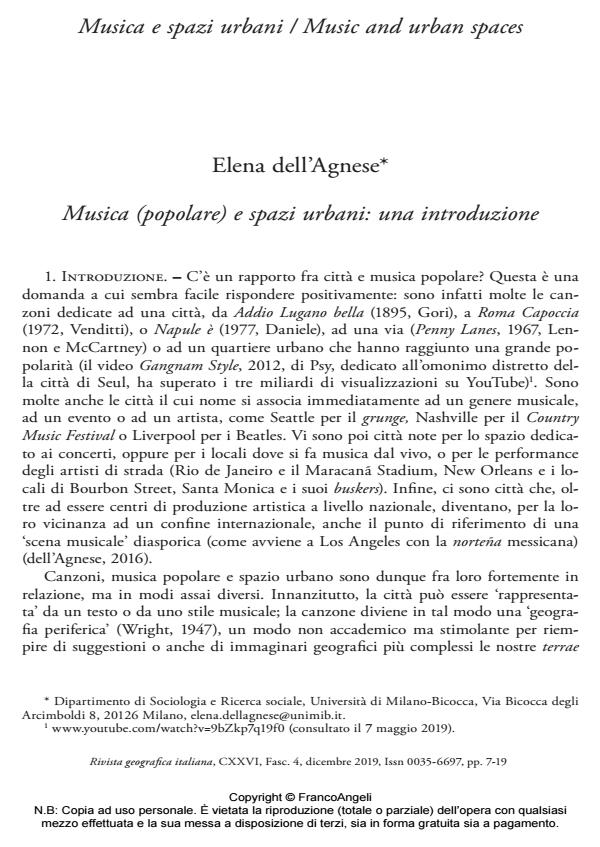
Below, you can see the article first page
If you want to buy this article in PDF format, you can do it, following the instructions to buy download credits
FrancoAngeli is member of Publishers International Linking Association, Inc (PILA), a not-for-profit association which run the CrossRef service enabling links to and from online scholarly content.
- Lafargue de Grangeneuve L. (2006). Comment Marseille est devenue l’autre capitale du rap français. Politique musicale et identité locale. Géographie et cultures, 59: 57-70. -- https://journals.openedition.org/gc/3763
- Lashua B., Spracklen K. e Wagg S., a cura di (2014). Sounds and the City. London: Palgrave Macmillan.
- Makkonen T. (2014). Tales from the thousand lakes: placing the creative network of metal music in Finland. Environment and Planning a, 46: 1586-1600. DOI: 10.1068/a130020p
- Marini A. (2016). Il Seattle Sound: l’espressione musicale di un territorio. In: dell’Agnese E. e Tabusi M., a cura di, La musica come geografia: suoni, luoghi, territori. Roma: Societa Geografica Italiana, 207-222.
- Martinez T.A. (1997). Popular culture as oppositional culture: Rap as resistance. Sociological Perspectives, 40: 265-286. DOI: 10.2307/1389525
- Minidio A. (2005). I suoni del mondo: studi geografici sul paesaggio sonoro. Milano: Guerini Scientifica.
- Montes C. (2003). La ville, le bruit et le son, entre mesure policiere et identités urbaines. Géocarrefour, 78: 91-94. -- https://journals.openedition.org/geocarrefour/168
- Pecknold D. (2014). Heart of the Country? The Construction of Nashville as the Capital of Country Music. In: Lashua B., Spracklen K. e Wagg S., a cura di, Sounds and the City. London: Palgrave Macmillan, 19-37.
- Pine J. e Pepe F. (2013). Transnational Neomelodica Music and Alternative Economic Cultures. California Italian Studies, 4. -- https://escholarship.org/uc/item/0rm113j6
- Raibaud Y. (2006). Les fetes musicales. Expérience de la ville et performativité. Géographie et cultures, 59: 87-104. -- https://halshs.archives-ouvertes.fr/halshs-00333346
- Romagnan J.M. (2000). La musique, un nouveau terrain pour les géographes. Géographie et Cultures, 36. -- http://catalogue.sciencespo.fr/ark:/46513/sc0000373743
- Id. (2015-16). Nicolas Canova La musique au coeur de l’analyse géographique. Quaderni, 89: 103-107. -- https://journals.openedition.org/quaderni/962
- Safitri D. (2014). Metal Satu Jari (Studi Deskriptif Mengenai Metal Satu Jari sebagai Counterculture terhadap Metalhead Mainstream di Jakarta). Surabaya: Universitas Airlangga. -- http://repository.unair.ac.id/15932/
- Scott A.J. (1999). The US recorded music industry: on the relations between organization, location, and creativity in the cultural economy. Environment and Planning A, 31: 1965-1984. -- https://journals.sagepub.com/doi/10.1068/a311965
- Simpson P. (2011). Street performance and the city: Public space, sociality, and intervening in the everyday. Space and Culture, 14: 415-430. DOI: 10.1177/1206331211412270
- Stratton J. e Trainer A. (2016). Nothing happens here: Songs about Perth. Thesis Eleven, 135: 34-50. DOI: 10.1177/0725513616657884
- Toccaceli L. (2016). Ti sputo ma ti amo: rock e rap cantano Milano. In: dell’Agnese E. e Tabusi M., a cura di, La musica come geografia: suoni, luoghi, territori. Roma: Societa Geografica Italiana, 99-114.
- Wallach J. e Levine A. (2011). “I want you to support local metal”: A theory of metal scene formation. Popular Music History, 6: 116-134. DOI: 10.1558/pomh.v6i1/2.116
- Watson A., Hoyler M. e Mager C. (2009). Spaces and Networks of Musical Creativity in the City. Geography Compass, 3: 856-878. DOI: 10.1111/j.1749-8198.2009.00222.x
- Wright J.K. (1947). Terrae incognitae: The place of the imagination in geography. Annals of the association of american geographers, 37: 1-15. DOI: 10.1080/00045604709351940
- Panitz L.M. (2012). Por uma geografia da música: um panorama mundial e vinte anos de pesquisas no Brasil. Para Onde!?, 6: 1-10. -- https://seer.ufrgs.br/paraonde/article/view/36474
- Di Quarto F. (2016). Reinventare lo spazio pubblico con la musica. Il caso del Viaduto Santa Tereza a Belo Horizonte. In: dell’Agnese E. e Tabusi M., a cura di, La musica come geografia: suoni, luoghi, territori. Roma: Societa Geografica Italiana, 263-277.
- Ford L. (1971). Geographic Factors in the Origin, Evolution, and Diffusion of Rock and Roll Music, Journal of Geography, 70: 455-464. DOI: 10.1080/0022134710898189
- French K. (2012). “Topomusica” in rap music: Role of geography in hip-hop music. M 16th International Conference Proceedings, International Association for the Study of Popular Music, 133-138.
- Florida R. e Jackson S. (2010). Sonic city: The evolving economic geography of the music industry. Journal of Planning Education and Research, 29: 310-321. -- DOI: 10.1177/0739456X09354453
- Id., Mellander C. e Stolarick K. (2010). Music scenes to music clusters: The economic geography of music in the US, 1970-2000. Environment and Planning A, 42: 785-804. DOI: 10.1068/a4253
- Gibson C. e Connell J. (2005). Music and tourism: On the road again. Bristol: Channel View Publications.
- Id. e Homan S. (2004). Urban redevelopment, live music and public space: Cultural performance and the re-making of Marrickville. International Journal of Cultural Policy, 10: 67-84. DOI: 10.1080/1028663042000212337
- Gillett C. (1970). The Sound of the City: The Rise of Rock’n’Roll. New York: Outerbridge. Giusto S. e Russo C. (2017). Note neomelodiche: estetica sociale, economia politica e reti di scambio asimmetrico nello spazio periferico napoletano. Antropologia, 4(1 NS). -- www.ledijournals.com/ojs/index.php/antropologia/article/view/1177
- Gotham K.F. (2005). Tourism gentrification: The case of New Orleans’ vieux carre (French Quarter). Urban studies, 42: 1099-1121. DOI: 10.1080/00420980500120881
- Graves S. (2009). Hip hop: A postmodern folk music. In: Johansson O. e Bell T.L., a cura di, Sound, Society, and the Geography of Popular Music. London and New York: Routledge, 245-260.
- Grésillon B. (2008). Ville et création artistique. Pour une autre approche de la géographie culturelle. Annales de géographie, 2: 179-198. -- www.cairn.info/revue-annales-degeographie-2008-2-page-179.htm
- Guarrasi V. (2016). Dancing Geographies. Danze popolari e spazi urbani. In: dell’Agnese E. e Tabusi M., a cura di, La musica come geografia: suoni, luoghi, territori. Roma: Societa Geografica Italiana, 249-262.
- Guillard S. (2012). «Représenter sa ville»: l’ancrage des identités urbaines dans le rap des Twin Cities. Cybergeo: European journal of Geography. 608 -- https://journals.openedition.org/cybergeo/25357
- Guiu C. (2006). Géographie et musiques: état des lieux. Une proposition de synthese. Géographie et cultures, 59: 7-26. -- https://journals.openedition.org/gc/3738
- Halfacree K.H. e Kitchin R.M. (1996). “Manchester rave on”: Placing the fragments of popular music. Area, 28: 47-55. -- http://mural.maynoothuniversity.ie/3944
- Johansson O. e Bell T.L., a cura di (2009). Sound, Society, and the Geography of Popular Music. London and New York: Routledge.
- Kloosterman R.C. (2005). Come together: An introduction to music and the city. Built Environment, 31: 181-191. DOI: 10.2148/benv.2005.31.3.181
- Kniaź L. (2017). My City, My ‘Hood, My Street: Ghetto Spaces in American Hip-Hop Music. New Horizons in English Studies, 2: 114-126.
- Krims A. (2012). Music and urban geography. London and New York: Routledge.
- Zheng S. (2010). Claiming Diaspora: Music, Transnationalism, and Cultural Politics in Asian/Chinese America. New York: Oxford University Press.
- Adamek-Schyma B. (2006). Les géographies de la nouvelle musique électronique a Cologne. Entre fluidité et fixité. Géographie et cultures, 59: 105-126. -- https://journals.openedition.org/gc/3794
- Atkinson R. (2007). Ecology of sound: the sonic order of urban space. Urban studies, 44: 1905-1917. DOI: 10.1080/00420980701471901
- Baker A. (2019). The Great Music City. Exploring Music, Space and Identity. Basingstoke: Palgrave Macmillan.
- Belgiojoso R. (2014). Constructing urban space with sounds and music. Farnham: Ashgate.
- Bell T. (1998). Why Seattle? An examination of an alternative rock culture hearth. Journal of Cultural Geography, 18: 35-47. DOI: 10.1080/08873639809478311
- Bettinelli S. (2007). Paesaggi di note: Bologna città della musica. Bologna: Universita degli Studi di Bologna, Dipartimento di scienze economiche Dottorato di ricerca in Qualita Ambientale e Sviluppo Economico Regionale (Ciclo XVIII).
- Brevda W. (1996). How Do I Get to Broadway? Reading Dos Passos’s Manhattan Transfer Sign. Texas Studies in Literature and Language, 38: 79-114. -- www.jstor.org/stable/40755091
- Canesi R. (2018). Le città da cantare: atlante semi-ragionato dei luoghi italiani cantati. Mulazzo (MS): Tarka.
- Canova N. (2013). Music in French geography as space marker and place maker. Social & Cultural Geography, 14: 861-867. DOI: 10.1080/14649365.2013.83982
- Id. (2014). La musique au coeur de l’analyse géographique. Parigi: L’Harmattan. Cattedra R., Tanca M. e Gaias G. (2017). “Voci migranti” e paesaggio urbano: per una lettura sonora dei processi migratori nel centro storico di Cagliari. Semestrale di Studi e Ricerche di Geografia, 29. -- www.semestrale-geografia.org/index.php/sdg/article/view/361
- Chambers I. (1985). Urban Rhythms: Pop Music and Popular Culture. Basingstoke: Palgrave Macmillan (ed. it. Milano: Feltrinelli, 2003; nuova ed. it., Ritmi Urbani. Pop music e cultura di massa. Sesto San Giovanni: Meltemi, 2018).
- Che D. (2009). Techno: Music and Entrepreneurship in Post-Fordist Detroit. In: Johansson O. e Bell T.L., a cura di, Sound, Society, and the Geography of Popular Music, London e New York: Routledge, 261-280. DOI: 10.1080/08873639809478311
- Cohen S. (2007). Decline, Renewal and the City in Popular Music Culture: Beyond the Beatles. Farham: Ashgate.
- Ead. (2012). Bubbles, tracks, borders and lines: Mapping music and urban landscape. Journal of the Royal Musical Association, 137: 135-170. DOI: 10.1080/02690403.2012.669939
- Coletti R. e De Rosa S. (2016). L’Orchestra di Piazza Vittorio, ovvero: la World Music alla romana. Geotema, 20: 83-89.
- Connell J. e Gibson C., ed. (2003). Sound Tracks. Popular Music, Identity and Place. London and New York: Routledge.
- Cooper B.L. (1981). Audio Images of the City Pop Culture in the Social Studies. The Social Studies, 72: 130-136. DOI: 10.1080/00220973.1944.11019710
- dell’Agnese E. (2016). Los Tigres del Norte: corridos e musica nortena nella costruzione dell’esperienza migratoria attraverso il confine Messico-Stati Uniti. Geotema, 50: 98-105.
- Ead. e Tabusi M. (2016). Introduzione. In: dell’Agnese E. e Tabusi M., a cura di, La musica come geografia: suoni, luoghi, territori. Roma: Societa Geografica Italiana, 5-12.
- New Geographies of Music 2 Séverin Guillard, Ola Johansson, Joseph Palis, pp.1 (ISBN:978-981-97-2071-2)
Elena dell’Agnese, Musica (popolare) e spazi urbani: una introduzione in "RIVISTA GEOGRAFICA ITALIANA" 4/2019, pp 7-19, DOI: 10.3280/RGI2019-004001