The Spazio Verso project. Toward an ecological approach to Welfare digitalization
Journal title TERRITORIO
Author/s Carlotta Caciagli, Claudia Mastrantoni, Paola Piscitelli
Publishing Year 2026 Issue 2024/111
Language Italian Pages 9 P. 145-153 File size 375 KB
DOI 10.3280/TR2024-111013
DOI is like a bar code for intellectual property: to have more infomation
click here
Below, you can see the article first page
If you want to buy this article in PDF format, you can do it, following the instructions to buy download credits
FrancoAngeli is member of Publishers International Linking Association, Inc (PILA), a not-for-profit association which run the CrossRef service enabling links to and from online scholarly content.
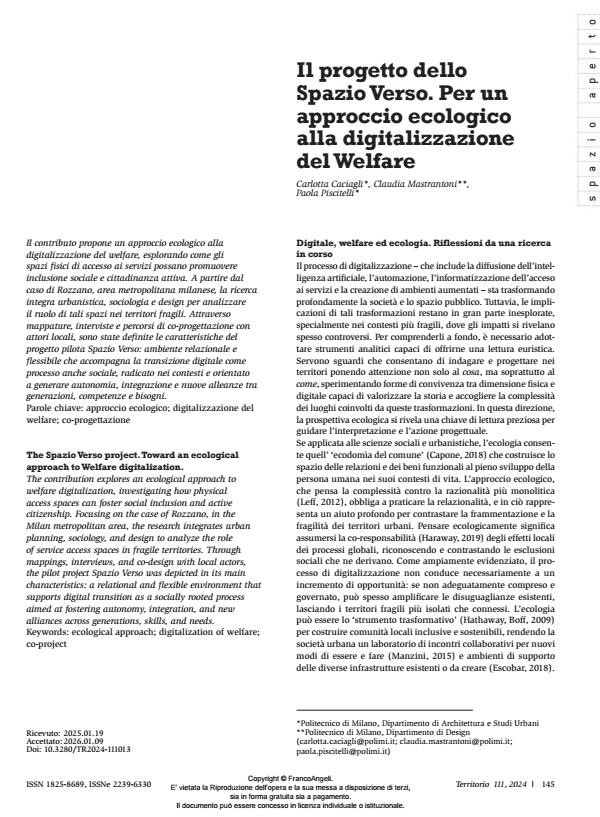
The contribution explores an ecological approach to welfare digitalization, investigating how physical access spaces can foster social inclusion and active citizenship. Focusing on the case of Rozzano, in the Milan metropolitan area, the research integrates urban planning, sociology, and design to analyze the role of service access spaces in fragile territories. Through mappings, interviews, and co-design with local actors, the pilot project Spazio Verso was depicted in its main characteristics: a relational and flexible environment that supports digital transition as a socially rooted process aimed at fostering autonomy, integration, and new alliances across generations, skills, and needs.
Keywords: ecological approach; digitalization of welfare; co-project
- Angelidou M., 2017, «The Role of Smart City Characteristics in the Plans of Fifteen Cities». Journal of Urban Technology,1-28. DOI: 10.1080/10630732.2017.1348880
- Aurigi A., Odendaal N., 2020, «From ‘Smart in the Box’ to ‘Smart in the City’: Rethinking the Socially Sustainable Smart City in Context». Journal of Urban Technology, 28,1: 1-16. DOI: 10.1080/10630732.2019.1704203
- Bazzi J., 2019, Febbre. Roma: Fandango.
- Bricocoli M., Marani B., Sabatinelli S., 2023,«Planning and designing uni-versal access to social services. A pioneering local program on welfare spaces in Italy». Environment and Planning. C, Politics and Space, 41, 4: 771-786. DOI: 10.1177/23996544231155786
- Capone N., 2018, «Ecodomia del comune». Quadranti, Rivista Internazio-nale di Filoso?a Contemporanea, 6, 2: 146-158. ISSN 2282-4219.
- Cucca R., Kazepov Y., Villa M., 2023, «Toward a Sustainable Welfare System? The Challenges and Scenarios of Eco-Social Transitions». Social Policies, 1: 3-26. DOI: 10.7389/107136
- Datta A., Odendaal N., 2019, «Smart cities and the banality of power». Environment and Planning D Society and Space, 37, 3: 387-392. DOI: 10.1177/0263775819841765
- Escobar A., 2018, Designing for the Pluriverse. Radical interdependence, Autonomy and the Making of Worlds. Durham-Londra: Duke Univer-sity Press.
- Floridi L., 2017, La quarta rivoluzione. Come l’infosfera sta trasformando il mondo. Milano: Raffello Cortina.
- Haraway D., 2019, CHTHULUCENE. Sopravvivere su un pianeta infetto. Roma: Nero.
- Hathaway M., Boff L., 2009, The Tao of Liberation: Exploring the Ecology of Transformation. Maryknoll (NY): Orbis Books.
- Hollands R., 2008, «Will the Real Smart City Please Stand Up?». City, 12, 3: 303-320. DOI: 10.1080/13604810802479126
- Kitchin R., 2014, «Making sense of smart cities: Addressing present shortcomings». Cambridge Journal of Regions Economy and Society, 8, 1: 131-136.
- Kitchin R., 2021, Data Lives. How Data Are Made and Shape Our World. Bristol: Bristol University Press.
- Latour B., 2020, La s?da di Gaia. Il nuovo regime climatico. Milano: Meltemi Editore.
- Leff E., 2012, «Political Ecology: A Latin American Perspective». Unpu-blished manuscript. Mexico City.
- Longo A., 2017, «Nativi e analfabeti digitali: il paradosso della ‘Genera-zione Google’». Scientificast: www.scientificast.it/nativi-analfabeti-dig-itali-paradosso-della-generazione-google/.
- Manzini E., 2015, Design, When Everybody Designs: An Introduction to Design for Social Innovation. Cambridge (MA): MIT Press.
- Meijer A., Bolívar M.P.R., 2016, «Governing the smart city: a review of the literature on smart urban governance». International Review of Ad-ministrative Sciences, 82, 2: 392-408.
- Bollati Boringhieri.
- OpenPolis 2019, Le mappe della povertà educativa in Lombardia, Osserva-torio povertà educativa #conibambini. www.openpolis.it/wp-content/ uploads/2021/01/Lombardia_povert%C3%A0_educativa.pdf.
- Papa E., Ferreira A., 2018, «Sustainable Accessibility and the Implemen-tation of Automated Vehicles: Identifying Critical Decisions». Urban Science, 2, 5: 1-14.
- Progetto Fondazione Milano, 2018, «Atlante socio-economico, Adda Martesana, Sud-Est, Sud-Ovest». www.fondazionecomunitamilano.org/ wp-content/uploads/2019/02/04_cariplo-def-gennaio_19.pdf.
- Rapporto Europass, 2024, «Relazione per paese sul decennio digitale 2024 dell’Italia». Commissione Europea. https://digital-strategy.ec.europa. eu/it/node/12855/printable/pdf.
- Stiegler B., 2020, Le nouveau génie urbain. Parigi: FYP éditions.
- Sabatinelli S., 2017, «Il ruolo dello spazio nell’innovazione del welfare locale». Territorio, 83: 75-80. DOI: 10.3280/TR2017-083011
- Vanolo A., 2014, «Smartmentality: The smart city as disciplinary strategy». Urban studies, 51,5: 883-898. 10.1177/0042098013494427
Carlotta Caciagli, Claudia Mastrantoni, Paola Piscitelli, Il progetto dello Spazio Verso. Per un approccio ecologico alla digitalizzazione del Welfare in "TERRITORIO" 111/2024, pp 145-153, DOI: 10.3280/TR2024-111013