Liminal subjectivities. Bears and migrants in the fabric of securitarianism
Journal title MONDI MIGRANTI
Author/s Walter Stefano Baroni, Gabriella Petti
Publishing Year 2026 Issue 2026/1
Language Italian Pages 29 P. 179-207 File size 376 KB
DOI 10.3280/MM2026-001009
DOI is like a bar code for intellectual property: to have more infomation
click here
Below, you can see the article first page
If you want to buy this article in PDF format, you can do it, following the instructions to buy download credits
FrancoAngeli is member of Publishers International Linking Association, Inc (PILA), a not-for-profit association which run the CrossRef service enabling links to and from online scholarly content.
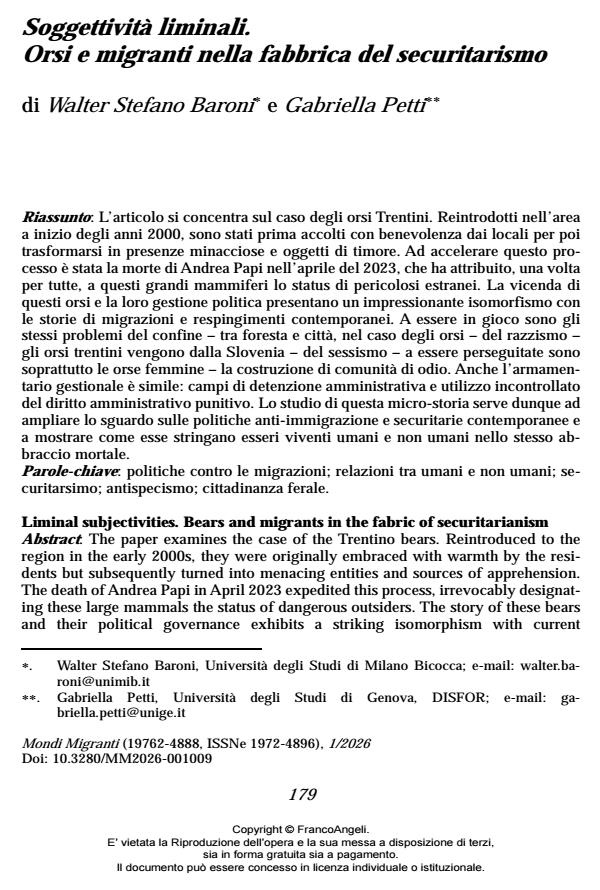
The paper examines the case of the Trentino bears. Reintroduced to the region in the early 2000s, they were originally embraced with warmth by the residents but subsequently turned into menacing entities and sources of apprehension. The death of Andrea Papi in April 2023 expedited this process, irrevocably designating these large mammals the status of dangerous outsiders. The story of these bears and their political governance exhibits a striking isomorphism with current management of migrations. At stake are the same issues of the border – between forest and city, in the case of the bears – of racism – the Trentino bears come from Slovenia – of sexism – it is mainly the female bears that are persecuted – and of the construction of communities of hate. The management mechanisms are analogous: administrative detention facilities and unregulated use of punitive administrative law. This micro-historical analysis expands the understanding of present-day anti-immigration and security policies, illustrating how they entrap both human and non-human beings in a lethal grasp.
Keywords: anti-migration policies; human-nonhuman relations; securitarism; anti-speciesism; feral citizenship.
- AA.VV. (2010). Piano d’Azione interregionale per la Conservazione dell’Orso bruno nelle Alpi centro-orientali. PACOBACE. Quaderni di conservazione della natura (Ministero dell’Ambiente e ISPRA), 33.
- Albarello F. (2020). Sono delle bestie! L'animalizzazione come strumento per svilire l’umanità altrui. Minority Reports: Cultural Disability Studies, 10, 1: 31-57.
- Anderson N. (1961). The Hobo: The Sociology of the Homeless Man. University of Chicago Press; [trad. it. Il vagabondo: sociologia dell’uomo senza dimora. Roma: Donzelli].
- Becker H. (2007). I trucchi del mestiere. Come fare ricerca sociale. Bologna: il Mulino.
- Best S. (2009). The Rise of Critical Animal Studies. Putting Theory into Action and Animal Liberation into Higher Education. Journal for Critical Animal Studies, 7, 1: 9-52
- Blattner C. (2021). Global Migration Crises, Non-human Animals, and the Role of Law. In: Khaazal N. e Almiron N., a cura di, “Like an Animal”: Critical Animal Studies Approaches to Borders, Displacement, and Othering (pp. 182-254). Leiden: Brill.
- Buzzelli S. (2020). Deumanizzazione e diritti umani: la cartina di tornasole dello ius migrandi. Minority Reports: Cultural Disability Studies, 10, 1: 197-224.
- Campesi G. (2012). Migrazioni, sicurezza, confini nella teoria sociale contemporanea. Studi sulla questione criminale, VII, 2; DOI: 10.7383/71455
- Colling S. (2020). Animals, Agency and Resistance, E-Book; trad. it Animali in rivolta: confini, resistenza e solidarietà umana. Milano: Mimesis.
- Dal Lago A. (1999). Non-persone. L’esclusione dei migranti in una società globale. Milano: Feltrinelli.
- Dal Lago A. e Quadrelli E. (2003). La città e le ombre. Milano: Feltrinelli.
- De Battaglia F. (2008). Il Parco: modello di vite possibili. Adamello Brenta Parco, 2, 7-15.
- De Mello M. (2021). Animals and Society. An Introduction to Human-Animal Studies. New York: Columbia University Press.
- Donaldson S. e Kymlicka W. (2011). Zoopolis. A Political Theory of Animal Rights. Oxford (UK): Oxford University Press.
- Dupré E., Genovesi P. e Pedrotti L. (2000). Studio di fattibilità per la reintroduzione dell’orso bruno (Ursus arctos) sulle Alpi centrali. Biologia e conservazione della fauna, 105: 1-96.
- Fico R. (2025). Animali o criminali. Il ruolo delle Scienze Forensi Veterinarie nei conflitti tra popolazioni umane e selvatiche. Liberazioni. Rivista di critica antispecista, XVI, 61: 20-29.
- Filippi M. (2021). Un quasi niente che ci ri/guarda. Aut Aut. Riflessioni sulla pandemia, 389: 13-31.
- Foucault M. (2005). Sicurezza, territorio, popolazione. Corso al Collège de France (1977-1978). Milano: Feltrinelli.
- Foucault M. (2000). Gli anormali. Corso al Collège de France (1974-1975). Milano: Feltrinelli.
- Fraser N. (2023). Capitalismo cannibale. Roma-Bari: Laterza.
- Garside N. (2013). Democratic Ideals and the Politicization of Nature, The Roving Life of a Feral Citizen. New York: Palgrave Macmillan.
- Genovesi P. e Aragno P. (2022). La gestione degli orsi confidenti in Italia: esempi, linee guida di gestione, basi legali e percezione dell’opinione pubblica. Confidenti a chi? Parliamone insieme. Atti del convegno (pp. 9-22). Pescara: Carsa edizioni.
- Glaser B. e Strauss A.L. (2009). La scoperta della grounded theory. Roma: Armando.
- Guild E. (2009). Security and Migration in the 21st Century. Cambridge: Polity Press.
- ISPAT (2025). Occupati e persone in cerca di occupazione in Trentino. 3° trimestre 2024; http://www.statistica.provincia.tn.it/binary/pat_statistica_new/mercato_lavoro/OccupatiDisoccupatiInTrentino3trim2024.1737019934.pdf/.
- Jerolmack C. (2008). How Pigeons Became Rats: The Cultural-Spatial Logic of Problem Animals. Social Problems, 55, 1: 72-94; https://doi.org/10.1525/sp.2008.55.1.72/.
- Khaazal N. e Almiron N., eds. (2021). Like an Animal. Critical Animal Studies Approaches to Borders, Displacement, and Othering, Leiden: Brill.
- Laclau E. (2005). La ragione populista. Laterza, Roma-Bari.
- Lévi-Strauss C. (1965). Introduzione all’opera di Marcel Mauss. In: Mauss M., Teoria generale della magia (pp. XV-LIV). Torino: Einaudi.
- Maroto M., González-Sánchez I. e Brandariz J.A. (2019). Editors’ Introduction: Policing the Protest Cycle of the 2010s. Social Justice, 46, 2/3, 156: 1-28.
- Masé A. (2008). Il primo orso del Parco. Adamello Brenta Parco, 2: 21.
- Mbembe A. (2003). Necropolitics. Public Culture, 15, 1: 11-40; [trad.it. Necropolitica. Verona: ombre corte, 2016].
- Mead G.H. (1986). La filosofia del presente. Napoli: Giuda.
- Mellino M.A. (2018). Governare la crisi dei rifugiati. L’emergere in Europa di una nuova ‘economia politica morale’ di gestione delle migrazioni. Mondi Migranti, 2: 193-220; DOI: 10.3280/MM2018-002010
- Mezzadra S. e Neilson B. (2013). Border as Method, or, the Multiplication of Labor. Duke University Press.
- Ostanel E. (2014). Immigrazione e giustizia spaziale. Pratiche, politiche e immaginari. Mondi Migranti, n. 1, numero monografico; DOI: 10.3280/MM2014-001003
- PAT (2008). Rapporto orso 2007.
- Pavarini M. (2006). L’amministrazione locale della paura. Ricerche tematiche sulle politiche di sicurezza urbana in Italia. Roma: Carocci.
- Pitch T. (2022). Il malintesto della vittima. Torino: GruppoAbele Edizioni.
- Pitch T. (2013). Contro il decoro. L’uso politico della pubblica decenza. Roma-Bari: Laterza.
- Pitch T. (2006). La società della prevenzione. Roma: Carocci.
- PNAB (2010). L’impegno del Parco per l’Orso: il Progetto Life Ursus. Rovereto (TN): Manfrini.
- Portes A. e Zhou M. (1993). The new second generations: segmented assimilation and its variants. Annals of American Academy of Political and Social Science, DXXX: 74-96; http://www.jstor.org/stable/1047678/.
- Reggio M. (2022). Cospirazione animale: tra azione diretta e intersezionalità. Milano: Meltemi.
- Sayad A. (1999). La doppia assenza. Dalle illusioni dell’emigrato alle sofferenze dell’immigrato. Milano: Raffaello Cortina.
- Schütz A. (2013). Lo straniero. Un saggio di psicologia sociale. Trieste: Asterios.
- Selmini R., a cura di (2004). La sicurezza urbana. Bologna: il Mulino.
- Seshadri K. (2012). HumAnimal: Race, Law, Language. University of Minnesota Press; http://www.jstor.org/stable/10.5749/j.cttttqft/.
- Sigona N. (2003). Figli del ghetto. Gli italiani nati da genitori stranieri, Roma: Laterza.
- Simmel G. (2006). Lo straniero. Roma: il Segnalibro.
- Smith A. (2006). Paddington Bear. A Case Study of Immigration and Otherness. Children’s Literature in Education, 37: 35-50;
- Stumpf J. (2006). The Crimmigration Crisis: Immigrants, Crime, and Sovereign Power. American University Law Review, 56, 2: 367-419.
- Tattoni C., Grilli G. e Ciolli M. (2016). Advertising Value of the Brown Bear in the Italian Alps. Ursus, 27, 2: 110-121; http://www.jstor.org/stable/44751849/.
- Tozzi L. (2023). L’invenzione di Milano. Culto della comunicazione e politiche urbane. Napoli: Cronopio.
- Walia H. (2013). Undoing Border Imperialism. AK Press.
- Zedrosser A., Dahle B. e Swenson E. (2001). Status and Management of the Brown Bear in Europe. Ursus, 12: 9-20; https://www.jstor.org/stable/3873224/.
Walter Stefano Baroni, Gabriella Petti, Soggettività liminali. Orsi e migranti nella fabbrica del securitarismo in "MONDI MIGRANTI" 1/2026, pp 179-207, DOI: 10.3280/MM2026-001009