Navigating Displacement Through Digital Spaces: Smartphones as Tools for Temporal Continuity and Identity Reconstruction in the Lives of Refugees
Journal title MONDI MIGRANTI
Author/s Claudia Lintner
Publishing Year 2026 Issue 2026/1
Language Italian Pages 18 P. 208-225 File size 255 KB
DOI 10.3280/MM2026-001010
DOI is like a bar code for intellectual property: to have more infomation
click here
Below, you can see the article first page
If you want to buy this article in PDF format, you can do it, following the instructions to buy download credits
FrancoAngeli is member of Publishers International Linking Association, Inc (PILA), a not-for-profit association which run the CrossRef service enabling links to and from online scholarly content.
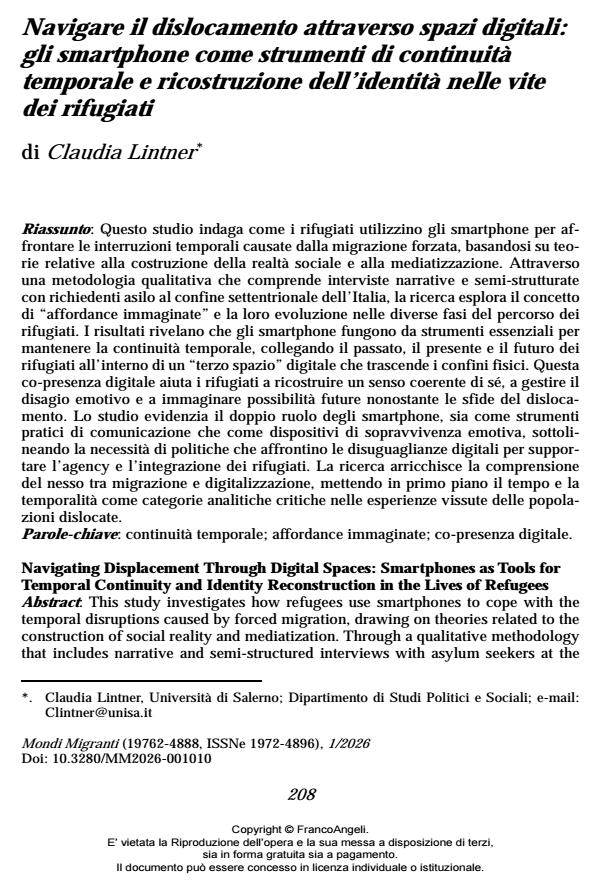
This study investigates how refugees use smartphones to cope with the temporal disruptions caused by forced migration, drawing on theories related to the construction of social reality and mediatization. Through a qualitative methodology that includes narrative and semi-structured interviews with asylum seekers at the northern border of Italy, the research explores the concept of “imagined affordances” and their evolution throughout the different stages of the refugees’ journey. The findings reveal that smartphones serve as essential tools for maintaining temporal continuity, connecting refugees’ past, present, and future within a digital “third space” that transcends physical borders. This digital co-presence helps refugees reconstruct a coherent sense of self, manage emotional distress, and envision future possibilities despite the challenges of displacement. The study highlights the dual role of smartphones as both practical communication tools and emotional survival devices, emphasizing the need for policies that address digital inequalities to support the agency and integration of refugees. The research enriches the understanding of the nexus between migration and digitalization, foregrounding time and temporality as critical analytical categories in the lived experiences of displaced populations.
Keywords: temporal continuity; imagined affordances; digital co-presence.
- Alencar A. (2018). Refugee integration and social media: A local and experiential perspective. Information, Communication & Society, 21, 11: 1588-1603; DOI: 10.1080/1369118X.2017.1340500/
- Berger P.L. e Luckmann T. (1966). The Social Construction of Reality: A Treatise in the Sociology of Knowledge. New York: Penguin Books.
- Boellstorff T. (2016). Coming of Age in Second Life: An Anthropologist Explores the Virtually Human. Princeton: Princeton University Press.
- Couldry N. e Hepp A. (2017). The Mediated Construction of Reality. Cambridge: Polity Press.
- Deuze M. (2011). Media life. Media, Culture & Society, 33, 1: 137-148; DOI: 10.1177/0163443710386518/
- Diminescu D. (2008). The connected migrant: An epistemological manifesto. Social Science Information, 47, 4: 565-579.
- Eriksen T.H. (2020). Overheating: An Anthropology of Accelerated Change. London: Pluto Press.
- Giddens A. (1984). The Constitution of Society: Outline of the Theory of Structuration. Berkeley: University of California Press.
- Gillespie M., Ampofo L., Cheesman M. e Stroppa A. (2018). Mapping refugee media journeys: Smartphones and social media networks. BBC Media Action Research Report; https://www.bbc.co.uk/mediaaction/publications-and-resources/research/reports/.
- Hillis K. (2009). Online a Lot of the Time: Ritual, Fetish, Sign. Durham: Duke University Press.
- Hine C. (2015). Ethnography for the Internet: Embedded, Embodied and Everyday. London: Bloomsbury Academic.
- Kaufmann V. (2017). Re-thinking Mobility: Contemporary Sociology. London: Routledge.
- Korac M. (2009). Remaking Home: Reconstructing Life, Place and Identity in Rome and Amsterdam. Oxford: Berghahn Books.
- Latonero M. (2015). Refugee connectivity: A survey of mobile phones, mental health, and privacy at a Syrian refugee camp in Greece. Data & Society Research Institute; https://datasociety.net/.
- Mead G.H. (1932). The Philosophy of the Present. La Salle: Open Court Publishing Company.
- Nagy P. e Neff G. (2015). Imagined affordances: Reconstructing a keyword for communication theory. Social Media + Society, 1, 2: 1-9; DOI: 10.1177/2056305115578142/
- Packer J. (2015). The Third Space and the Fourth Screen: Mediated Transcendence in Digital Networks. Thousand Oaks: Sage Publications.
- Patton M.Q. (2002). Qualitative Research and Evaluation Methods (3rd ed.). Thousand Oaks: Sage Publications.
- Riessman C.K. (2008). Narrative Methods for the Human Sciences. Thousand Oaks: Sage Publications.
- Silverman D. (2013). Doing Qualitative Research: A Practical Handbook (4th ed.). Thousand Oaks: Sage Publications.
- Strauss A. e Corbin J. (2008). Basics of Qualitative Research: Techniques and Procedures for Developing Grounded Theory (3rd ed.). Thousand Oaks: Sage Publications.
- Thrift N. (2008). Non-representational Theory: Space, Politics, Affect. London: Routledge.
- Twigt M. (2018). The mediation of refugee lives: Smartphones and social media in the context of displacement. Global Networks, 18, 4: 554-568.
- Witteborn S. (2018). Becoming (im)perceptible: Forced migrants and digital connectivity. Media, Culture & Society, 40, 4: 631-647; DOI: 10.1177/0163443717736116/.
Claudia Lintner, Navigare il dislocamento attraverso spazi digitali: gli smartphone come strumenti di continuità temporale e ricostruzione dell’identità nelle vite dei rifugiati in "MONDI MIGRANTI" 1/2026, pp 208-225, DOI: 10.3280/MM2026-001010