Vissuti LGBT+ nei servizi sanitari italiani tra micro esclusioni ed agency narrativa. Una ricerca Photovoice
Journal title SALUTE E SOCIETÀ
Author/s Pierpaola Pierucci
Publishing Year 2026 Issue 2026/2
Language Italian Pages 15 P. 145-159 File size 153 KB
DOI 10.3280/SES2026-002014
DOI is like a bar code for intellectual property: to have more infomation
click here
Below, you can see the article first page
If you want to buy this article in PDF format, you can do it, following the instructions to buy download credits
FrancoAngeli is member of Publishers International Linking Association, Inc (PILA), a not-for-profit association which run the CrossRef service enabling links to and from online scholarly content.
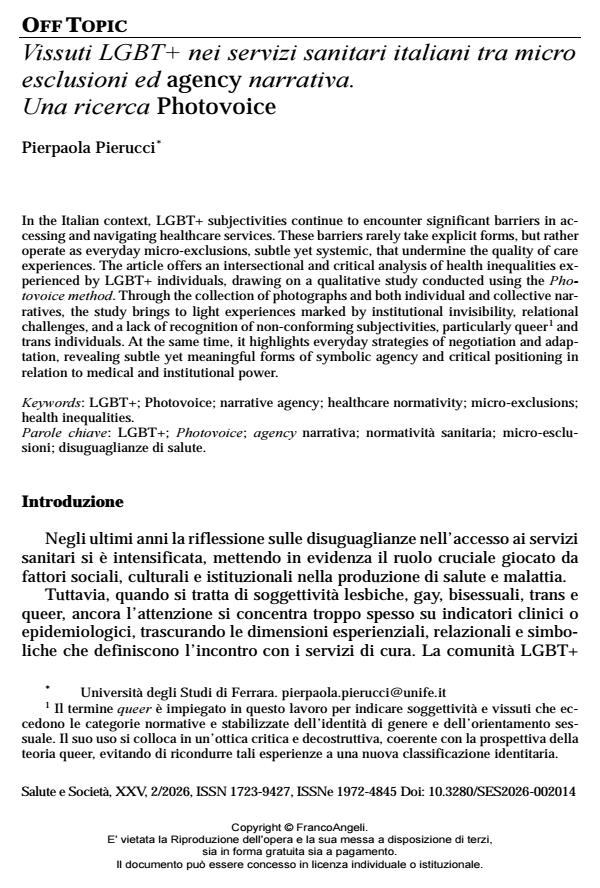
In the Italian context, LGBT+ subjectivities continue to encounter significant barriers in accessing and navigating healthcare services. These barriers rarely take explicit forms, but rather operate as everyday micro-exclusions, subtle yet systemic, that undermine the quality of care experiences. The article offers an intersectional and critical analysis of health inequalities experienced by LGBT+ individuals, drawing on a qualitative study conducted using the Photovoice method. Through the collection of photographs and both individual and collective narratives, the study brings to light experiences marked by institutional invisibility, relational challenges, and a lack of recognition of non-conforming subjectivities, particularly queer and trans individuals. At the same time, it highlights everyday strategies of negotiation and adaptation, revealing subtle yet meaningful forms of symbolic agency and critical positioning in relation to medical and institutional power.
Keywords: LGBT+; Photovoice; narrative agency; healthcare normativity; micro-exclusions; health inequalities.
- Butler J. (2004). Undoing Gender. New York and London: Routledge.
- Catalani C., Minkler M. (2010). Photovoice: A review of the literature in health and public health. Health Education & Behavior, 37(3): 424-451. DOI: 10.1177/109019810934208
- Charmaz K. (2006). Constructing Grounded Theory: A Practical Guide Through Qualitative Analysis. London: Sage.
- Crenshaw K. (1989). Demarginalizing the Intersection of Race and Sex: A Black Feminist Critique of Antidiscrimination Doctrine, Feminist Theory and Antiracist Politics. The University of Chicago Legal Forum, Article 8: 139-167.
- Deegan M.J. (1988). Jane Addams and the Men of the Chicago School, 1892-1918. New York and London: Routledge.
- Denzin N.K., Lincoln Y.S. (2018). The SAGE Handbook of Qualitative Research (5th ed.). London: Sage.
- Emirbayer M., Mische A. (1998). What Is Agency? American Journal of Sociology, 103(4): 962-1023. DOI: 10.1086/23129
- Gale N.K., Heath G., Cameron E., Rashid S., Redwood S. (2013). Using the framework method for the analysis of qualitative data in multi-disciplinary health research. BMC Medical Research Methodology, 13(1): 117. DOI: 10.1186/1471-2288-13-11
- Gubrium A., Harper K. (2013). Participatory Visual and Digital Methods. Walnut Creek: Left Coast Press.
- Haraway D. (1988). Situated knowledges: The science question in feminism and the privilege of partial perspective. Feminist Studies, 14(3): 575-599. DOI: 10.2307/317806
- Harper D. (2002). Talking about pictures: A case for photo elicitation. Visual Studies, 17(1): 13-26. DOI: 10.1080/1472586022013734
- Hill Collins P., Bilge S. (2016). Intersectionality. Malden: Polity Press.
- Knowles C., Sweetman P. (2004). Picturing the Social Landscape: Visual Methods and the Sociological Imagination. New York and London: Routledge.
- Liebenberg L. (2018). Thinking Critically about Photovoice: Achieving Empowerment and Social Change. International Journal of Qualitative Methods, 17: 1-9. DOI: 10.1177/160940691875763
- Mattingly C. (1998). Healing Dramas and Clinical Plots: The Narrative Structure of Experience. Cambridge: Cambridge University Press.
- Mattingly C. (2014). Moral Laboratories: Family Peril and the Struggle for a Good Life. Berkeley: University of California Press.
- Pauwels L. (2015). Reframing Visual Social Science: Towards a More Visual Sociology and Anthropology. Cambridge: Cambridge University Press.
- Wang C., Burris M.A. (1994). Empowerment through Photo Novella: Portraits of Participation. Health Education Quarterly, 21(2): 171-186. DOI: 10.1177/10901981940210020
- Wang C., Burris M.A. (1997). Photovoice: Concept, methodology, and use for participatory needs assessment, Health Education & Behavior, 24(3): 369-387. DOI: 10.1177/10901981970240030
- Wiles R., Coffey A., Robinson J., Prosset J. (2012). Ethical regulation and visual methods: Making visual research impossible or developing good practice? Sociological Research Online, 17(1): 1-17.
Pierpaola Pierucci, Vissuti LGBT+ nei servizi sanitari italiani tra micro esclusioni ed agency narrativa. Una ricerca Photovoice in "SALUTE E SOCIETÀ" 2/2026, pp 145-159, DOI: 10.3280/SES2026-002014