Managing Deviations between Expected and Actual Performance
Journal title QUADERNI DI ECONOMIA DEL LAVORO
Author/s Azio Barani
Publishing Year 2026 Issue 2022/116
Language Italian Pages 16 P. 39-54 File size 83 KB
DOI 10.3280/QUA2022-116003
DOI is like a bar code for intellectual property: to have more infomation
click here
Below, you can see the article first page
If you want to buy this article in PDF format, you can do it, following the instructions to buy download credits
FrancoAngeli is member of Publishers International Linking Association, Inc (PILA), a not-for-profit association which run the CrossRef service enabling links to and from online scholarly content.
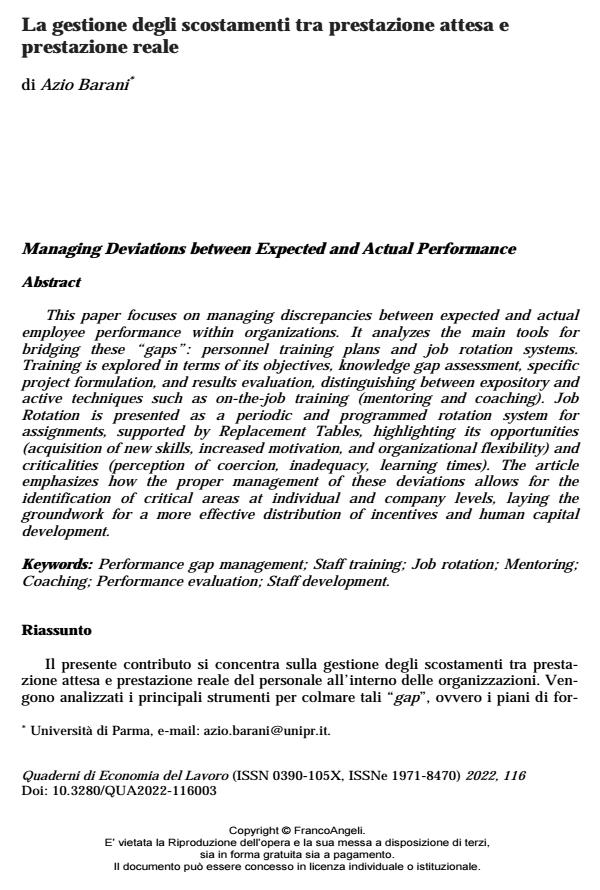
This paper focuses on managing discrepancies between expected and actual employee performance within organizations. It analyzes the main tools for bridging these “gaps”: personnel training plans and job rotation systems. Training is explored in terms of its objectives, knowledge gap assessment, specific project formulation, and results evaluation, distinguishing between expository and active techniques such as on-the-job training (mentoring and coaching). Job Rotation is presented as a periodic and programmed rotation system for assignments, supported by Replacement Tables, highlighting its opportunities (acquisition of new skills, increased motivation, and organizational flexibility) and criticalities (perception of coercion, inadequacy, learning times). The article emphasizes how the proper management of these deviations allows for the identification of critical areas at individual and company levels, laying the groundwork for a more effective distribution of incentives and human capital development.
Keywords: Performance gap management; Staff training; Job rotation; Mentoring; Coaching; Performance evaluation; Staff development.
- Aguinis H. (2019). Performance Management (4th ed.). Chicago Business Press/SAGE. Author site: -- https://hermanaguinis.com/.
- Aguinis H. e Kraiger K. (2009). Benefits of training and development for individuals and teams, organizations, and society. Annual Review of Psychology, 60: 451-474.
- Alagaraja M. (2013). Mobilizing organizational alignment through strategic human resource development. Human Resource Development International, 16(1): 74-93.
- Alagaraja M. e Egan T. (2013). The strategic value of HRD in lean strategy implementation. Human Resource Development Quarterly, 24(1): 1-27.
- Arneson J., Rothwell W. e Naughton J. (2013). Training and development competencies redefined to create competitive advantage. T&D, 67(1): 42-47.
- Boldizzoni D. e Quaratino L. (2014). Risorse umane. Logiche e strumenti per la valorizzazione del capitale umano. Bologna: il Mulino.
- Castiello D’Antonio A. (2005). Il colloquio di valutazione delle prestazioni. Milano: FrancoAngeli.
- Catino M. (2012). L’organizzazione e l’ambiente. In: Capire le organizzazioni. Bologna: il Mulino.
- Chinotti O. e Festa A. (2008). Nuovi strumenti per lo sviluppo delle persone nelle organizzazioni: La tecnica della valutazione a 360°. Milano: FrancoAngeli.
- Costa G. e Giannecchini M. (2019). Il ciclo del valore delle risorse umane. In: Risorse umane, persone, relazioni e valore. Milano: The McGraw-Hill Education (Italia).
- Crouse P., Doyle W. e Young J.D. (2011). Workplace learning strategies, barriers, facilitators and outcomes: A qualitative study among human resource management practitioners. Human Resource Development International, 14(1): 39-55.
- Dahoumane M. (2020). Analyzing the impact of performance appraisal on employee development and performance gap reduction. International Journal of Human Resource Management, 31(1): 1-20.
- De Lazzari P. (2005). L’impatto della Responsabilità Sociale d’Impresa sul Commitment Organizzativo: Il caso ENEL. Ticonzero, knowledge and ideas for emerging leaders, (58).
- De Vito Piscicelli P. (1984). Il clima organizzativo e le sue dimensioni. Psicologia e Lavoro, 2.
- DeNisi A.S. e Smith C.E. (2020). Performance appraisal, performance management, and the performance management system: The evolution of the field. Annual Review of Organizational Psychology and Organizational Behavior, 7(1): 401-421.
- Eby L.T., Allen T.D., Evans S.C., Ng T. e DuBois D.L. (2008). Does Mentoring Matter? A Multidisciplinary Meta-Analysis Comparing Mentored and Non-Mentored Individuals. Journal of Vocational Behavior, 72(3): 254-267.
- Eurofound (2019). Skills forecast: trends and challenges to 2030. Publications Office of the European Union.
- Gabrielli G. (2010). People management. Teorie e pratiche per una gestione sostenibile delle persone. Milano: FrancoAngeli.
- Gadekar D.J. (2015). Level of human resources development - Concepts and review. Acme International Journal of Multidisciplinary Research, 3(6): 48-61.
- Gallwey W.T. (1997). The inner game of tennis: The classic guide to the mental side of peak performance. Owl Books.
- Grant A.M. (2014). The efficacy of executive coaching in times of organisational change. Journal of Change Management, 14(2): 258-280.
- Hesketh A. e Laker B. (2020). Closing the skills gap: The pivotal role of learning and development in talent management. Journal of Organizational Effectiveness: People and Performance, 7(3): 295-312.
- Ifidon P., Biriowu C. e Dagogo E. (2020). Examining Succession and Replacement Planning in Work Organizations. European Journal of Business and Management Research, 5(2).
- ILO (2021). Reskilling and job transitions in the post-COVID world of work. International Labour Office.
- Johnson G., Whittington R., Scholes K., Agwin D., Régener P. e Paci A. (2019). Introduzione alla strategia. In: Fondamenti di strategia. Londra: Pearson.
- Jones R.J., Woods S.A. e Guillaume Y.R.F. (2016). The Effectiveness of Workplace Coaching: A Meta-analysis of Learning and Performance Outcomes from Coaching. Journal of Occupational and Organizational Psychology. -- PDF: https://centaur.reading.ac.uk/74522/1/Jones%20et%20al%202016_JOOP.pdf.
- Klein A. et al. (2021). More Hype Than Substance? A Meta-Analysis on Job and Task Rotation. Frontiers in Psychology.
- Kozlowski S.W.J. e Salas E., a cura di (2010). Learning, training, and development in organizations. Routledge/Taylor & Francis.
- Mariani M.G. (2011). Valutare le prestazioni: Come gestire e migliorare la performance lavorativa. Bologna: il Mulino.
- McLagan P.A. (1989). Models for HRD practice. Training & Development Journal, 41(9): 49-59.
- Mintzberg H. (1996). La progettazione dell’organizzazione aziendale. Bologna: il Mulino.
- Morris J.R. (1956). Job Rotation. The Journal of Business, 29(4): 263-268.
- Muzzarelli F. (2014). Guidare l’apprendimento. Metodologie e tecniche di formazione in azienda. Milano: FrancoAngeli.
- OECD (2019). OECD Skills Outlook 2019: Thriving in a Digital World. OECD Publishing. -- Link: https://www.oecd.org/en/publications/oecd-skills-outlook-2019_df80bc12-en.htm.
- OECD (2020). Adult Learning and COVID-19: How much informal and non-formal learning are workers missing? OECD Policy Responses to Coronavirus.
- Robbins S.P., Judge T.A. e Bodega D. (2016). Comportamento organizzativo. Conoscere e sviluppare competenze organizzative. Milano-Torino: Pearson Italia.
- Salas E., Tannenbaum S.I., Kraiger K. e Smith-Jentsch K.A. (2012). The Science of Training and Development in Organizations: What Matters in Practice. Psychological Science in the Public Interest, 13(2): 74-101. DOI: 10.1177/1529100612436661
- Sarchielli G. e Fraccaroli F. (2010). Introduzione alla psicologia del lavoro. Bologna: il Mulino.
- Schleicher D.J., Bull R.E. e Green M. (2021). The role of feedback in performance management systems: A review and research agenda. Journal of Management, 47(1): 163-195. Thousand Oaks, CA: Sage Publications.
- Short D.C. e Bing J.W., a cura di (2003). Shaping the future of human resource development. Advances in Developing Human Resources, 5(3): 242-351.
- Silvi R. (2007). Il controllo strategico nella gestione dell’impresa. In: Lipparini A., a cura di, Economia e gestione delle imprese. Bologna: il Mulino.
- Theeboom T., Beersma B. e van Vianen A.E. (2014). Does coaching work? A meta-analysis on the effects of coaching on individual level outcomes. The Journal of Positive Psychology. DOI: 10.1080/17439760.2013.837499
- Tomaževic N. e Vintar M. (2020). Reducing performance gaps in public sector organizations: The role of strategic management practices. International Journal of Public Sector Management, 33(2/3): 241-260.
- UNI EN ISO 9001:2015. (2015). Sistemi di gestione per la qualità - Requisiti. Ente Italiano di Normazione.
- Wexley K.N. e Latham G.P. (2002). Developing and training human resources in organizations (3rd ed.). Pearson/Prentice Hall.
- World Bank (2022). Public Sector Performance: Towards a New Agenda. World Bank Report.
- Yawson R.M. (2013). Systems theory and thinking as a foundational theory in human resource development - A myth or reality?. Human Resource Development Review, 12(1): 53-85.
- Yorks L. (2005). Strategic human resource development. Thomson/South-Western.
- Yorks L. e Barto J. (2013). Invited reaction: The strategic value of HRD in lean strategy implementation. Human Resource Development Quarterly, 24(1): 29-33.
Azio Barani, La gestione degli scostamenti tra prestazione attesa e prestazione reale in "QUADERNI DI ECONOMIA DEL LAVORO" 116/2022, pp 39-54, DOI: 10.3280/QUA2022-116003