From Freehold to Social Function: Revisiting Bromley’s Rousseau’s Revenge in the Indian Context

Journal title HISTORY OF ECONOMIC THOUGHT AND POLICY
Author/s Sattwick Dey Biswas
Publishing Year 2026 Issue 2026/1
Language English Pages 33 P. 5-27 File size 290 KB
DOI 10.3280/SPE2026-001001
DOI is like a bar code for intellectual property: to have more infomation click here

Below, you can see the article first page

If you want to buy this article in PDF format, you can do it, following the instructions to buy download credits
Article preview

FrancoAngeli is member of Publishers International Linking Association, Inc (PILA), a not-for-profit association which run the CrossRef service enabling links to and from online scholarly content.

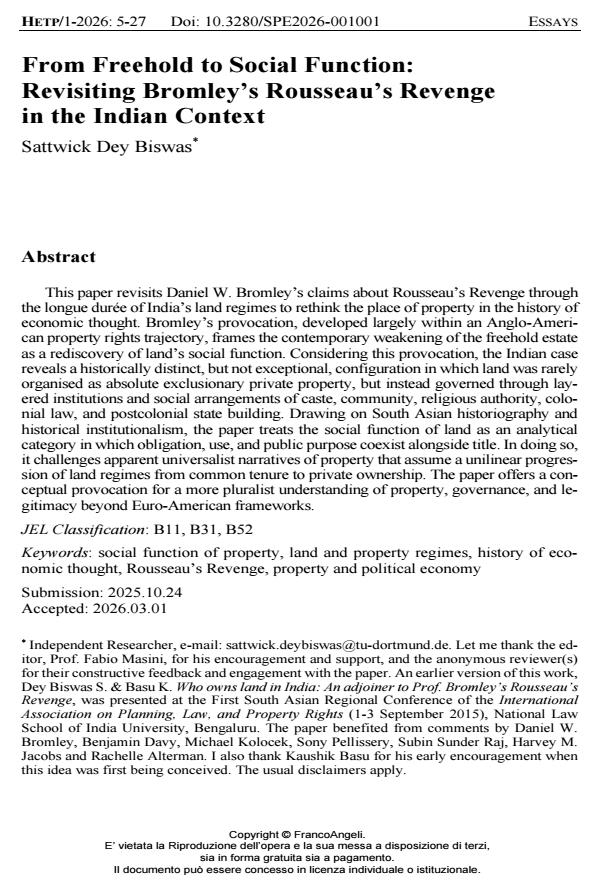
This paper revisits Daniel W. Bromley’s claims about Rousseau’s Revenge through the longue durée of India’s land regimes to rethink the place of property in the history of economic thought. Bromley’s provocation, developed largely within an Anglo-Ameri-can property rights trajectory, frames the contemporary weakening of the freehold estate as a rediscovery of land’s social function. Considering this provocation, the Indian case reveals a historically distinct, but not exceptional, configuration in which land was rarely organised as absolute exclusionary private property, but instead governed through lay-ered institutions and social arrangements of caste, community, religious authority, colo-nial law, and postcolonial state building. Drawing on South Asian historiography and historical institutionalism, the paper treats the social function of land as an analytical category in which obligation, use, and public purpose coexist alongside title. In doing so, it challenges apparent universalist narratives of property that assume a unilinear progres-sion of land regimes from common tenure to private ownership. The paper offers a con-ceptual provocation for a more pluralist understanding of property, governance, and le-gitimacy beyond Euro-American frameworks.

Keywords: social function of property, land and property regimes, history of eco-nomic thought, Rousseau’s Revenge, property and political economy

Jel codes: B11, B31, B52

  1. Abbasi M.Z. 2012. The classical Islamic law of waqf: a concise introduction. Arab Law Quarterly, 26(2), 121153.
  2. Appu P.S. 1996. Land reforms in India: a survey of policy, legislation and implementation. New Delhi, Vikas Publishing House.
  3. Ballantyne T. 2001. Archive, discipline, state: power and knowledge in South Asian historiography. New Zealand Journal of Asian Studies, 3, 87105.
  4. Bandyopadhyay S. 2004. From Plassey to Partition: a history of modern India. New Delhi, Orient Longman.
  5. Banner S. 2005. How the Indians lost their land: law and power on the frontier. Cambridge (MA), Harvard University Press.
  6. Benton L.A. 2021. They called it peace: worlds of imperial violence. Princeton (NJ), Princeton University Press.
  7. Bhandar B. 2018. Colonial lives of property: law, land, and racial regimes of ownership. Durham (NC), Duke University Press.
  8. Bhattacharya N. 2019. The great agrarian conquest: the colonial reshaping of a rural world. Albany (NY), SUNY Press.
  9. BinswangerMkhize H.P., Bourguignon C. and van den Brink R. 2009. Agricultural land redistribution: toward greater consensus. Washington (DC), World Bank Publications.
  10. Chakrabarty D. 2000. Provincializing Europe: postcolonial thought and historical difference. Princeton (NJ), Princeton University Press.
  11. Chakravorty S. 2013. The price of land: acquisition, conflict, consequence. Oxford, Oxford University Press.
  12. Chakravorty S., Chandrasekhar S. and Naraparaju K. 2019. Land distribution, income generation and inequality in India’s agricultural sector. Review of Income and Wealth, 65(S1), S182S207.
  13. Chatterjee M. 2025. Rural land markets and accumulation in an agrarian periphery: a classrelational approach to rentierism in India. Journal of Agrarian Change, xx(x), e70001.
  14. Comte A. 1858. The positive philosophy of Auguste Comte. London, G. Bell & Sons. Cowell E.B. and Thomas F.W. 1968. Harshacharita of Banabhatta. Delhi, Motilal Banarsidass.
  15. D’Costa A.P. and Chakraborty A. (eds.) 2017. The land question in India: state, dispossession, and capitalist transition. Oxford, Oxford University Press.
  16. Deininger K. and Nagarajan H. 2007. Land policies and land reforms in India: progress and implications for the future. Washington (DC), World Bank.
  17. Deshpande S. 2010. The problem of caste. New Delhi, Orient BlackSwan.
  18. Dey Biswas S. 2014. Land rights formalization in India: examining de Soto through the lens of Rawls’ theory of justice. FLOOR Working Paper 18, TU Dortmund University, Dortmund.
  19. Dutt D. 2025. No development (economics or studies) without decolonisation. The European Journal of Development Research, 37, 110.
  20. Dutt D., Alves C., Kesar S. and Kvangraven I.H. 2024. Decolonizing economics: an introduction. Cambridge, Polity Press.
  21. FirminSellers K. 2000. Custom, capitalism, and the state: the origins of insecure land tenure in West Africa. Journal of Institutional and Theoretical Economics, 156, 513530.
  22. Government of India 2005. Report of the Committee on State Agrarian Relations and the Unfinished Task in Land Reforms. New Delhi, Ministry of Rural Development.
  23. Graeber D. and Wengrow D. 2021. The dawn of everything: a new history of humanity. London, Allen Lane.
  24. Grosfoguel R. 2007. The epistemic decolonial turn: beyond politicaleconomy paradigms. Cultural Studies, 21(23), 211223.
  25. Guha R. 1982. A rule of property for Bengal: an essay on the idea of Permanent Settlement. New Delhi, Orient Longman.
  26. Guha R. 1983. Forestry in British and postBritish India: a historical analysis. Economic and Political Weekly, 18(44), 18821896.
  27. Gupta A. 2002. Women’s ownership of land in West Bengal: lessons from land reform and postreform period. Economic and Political Weekly, 37(17), 16301636.
  28. Habib I. 2002. The Indus Valley Civilization. New Delhi, Tulika Books.
  29. Habib I. 2015. Essays in Indian history: towards a Marxist perception. New Delhi, Tulika Books.
  30. Hanstad T. 2005. Designing land records systems for the poor. In Prosterman R., Mitchell R. and Hanstad T. (eds.), One billion rising: law, land and the alleviation of global poverty, Leiden, Leiden University Press, 2759.
  31. Jonnalagadda I., Stock R. and Misquitta K. 2021. Titling as a contested process: conditional land rights and subaltern citizenship in South India. International Journal of Urban and Regional Research, 45(3), 458476.
  32. Kosambi D.D. 1963. Combined methods in Indology. IndoIranian Journal, 6(34), 177202.
  33. Kosambi D.D. 2005. An introduction to the study of Indian history. Mumbai, Popular Prakashan (original work published 1956).
  34. Kosambi D.D. 2007. The culture and civilization of ancient India in historical outline. New Delhi, Vikas Publishing House.
  35. Kumar K.K. and Moharaj P. 2023. Land and asset inequality among social groups.
  36. Social Change, 53(1), 5174.
  37. Kvangraven I.H. and Kesar S. 2023. Standing in the way of rigor? Economics’ meeting with the decolonization agenda. Review of International Political Economy, 30(5), 17231748.
  38. Liangqun L. and Murphy R. 2006. Lineage networks, land conflicts and rural migration in late socialist China. The Journal of Peasant Studies, 33(4), 612645.
  39. Macpherson C.B. 1962. The political theory of possessive individualism: Hobbes to Locke. Oxford, Oxford University Press.
  40. Mantz F. 2019. Decolonizing the IPE syllabus: Eurocentrism and the coloniality of knowledge in international political economy. Review of International Political Economy, 26(6), 13611378.
  41. Mishra P. and Suhag R. 2017. Land records and titles in India. Ideas for India, accessed 2 October 2025.
  42. Moewaka Barnes H., Eich E. and Yessilth S. 2018. Colonization, whenua and capitalism: experiences from Aotearoa New Zealand. Continuum, 32(6), 685697.
  43. Needham B., Buitelaar E. and Hartmann T. 2018. Planning, law and economics: the rules we make for using land. 2nd edn. Abingdon, Routledge.
  44. Needham B. 2006. Planning, law and economics: the rules we make for using land. London and New York, Routledge.
  45. Nielsen K.B. and Oskarsson P. (eds.) 2016. Industrialising rural India: land, policy and resistance. London and New York, Routledge.
  46. Olivelle P. 2016. King, governance, and law in ancient India: Kautilya’s Arthasastra. New York, Oxford University Press.
  47. Pankaj A.K. 2016. Land, labour and market: exclusion of Dalits in Uttar Pradesh.
  48. Contemporary Voice of Dalit, 8(2), 196205.
  49. Pellissery S. and Dey Biswas S. 2012. Emerging property regimes in India: what it holds for the future of socioeconomic rights. IRMA Working Paper 234, Anand,
  50. Pellissery S., Dey Biswas S., Panickar V. and Priyadarshini S. 2022. Social function of property (SFP) in India: is credibility of property in informal settlements emerging?. Occasional Paper 14/2022, Institute of Public Policy, National Law School of India University, Bangalore.
  51. Pellissery S., Davy B. and Jacobs H.M. (eds.) 2017. Land policies in India: promises, practices and challenges. Cham, Springer.
  52. Ramesh P. 2023. Illegibly legible: outcomes of a land records modernisation programme in South India. Journal of Agrarian Change, 23(4), 684703.
  53. Singh H. 2014. Recasting caste: from the sacred to the profane. New Delhi, Sage. Sinha N.K. 1962. The economic history of Bengal: from Plassey to the Permanent
  54. Settlement. Vol. II. Calcutta, Firma K.L. Mukhopadhyay.
  55. Sircar D.C. 1996. Studies in the political and administrative systems in ancient and medieval India. Vol. 11. Delhi, Motilal Banarsidass.
  56. Swamy A.V. 2011. Land and law in colonial India. In: Ma D. and van Zanden J.L. (eds.), Longterm economic change in Eurasian perspective. Stanford, Stanford University Press, 138157.
  57. Trautmann T.R. 1971. Kau?ilya and the Arthasastra: a statistical investigation of the
  58. authorship and evolution of the text. Leiden, Brill.
  59. Trivedi P.K. 2022. Reinforcing exclusions: caste, patriarchy and land reforms in India. Journal of Land and Rural Studies, 10(2), 262277.
  60. Yadu C.R. and Vijayasuryan C.K. 2016. Triple exclusion of Dalits in land ownership in Kerala. Social Change, 46(3), 393408.

Sattwick Dey Biswas, From Freehold to Social Function: Revisiting Bromley’s Rousseau’s Revenge in the Indian Context in "HISTORY OF ECONOMIC THOUGHT AND POLICY" 1/2026, pp 5-27, DOI: 10.3280/SPE2026-001001