Intersubjectivity and Otherness in the Clinical Encounter
Journal title RIVISTA SPERIMENTALE DI FRENIATRIA
Author/s Marcella Bellani, Amedeo Serino, David Ricciardolo, Cinzia Perlini
Publishing Year 2026 Issue 2026/2
Language Italian Pages 13 P. 85-97 File size 227 KB
DOI 10.3280/RSF2026-002006
DOI is like a bar code for intellectual property: to have more infomation
click here
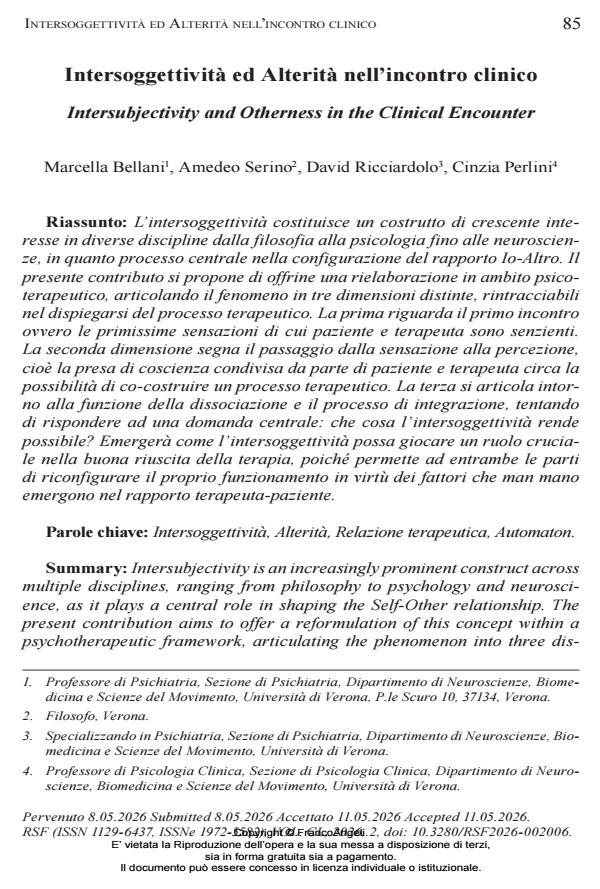
Below, you can see the article first page
If you want to buy this article in PDF format, you can do it, following the instructions to buy download credits
FrancoAngeli is member of Publishers International Linking Association, Inc (PILA), a not-for-profit association which run the CrossRef service enabling links to and from online scholarly content.
Intersubjectivity is an increasingly prominent construct across multiple disciplines, ranging from philosophy to psychology and neuroscience, as it plays a central role in shaping the SelfOther relationship. The present contribution aims to offer a reformulation of this concept within a psychotherapeutic framework, articulating the phenomenon into three distinct dimensions that can be traced throughout the unfolding of the therapeutic process. The first concerns the initial encounter, the very first sensations experienced by both patient and therapist. The second dimension marks the transition from sensation to perception, namely the shared awareness, on the part of both patient and therapist, of the possibility of coconstructing a therapeutic process. The third revolves around the function of dissociation and the process of integration, through which an attempt is made to answer, from a phenomenological perspective, to a central question: what can intersubjectivity do? Intersubjectivity can play a crucial role in the success of therapy, as it enables both parties to reconfigure their own functioning in light of the factors that gradually arise within the therapistpatient relationship.
Keywords: Intersubjectivity, Otherness, Therapeutic Relationship, Automaton
- [1.] Bion WR. Apprendere dall’esperienza. Roma: Armando Editore; 2009. [2.] Callieri B. La prospettiva fenomenologica come possibile presupposto all’incontro psicoterapeutico. Formazione in Psicoterapia Counselling Fenomenologia 2013; 1: 611.
- [3.] Pelgreffi I. Voce: singolarità e struttura tra Barthes, Artaud e Derrida. Voce ipnosi immagine 2018; 3: 1932.
- [4.] Porges SW, Furman SA. The early development of the autonomic nervous system provides a neural platform for social behaviour: a polyvagal perspective. Infant and Child Development 20(1): 10618.
- [5.] Bromberg PM. Truth, human relatedness, and the analytic process: an interpersonal/relational perspective. The International Journal of Psychoanalysis 2009; 90(2): 34761.
- [6.] Callieri B. Il piano interpersonale. Comprendre. Archive International pour l’Anthropologie et la Psychopathologie Phénoménologiques 2013; 1: 28.
- [7.] Tuppini T. Vortici. Forme dell’esperienza. Napoli: Orthotes; 2020. p. 46. [8.] Bion WR. Trasformazioni. Il passaggio dall’apprendimento alla crescita. Roma: Astrolabio; 2024.
- [9.] Mortari L. Fenomenologia empirica. Genova: Il Melangolo; 2022.
- [10.] Bion WR. Attenzione e interpretazione. Una prospettiva scientifica sulla psicanalisi e sui gruppi. Roma: Armando; 1982.
- [11.] McDougall J. Teatri del corpo. Un approccio psicoanalitico ai disturbi psicosomatici. Milano: Raffaello Cortina Editore; 1990.
- [12.] Bonazzi M. La sedia, il divano, lo sgabello. In: Leoni F, Rufo P, ed. Divano. Il dispositivo della psicoanalisi. Napoli: Orthotes; 2020.
- [13.] MerleauPonty M. Fenomenologia della percezione. Milano: Bompiani; 2003.
- [14.] Barthes R. L’ovvio e l’ottuso. Torino: Einaudi;1985.
- [15.] Pelgreffi I. Filosofia dell’automatismo. NapoliSalerno: Orthotes; 2018. [16.] Porges S. Sicurezza polivagale. Attaccamento, comunicazione, autore golazione. Roma: Fioriti; 2023.
- [17.] Bromberg PM. Destare il sognatore. Percorsi clinici. Milano: Raffaello Cortina; 2009.
- [18.] Fosha D, Siegel DJ, Solomon MF, ed. The Healing Power of Emotion. Affective Neuroscience, Development and Clinical Practice. New York: W.W. Norton & Company; 2011.
- [19.] Siegel DJ. Mappe per la mente. Guida alla neurobiologia interpersonale. Milano: Raffaello Cortina; 2014.
- [20.] Harris A. Gender as Soft Assembly. Hillsdale, NJ: The Analytic Press; 2005.
- Editorial: The interaction between self and other in the clinical setting: the role of inter-subjectivity, volume I Cinzia Perlini, Angelo Picardi, Alessandro Vinciarelli, Marcella Bellani, in Frontiers in Psychology 1920628/2026
DOI: 10.3389/fpsyg.2026.1920628
Marcella Bellani, Amedeo Serino, David Ricciardolo, Cinzia Perlini, Intersoggettività ed Alterità nell’incontro clinico in "RIVISTA SPERIMENTALE DI FRENIATRIA" 2/2026, pp 85-97, DOI: 10.3280/RSF2026-002006