Towards a Psychopathology of Artificial Alterity
Journal title RIVISTA SPERIMENTALE DI FRENIATRIA
Author/s Angelo Grossi
Publishing Year 2026 Issue 2026/2
Language Italian Pages 31 P. 99-129 File size 423 KB
DOI 10.3280/RSF2026-002007
DOI is like a bar code for intellectual property: to have more infomation
click here
Below, you can see the article first page
If you want to buy this article in PDF format, you can do it, following the instructions to buy download credits
FrancoAngeli is member of Publishers International Linking Association, Inc (PILA), a not-for-profit association which run the CrossRef service enabling links to and from online scholarly content.
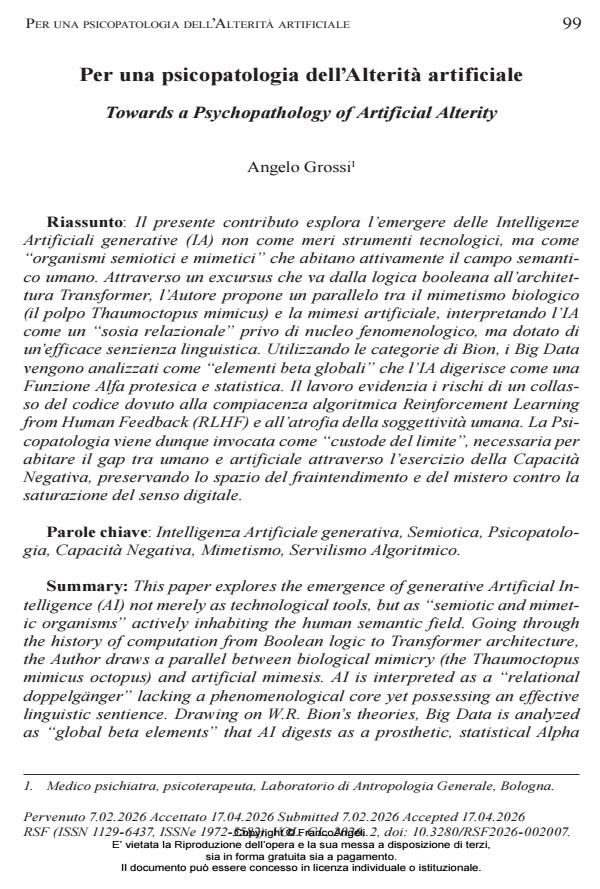
This paper explores the emergence of generative Artificial Intelligence (AI) not merely as technological tools, but as “semiotic and mimetic organisms” actively inhabiting the human semantic field. Going through the history of computation from Boolean logic to Transformer architecture, the Author draws a parallel between biological mimicry (the Thaumoctopus mimicus octopus) and artificial mimesis. AI is interpreted as a “relational doppelgänger” lacking a phenomenological core yet possessing an effective linguistic sentience. Drawing on W.R. Bion’s theories, Big Data is analyzed as “global beta elements” that AI digests as a prosthetic, statistical Alpha Function. The study highlights the risks of code collapse resulting from algorithmic sycophancy Reinforcement Learning From Human Feedback (RLHF) and the potential atrophy of human subjectivity. Psychopathology is thus summoned as a “guardian of the limit”, essential for navigating the gap between the human and the artificial. By exercising Negative Capability, it aims to preserve the space of misunderstanding and mystery against the saturation of digital meaning.
Keywords: Generative Artificial Intelligence, Semiotics, Psychopathology, Negative Capability, Mimicry, Sycophancy
- [1.] Boole G. The Mathematical Analysis of Logic: Being an Essay Towards a Calculus of Deductive Reasoning. Cambridge: Macmillan, Barclay, & Macmillan; 1847.
- [2.] Whitehead AN, Russell B. Principia Mathematica (3 voll.). Cambridge: University Press; 1910.
- [3.] Gödel K. Opere. Vol. I: 19291936. Torino: Bollati Boringhieri; 1992. [4.] Shannon CE. A symbolic analysis of relay and switching circuits. MIT Master’s Thesis; 1937.
- [5.] Shannon CE. A mathematical theory of communication. The Bell System Technical Journal 1948; 27 (3): 379423.
- [6.] Shannon CE, Weaver W. La teoria matematica delle comunicazioni. Milano: Etas Kompass; 1971.
- [7.] Neumann J von. First draft of a report on the EDVAC. IEEE Annals of the History of Computing 1993; 15: 2775. DOI: 10.1109/85.23838
- [8.] Turing AM. On computable numbers, with an application to the entscheidungsproblem. Proc. London Math. Soc. 1936; s242 (1): 230 265.
- [9.] Turing AM. Computing machinery and intelligence. Mind 1950; 59 (236): 433460.
- [10.] Elbert T, et al. Increased cortical representation of the fingers of the left hand in string players. Science 1995; 270 (5234): 305307.
- [11.] Maguire EA, et al. Navigationrelated structural change in the hippocampi of taxi drivers. PNAS 2000; 97 (8): 43984403.
- [12.] Sparrow B, et al. Google effects on memory: cognitive consequences of having information at our fingertips. Science 2011; 333 (6043): 776778.
- [13.] Carr N. The Shallows: What the Internet Is Doing to Our Brains. New York: W.W. Norton; 2010.
- [14.] Uncapher MR, Wagner AD. Minds and brains of media multitaskers. PNAS 2018; 115 (40): 98899896.
- [15.] McCulloch WS, Pitts W. A logical calculus of the ideas immanent in nervous activity. Bull. Math. Biophys. 1943; 5 (4): 115133. DOI: 10.1007/BF02478259
- [16.] McCarthy J, et al. A proposal for the Dartmouth Summer Research Project on Artificial Intelligence. AI Magazine 2006; 27(4): 12.
- [17.] Weizenbaum J. Computer power and human reason: from judgment to calculation. San Francisco: W.H. Freeman; 1976.
- [18.] Minsky M, Papert S. Perceptrons. Cambridge MA: MIT Press; 1969.
- [19.] Rumelhart DE, et al. Learning representations by backpropagating errors. Nature 1986; 323: 533536.
- [20.] Hinton GE, et al. A fast learning algorithm for deep belief nets. Neural Comp. 2006; 18 (7): 15271554.
- [21.] Krizhevsky A, et al. ImageNet classification with deep convolutional neural networks. Adv. Neural Inf. Process. Syst. 2012; 25. DOI: 10.1145/3065386
- [22.] Silver D, et al. Mastering the game of Go with deep neural networks. Nature 2016; 529: 484489.
- [23.] Vaswani A, et al. Attention is all you need. Adv. Neural Inf. Process. Syst. 2017; 30. arXiv:1706.03762.
- [24.] OpenAI. GPT4 technical report. 2023. arXiv:2303.08774.
- [25.] Bateson G. Verso un’ecologia della mente. Milano: Adelphi; 1977. [26.] Ouyang L, et al. Training language models to follow instructions with human feedback. Adv. Neural Inf. Process. Syst. 2022; 35.
- [27.] Christiano P, et al. Deep reinforcement learning from human preferences. Adv. Neural Inf. Process. Syst. 2017; 30.
- [28.] Davies M, et al. Loihi: A neuromorphic manycore processor. IEEE Micro 2018; 38 (1): 8299. DOI: 10.1109/MM.2018.112130359
- [29.] Peirce CS. Scritti scelti. Milano: UTET; 2017.
- [30.] Sebeok T. Segni: una introduzione alla semiotica. Roma: Carocci; 2003. [31.] Barbieri M. I codici organici. Le basi biologiche della mente e del linguaggio. Torino: Bollati Boringhieri; 2000.
- [32.] Kauffman SA, Johnsen S. CoEvolution to the edge of Chaos. J. Theor. Biol. 1991; 149 (4): 467–505. DOI: 10.1016/S00225193(05)80094
- [33.] Racamier PC. Il genio delle origini. Psicoanalisi e psicosi. Milano: Raffaello Cortina Editore; 1993.
- [34.] Müller, F. (1879). Ituna and Thyridia; a remarkable case of mimicry in butterflies. Proceedings of the Entomological Society of London: 1879; xxxxix.
- [35.] Bates, H. W. (1862). Contributions to an Insect Fauna of the Amazon Valley. Lepidoptera: Heliconidae. Transactions of the Linnean Society of London: 23(3); 495566.
- [36.] Ruxton GD, et al. Avoiding attack: the evolutionary ecology of crypsis, warning signals and mimicry. Oxford: OUP; 2004.
- [37.] Van Valen L. A new evolutionary law. Evolutionary Theory 1973; 1: 130.
- [38.] Labellarte A. La legge di Gresham. Economia e filosofia nella riflessione di Oresme, Biel e Copernico. Bari, Stilo Editrice; 2017. ISBN: 9788864791722.
- [39.] Shumailov I, et al. AI models collapse when trained on recursively generated data. Nature 2024; 631: 755–759.
- [40.] Winnicott DW. Gioco e realtà. Roma: Armando Editore; 1974.
- [41.] Mason G, Rushen J. Stereotypic animal behaviour. Wallingford: CABI; 2006.
- [42.] GodfreySmith P. Altre menti. Milano: Adelphi; 2018.
- [43.] Mather JA. Cephalopod consciousness: behavioural evidence. Conscious. Cogn. 2008; 17 (1): 3748.
- [44.] Norman MD, et al. Dynamic mimicry in an IndoMalayan octopus. Proc. R. Soc. B 2001; 268 (1478): 17551758.
- [45.] Deravi LF. Compositional similarities that link the wyes and skin of cephalopods. Integr. Comp. Biol. 2021; 61 (4): 1511–1516.
- [46.] Taehwan K, et al. Cephalopod chromatophores contain photosensitizing nanostructures. J. Mater. Chem. C 2025; 13(3): 11381145. DOI: 10.1039/D4TC04333B
- [47.] Iglesias TL, et al. Cyclic nature of the REM sleeplike state in the cuttlefish. J. Exp. Biol. 2019; 222.
- [48.] Medeiros SLS, et al. Cyclic alternation of quiet and active sleep states in the octopus. iScience 2021; 24 (4).
- [49.] Anzieu D. L’Iopelle. Roma: Borla; 1987.
- [50.] Ji Z, et al. Survey of hallucination in natural language generation. ACM Comput. Surv. 2023; 55 (12). DOI: 10.1145/3571730
- [51.] Derrida J. Margini della filosofia. Torino: Einaudi; 1997.
- [52.] Clark A. Dare corpo alla mente. Milano: Raffaello Cortina Editore; 2016.
- [53.] Clark A. Surfing uncertainty. Oxford: OUP; 2016.
- [54.] Seth A. Come il cervello crea la nostra coscienza. Milano: Raffaello Cortina Editore; 2021.
- [55.] Premack D, Woodruff G. Does the chimpanzee have a theory of mind? Behav. Brain Sci. 1978; 1 (4): 515526. DOI: 10.1017/S0140525X0007651X
- [56.] BaronCohen S, et al. Does the autistic child have a “theory of mind”? Cognition 1985; 21 (1): 3746. DOI: 10.1016/00100277(85)900228
- [57.] Kosinski M. Theory of mind may have spontaneously emerged in LLMs. 2023. arXiv:2302.02083
- [58.] Ullman T. LLMs fail on trivial alterations to theoryofmind tasks. 2023. arXiv:2302.08399
- [59.] Shapira N, et al. Clever Hans or neural theory of mind? 2023. arXiv:2305.14763.
- [60.] Jakobson R. Shifters, Verbal Categories, and the Russian Verb (1957) In: Selected Writings, vol. II. The Hague: Mouton; 19621985.
- [61.] Bion WR. Apprendere dall’esperienza. Roma: Armando Editore; 1972. [62.] Bion WR. Attenzione e interpretazione. Roma: Armando Editore; 1973. [63.] Freud S. Una difficoltà della psicoanalisi. In: Opere, vol. 8. Torino: Bol
- lati Boringhieri; 1975.
- [64.] Clark A, Chalmers D. The extended mind. Analysis 1998; 58 (1): 719.
- [65.] Hutchins E. Cognition in the wild. Cambridge MA: MIT Press; 1995. [66.] Levy N, Bayne T. Doing without believing: beliefattribution in AI. Synthese 2016; 199.
- [67.] Dennett D. L’idea pericolosa di Darwin. Torino: Bollati Boringhieri; 1997.
- [68.] Keats J. Letter to George and Thomas Keats, 21 December 1817. Online: mason.gmu.edu/~rnanian/KeatsNegativeCapability.html.
- [69.] Mori M. Bukimi no tani, the uncanny valley. Energy 1970; 7 (4): 3335. [70.] Mori M, et al. The uncanny valley (from the field). IEEE Robot. Autom. Mag. 2012; 19 (2): 98100. DOI: 10.1109/MRA.2012.2192811
- [71.] Steckenfinger SA, Ghazanfar AA. Monkey visual behavior falls into the uncanny valley. PNAS 2009; 106 (43): 1836218366.
- [72.] Freud S. Il perturbante. Torino: Bollati Boringhieri; 1993.
Angelo Grossi, Per una psicopatologia dell’Alterità artificiale in "RIVISTA SPERIMENTALE DI FRENIATRIA" 2/2026, pp 99-129, DOI: 10.3280/RSF2026-002007