We are protecting your health: Accounting for biopower during the Spanish Flu in the town of Monza
Journal title CONTABILITÀ E CULTURA AZIENDALE
Author/s Andrea Fontanella, Alessandro Paolo Rigamonti, Maria Rita Pierotti, Francesco Bianchi
Publishing Year 2026 Issue 2025/2
Language English Pages 26 P. 35-70 File size 302 KB
DOI 10.3280/CCA2025-002003
DOI is like a bar code for intellectual property: to have more infomation
click here
Below, you can see the article first page
If you want to buy this article in PDF format, you can do it, following the instructions to buy download credits
FrancoAngeli is member of Publishers International Linking Association, Inc (PILA), a not-for-profit association which run the CrossRef service enabling links to and from online scholarly content.
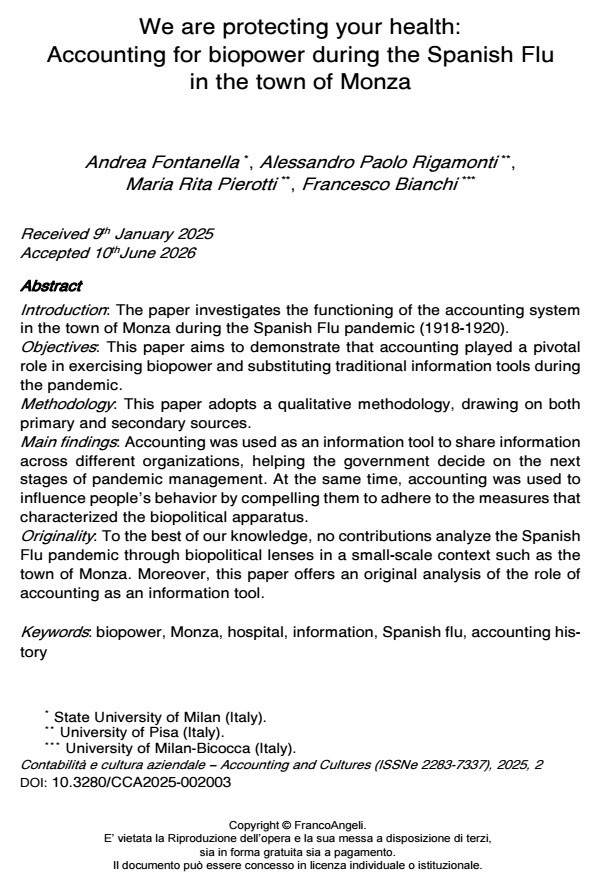
Introduction: The paper investigates the functioning of the accounting system in the town of Monza during the Spanish Flu pandemic (1918-1920). Objectives: This paper aims to demonstrate that accounting played a pivotal role in exercising biopower and substituting traditional information tools during the pandemic. Methodology: This paper adopts a qualitative methodology, drawing on both primary and secondary sources. Main findings: Accounting was used as an information tool to share information across different organizations, helping the government decide on the next stages of pandemic management. At the same time, accounting was used to influence people’s behavior by compelling them to adhere to the measures that characterized the biopolitical apparatus. Originality: To the best of our knowledge, no contributions analyze the Spanish Flu pandemic through biopolitical lenses in a small-scale context such as the town of Monza. Moreover, this paper offers an original analysis of the role of accounting as an information tool.
Keywords: biopower, Monza, hospital, information, Spanish flu, accounting history
- Agamben G. (1998). Homo Sacer. Stanford, CA: Stanford University Press.
- Agamben G. (2005). The State of Exception. Chicago, IL: University of Chicago Press.
- Agamben G. (2020A). A che punto siamo? Macerata: Quodlibet.
- Agamben G. (2020B). Biosicurezza e politica. Macerata: Quodlibet.
- Agamben G. (2023). Le due facce del potere 4: anarchia e politica. Macerata: Quodlibet.
- Alawattage C., Graham C., Wickramasinghe D. (2019). Microaccountability and biopolitics: Microfinance in a Sri Lankan village. Critical Perspectives on Accounting, 72: 38-60,
- Alawattage C., Wickramasinghe D. (2022). Strategising management accounting: liberal origins and neoliberal trends. Accounting, Auditing & Accountability Journal, 35(2): 518-546, DOI: 10.1108/AAAJ-01-2021-5124
- Alfani G., Percoco M. (2019). Plague and long-term development: the lasting effects of the 1629-30 epidemic on the Italian cities. Economic History Review, 72(4): 1175-1201,
- Antonelli V., D’Alessio R., Walker S.P. (2023). Operationalizing expulsion. Jewish accountants in Fascist Italy, 1938-1943. Critical Perspectives on Accounting, 94, 102462,
- Araújo-Pinzón P., Capelo-Bernal M., Núñez-Nickel M. (2024). Accountability and information disclosure in a Catholic charity (1798-1801). Business History, 1-41, DOI: 10.1080/00076791.2024.2304746.
- Arendt H. (2013). The human condition. Chicago: University of Chicago Press.
- Baker C.R. (2014). Breakdowns of accountability in the face of natural disasters: The case of Hurricane Katrina. Critical Perspectives on Accounting, 25(7): 620-632,
- Potter B.N. (2005). Accounting as a social and institutional practice: Perspectives to enrich our understanding of accounting change. Abacus, 41(3): 265-289,
- Barro R.J., Ursúa J.F., Weng J. (2020). The coronavirus and the great influenza pandemic: Lessons from the “Spanish flu” for the coronavirus’s potential effects on mortality and economic activity (No. w26866). National Bureau of Economic Research,
- Bigoni M., Funnell W. (2015). Ancestors of governmentality: Accounting and pastoral power in the 15th century. Critical Perspectives on Accounting, 27: 160-176,
- Bigoni M., Funnell W., Deidda Gagliardo E., Pierotti M. (2021). Accounting for control of Italian culture in the fascist ethical state: The Alla Scala Opera house. Accounting, Auditing & Accountability Journal, 34(1): 194-222, DOI: 10.1108/AAAJ-09-2019-4186
- Bodenhorn H. (2020). Business in a time of Spanish influenza. National Bureau of Economic Research.
- Booth P. (1993). Accounting in churches: A research framework and agenda. Accounting, Auditing & Accountability Journal, 6(4): 37-67.
- Booth P. (1993). Accounting in churches: A research framework and agenda. Accounting, Auditing & Accountability Journal, 6(4): 37-67, DOI: 10.1108/09513579310045684
- Bryer R. (2006). Accounting and control of the labour process. Critical Perspectives on Accounting, 17(5): 551-598.
- Burchell S., Clubb C., Hopwood A., Hughes J., Nahapiet J. (1980). The roles of accounting in organizations and society. Accounting, Organizations and Society, 5(1): 5-27, DOI: 10.1016/0361-3682(80)90017-3
- Carillo M.F., Jappelli T. (2022). Pandemics and regional economic growth: Evidence from the Great Influenza in Italy. European Review of Economic History, 26(1): 78-106,
- Carnegie G.D., Napier C.J. (1996). Critical and interpretive histories: insights into accounting’s present and future through its past. Accounting, Auditing & Accountability Journal, 9(3): 7-39, DOI: 10.1108/09513579610121956
- Chriss J.J. (2007). Social control: An introduction. Polity.
- Cooper C. (2015). Entrepreneurs of the self: The development of management control since 1976. Accounting, Organizations and Society, 47: 14-24,
- Dean M. (2010). Governmentality: Power and rule in modern society. SAGE.
- Di Cimbrini T., Musella A.M., Corsi C. (2024A). Accounting for and of the epidemic in Bologna in 1855: The medicus-politicus in the Papal States. Accounting History, 29(1): 123-155.
- Di Cimbrini T., Musella A.M., Dobie A. (2026). Necroaccountability, epidemics and symbolic power: A comparison between London and Naples in 1854. Accounting History, 10323732251371328.
- Di Cimbrini T., Musella A.M., Fosco G. (2024B). How does accounting save lives? An econometric analysis exploring the effectiveness of the Crispi-Pagliani Health Reform (1888) in Italy. Accounting History, 29(1): 156-178.
- Domin J.P. (2018). Socialisation of healthcare demand and development of the French health system (1890-1938). Business History, 61(3): 498-517.
- Ferrari L. (2020). Spanish flu in Turin as told by historical autopsy reports. Pathologica, 112(2): 110, DOI: 10.32074/1591-951X-2-20
- Foucault M. (1982). The subject and power. Critical inquiry, 8(4): 777-795.
- Foucault M. (1990). The history of sexuality: An introduction. New York: Vintage.
- Foucault M. (1991). The Foucault effect: Studies in governmentality. Chicago: University of Chicago Press.
- Foucault M. (2003). “Society Must Be Defended”: Lectures at the Collège de France, 1975-1976 (Vol. 1). London: Macmillan.
- Foucault, M. (2007). Security, territory, population: lectures at the Collège de France, 1977-78. Berlin: Springer.
- Funnell W., Antonelli V., Bigoni M., Cafaro E.M., D’Alessio R. (2022). Accounting for Jewish ‘bare life’ in the Fossoli Concentration Camp, 1943-44. Critical Perspectives on Accounting, 88, 102323, 2021.102323.
- Funnell W., Antonelli V., D’Alessio R. (2019). Accounting and psychiatric power in Italy: The royal insane hospital of Turin in the 19th century. Critical Perspectives on Accounting, 61(1-21),
- Galletta S., Giommoni T. (2022). The effect of the 1918 influenza pandemic on income inequality: Evidence from Italy. Review of Economics and Statistics, 104(1): 187-203.
- Gazzini M. (1996). Ospedali a Monza nei secoli VIII-XIII: spazi, uomini, istituzioni. Studi di storia medioevale e di diplomatica-Nuova Serie, (16), DOI: 10.54103/2611-318X/9796
- Genel K., Carson C. (2023). The question of biopower: Foucault and Agamben. Rethinking Marxism: 43-62. London: Routledge.
- Granata M. (2002). I Consigli d’amministrazione della Congregazione di carità di Milano (1862-1937) e dell’Ente comunale di assistenza (1937-1978). I Consigli d’amministrazione della Congregazione di carità di Milano (1862-1937) e dell’Ente comunale di assistenza (1937-1978): 1000-1014.
- Hopwood A.G., Miller P. (eds.) (1994). Accounting as social and institutional practice (Vol. 24). Cambridge: Cambridge University Press.
- Kim K. (2018). Proactive versus reactive corporate environmental practices and environmental performance. Sustainability, 10(1): 97, su10010097.
- Lai A., Leoni G., Stacchezzini R. (2014). The socializing effects of accounting in flood recovery. Critical Perspectives on Accounting, 25(7): 579-603,
- Lazzini S., Nicoliello M. (2021). Accounting as an instrument of power: The case of an Italian hospital in the late nineteenth century. Accounting History, 26(2): 236-254, DOI: 10.1177/1032373220948639
- Lewkowicz J., Wozniak M., Wrzesinski M. (2022). COVID-19 and erosion of democracy. Economic Modelling, 106, 105682, 2021.105682.
- Manetti G., Bellucci M., Bagnoli L. (2017). The management of the plague in Florence at the beginning of the Renaissance: The role of the partnership between the Republic and the Confraternita of Misericordia. Accounting History, 22(4): 510-529, DOI: 10.1177/1032373217720779
- Mapelli V. (2012). Il sistema sanitario italiano. Bologna: il Mulino.
- McKinlay A., Pezet E. (2010). Accounting for Foucault. Critical Perspectives on Accounting, 21(6): 486-495,
- Mennicken A., Miller P. (2012). Accounting, territorialization and power. Foucault Studies: 4-24,
- Miller P. (1994). Accounting as social and institutional practice: An introduction. Accounting as Social and Institutional Practice, 1(20).
- Miller P., Napier C. (1993). Genealogies of calculation. Accounting, Organizations and Society, 18(7-8): 631-647, DOI: 10.1016/0361-3682(93)90047-A
- Napier C.J. (1989). Research directions in accounting history. British Accounting Review, 21(3): 237-254, DOI: 10.1016/0890-8389(89)90095-4
- Opilowska E. (2021). The Covid-19 crisis: The end of a borderless Europe?. European Societies, 23(S1), S589-S600, DOI: 10.1080/14616696.20201833065.
- Orlandini P., Amelio S. (2022). Un percorso aziendale verso la sostenibilità. Torino: Giappichelli.
- Pierotti M., Capocchi A., Orlandini P. (2020). Mutual aid for the arts in nineteenth-and twentieth-century Milan: The ‘Pio Istituto Teatrale’. Accounting History, 25(4): 602-624, DOI: 10.1177/1032373219895295
- Pozzoli M., Bellucci M., Manetti G. (2024). Institutional cooperation in handling epidemics: The case of the Misericordia of Florence during the Italian preunification period. Accounting History, 29(4): 585-612.
- Preite D., Fontanella A. (2025). Economia e management delle aziende editoriali. Biblioteca dell’economia d’azienda.
- Previts G.J., Parker L.D., Coffman E.N. (1990). Accounting history: Definition and relevance. Abacus, 26(1), 1-16, tb00229.x.
- Pufendorf S., Samuel P. (1991). Pufendorf: On the Duty of Man and Citizen According to Natural Law. Cambridge: Cambridge University Press.
- Repetto L. (2015). Balance sheet disclosure and the budget cycle of Italian municipalities. In: CES-IFO Area Conference on Public Sector Economics (Munich, April 16-18).
- Rossiter C.L. (1949). Constitutional dictatorship in the atomic age. The Review of Politics, 11(4): 395-418, DOI: 10.1017/S0034670500043783
- Sargiacomo M., Gomes D. (2011). Accounting and accountability in local government: Contributions from accounting history research. California Management Review, 16(3): 46-70, DOI: 10.1177/1032373211407043
- Sargiacomo M., Ianni L., Everett J. (2014). Accounting for suffering: Calculative practices in the field of disaster relief. Critical Perspectives on Accounting, 25(7): 652-669,
- Sargiacomo M., Servalli S., Potito S., D’Andreamatteo A., Gitto A. (2021). Accounting for natural disasters from a historical perspective: A literature review and research agenda. Accounting History, 26(2): 179-204.
- Schmitt C. (1921). Die Diktatur. Munich-Leipzig: Duncker & Humblot.
- Servalli S. (2013). The interface of power and charity in the government of poor: A case from the Italian context in the sixteenth-seventeenth centuries. Accounting, Auditing & Accountability Journal, 26(8): 1306-1341, DOI: 10.1108/AAAJ-05-2013-1360
- Sorrentino V. (2008). Il pensiero politico di Foucault. Sesto San Giovanni: Meltemi Editore.
- Stoler A.L. (1995). Race and the education of desire: Foucault’s history of sexuality and the colonial order of things. Durham, NC: Duke University Press.
- Walker S.P. (2005). Accounting in history. Accounting Historians Journal, 32(2): 233-259, DOI: 10.2308/0148-4184.32.2.233
- Watts R.L., Zimmerman J.L. (1990). Positive accounting theory: A ten year perspective. Accounting Review: 131-156.
- Zimmerman JL. (2011). Accounting for decision making and control. New York: McGraw-Hill.
Andrea Fontanella, Alessandro Paolo Rigamonti, Maria Rita Pierotti, Francesco Bianchi, We are protecting your health: Accounting for biopower during the Spanish Flu in the town of Monza in "CONTABILITÀ E CULTURA AZIENDALE" 2/2025, pp 35-70, DOI: 10.3280/CCA2025-002003