The architecture of care: Governance, access and digital inequalities in healthcare in Basilicata
Journal title WELFARE E ERGONOMIA
Author/s Noemi Crescentini, Dora Gambardella, Rosaria Lumino, Giuseppe Michele Padricelli
Publishing Year 2026 Issue 2026/1
Language Italian Pages 10 P. 71-80 File size 43 KB
DOI 10.3280/WE2026-0001006
DOI is like a bar code for intellectual property: to have more infomation
click here
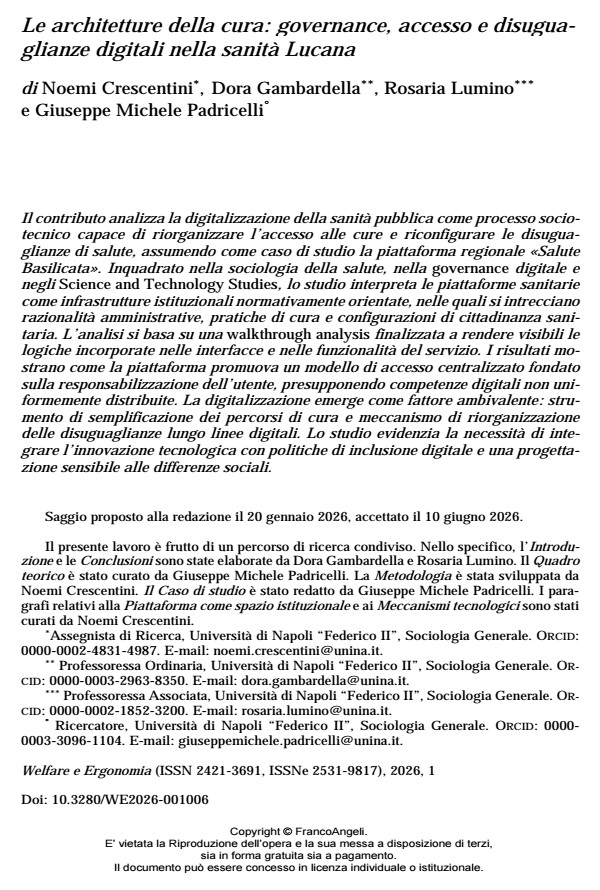
Below, you can see the article first page
If you want to buy this article in PDF format, you can do it, following the instructions to buy download credits
FrancoAngeli is member of Publishers International Linking Association, Inc (PILA), a not-for-profit association which run the CrossRef service enabling links to and from online scholarly content.
This paper analyses the digitalisation of public healthcare as a socio-technical process capable of reorganising access to care and reshaping health inequalities, using the regional “Salute Basilicata” platform as a case study. Framed within the sociology of health, digital governance and Science and Technology Studies, the study interprets healthcare platforms as normatively oriented institutional infrastructures, in which administrative rationalities, care practices and configurations of healthcare citizenship intertwine. The analysis is based on a walkthrough analysis aimed at revealing the logics embedded in the service’s interfaces and functionalities. The results show how the platform promotes a centralised access model based on user empowerment, assuming digital skills that are not uniformly distributed. Digitalisation emerges as an ambivalent factor: both a tool for simplifying care pathways and a mechanism for reorganising inequalities along digital lines. The study highlights the need to integrate technological innovation with digital inclusion policies and design approaches that are sensitive to social differences.
Keywords: digital health governance; health inequalities; sociotechnical infrastructures; digital divide; digital health citizenship; walkthrough analysis.
- Bowker G.C. and Star S.L. (2000). Sorting things out: Classification and its consequences. Cambridge: MIT Press.
- Callon M. (1999). Actor-network theory: the market test. The Sociological Review, 47(1): 181-195.
- Felt U. (2015). Sociotechnical imaginaries of “the internet,” digital health information and the making of citizen-patients. In: Science and Democracy, pp. 176-197. Routledge. DOI: 10.4324/9780203564370
- Greenhalgh T. and Papoutsi C. (2018). Studying complexity in health services research: desperately seeking an overdue paradigm shift. BMC Medicine, 16(1), 95.
- Heponiemi T., Gluschkoff K., Vehko T., Kaihlanen A.M., Saranto K., Nissinen S. and Kujala S. (2021). Electronic health record implementations and insufficient training endanger nurses’ well-being. Journal of Medical Internet Research, 23(12), e27096. DOI: 10.2196/27096
- ISTAT (2025). Censimento permanente della popolazione in Basilicata. Roma: ISTAT.
- Kostkova P. (2015). Grand challenges in digital health. Frontiers in Public Health, 3, 134.
- Latour B. (2005). Reassembling the Social: An Introduction to Actor-Network-Theory. Oxford: Oxford University Press.
- Light B., Burgess J. and Duguay S. (2018). The walkthrough method: An approach to the study of apps. New Media & Society, 20(3): 881-900. DOI: 10.1177/1461444816675438
- Lupton D. (2014). Digital Sociology. London: Routledge.
- Narkhede M.R., Wankhede N.I. and Kamble A.M. (2025). Enhancing patient autonomy in data ownership: privacy models and consent frameworks for healthcare. Journal of Digital Health, 1: 1-23. DOI: 10.1177/20552076251314207
- Nissenbaum H. (2011). A contextual approach to privacy online. Daedalus, 140(4): 32-48.
- Petersen A. (2018). Digital Health and Technological Promise: A Sociological Inquiry. London: Routledge.
- Ragnedda M. and Muschert G. (2018). Theorizing Digital Divides. London: Routledge.
- Rose N. (2007). Beyond medicalisation. The Lancet, 369(9562): 700-702. DOI: 10.1016/S0140-6736(07)60319-5
- Schou J. and Pors A.S. (2019). Digital by default? A qualitative study of exclusion in digitalised welfare. Social Policy & Administration, 53(3): 464-477.
- Suchman L.A. (2007). Human-Machine Reconfigurations: Plans and Situated Actions. Cambridge: Cambridge University Press.
- Timmermans S. and Berg M. (2003). The practice of medical technology. Sociology of Health & Illness, 25(3): 97-114. DOI: 10.1111/1467-9566.00336
- Van Dijck J. (2013). The Culture of Connectivity: A Critical History of Social Media. Oxford: Oxford University Press.
- Wang T., Wu Q., Chen J., Chen F., Xie D. and Shen H. (2024). Health data security sharing method based on hybrid blockchain. Future Generation Computer Systems, 153: 251-261.
Noemi Crescentini, Dora Gambardella, Rosaria Lumino, Giuseppe Michele Padricelli, Le architetture della cura: governance, accesso e disuguaglianze digitali nella sanità Lucana in "WELFARE E ERGONOMIA" 1/2026, pp 71-80, DOI: 10.3280/WE2026-0001006