Digitalisation and social services beyond the emergency: Findings from a study in the field of social services
Journal title WELFARE E ERGONOMIA
Author/s Romina Ciaccia, Federica Scaffai, Paolo Parra Saiani
Publishing Year 2026 Issue 2026/1
Language Italian Pages 12 P. 117-128 File size 89 KB
DOI 10.3280/WE2026-0001009
DOI is like a bar code for intellectual property: to have more infomation
click here
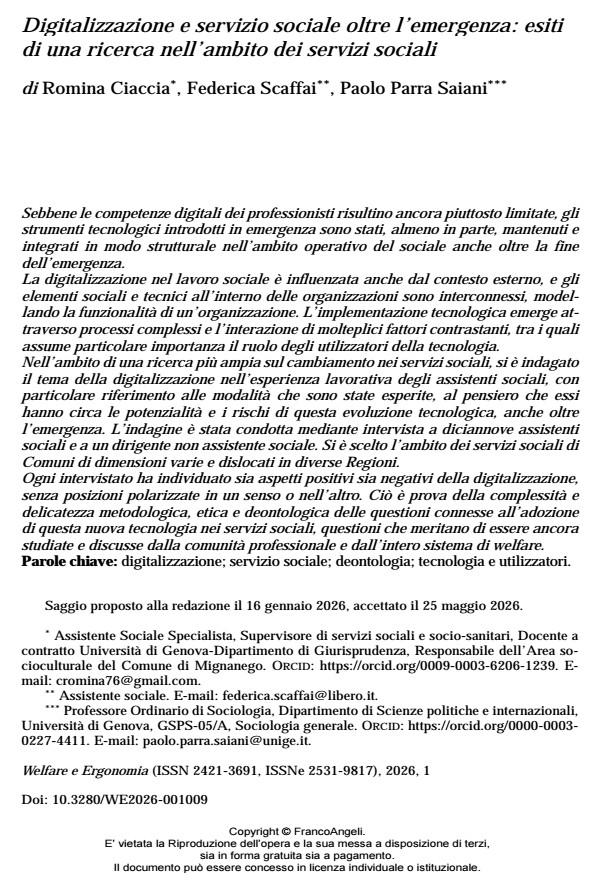
Below, you can see the article first page
If you want to buy this article in PDF format, you can do it, following the instructions to buy download credits
FrancoAngeli is member of Publishers International Linking Association, Inc (PILA), a not-for-profit association which run the CrossRef service enabling links to and from online scholarly content.
Although professionals’ digital skills are still rather limited, the technological tools introduced during the emergency have been, at least in part, retained and structurally integrated into the social services sector even beyond the emergency context. Digitalisation in social work is also influenced by the external context, and the social and technical elements within organisations are interconnected, shaping the functionality of an organisation. Technological implementation emerges through complex processes and the interaction of multiple conflicting factors, among which the role of technology users is particularly important. As part of a broader study on change in social services, the role of digitalisation in the work experience of social workers was investigated, with particular attention to the methods that have been tried, their thoughts on the potential and risks of this technological evolution, even beyond the emergency. The survey was conducted through interviews with nineteen social workers and one non-social worker manager. The social services of municipalities of various sizes and located in different regions were chosen. Each interviewee identified both positive and negative aspects of digitalisation, without polarised positions in one direction or the other. This highlights the methodological, ethical and deontological complexity and sensitivity of the issues related to the adoption of this new technology in social services, issues that deserve further study and discussion by the professional community and the entire welfare system.
Keywords: digitisation; social work; professional ethics; technology and users.
- Rosa H. (2010). Alienation and Acceleration: Towards a Critical Theory of Late-Modern Temporality. NSU Press.
- Argyris C. (1995). Action science and organizational learning. Journal of Managerial Psychology, 10(6): 20-26. DOI: 10.1108/02683949510093849
- Akrich M. and Latour B. (1992). A summary of convenient vocabulary for the semiotics of human and nonhuman assemblies. In: Bijker W. and Law J., a cura di. Shaping Technology / Building Society Studies in Sociotechnical Change, The MIT Press, pp. 259-264.
- Bauwens R., Batistic S. and Kilroy S. (2021). Digitalization and burnout in social work: Challenges and implications. Journal of Social Work, 21(4): 779-795. DOI: 10.1177/1468017320956060
- Cheung J. C.-S. (2022). Responses to COVID-19 in major social work journals: A systematic review of empirical studies, comments, and editorials. Research on Social Work Practice, 32(2): 168-185. DOI: 10.1177/10497315211046846
- Czarniawska B. and Joerges B. (1996). Travels of Ideas. In: Czarniawska B. and Sevón G., editors, Translating Organizational Change. Berlin, New York: De Gruyter, pp. 13-48. DOI: 10.1515/9783110879735.13
- European Commission: Directorate-General for Communications Networks, Content and Technology (2024). Digital Decade Country Report 2024: Italy, testo disponibile al sito: https://ec.europa.eu/newsroom/dae/redirection/document/106709, accesso effettuato il 4/6/2025.
- Fiorentino V., Romakkaniemi M., Harrikari T., Saraniemi S. and Tiitinen L. (2023). Towards digitally mediated social work – The impact of the COVID-19 pandemic on encountering clients in social work. Qualitative Social Work, 22(3): 448-464. DOI: 10.1177/14733250221075603
- Fletcher G. and Griffiths M. (2020). Digital transformation during COVID-19: A sociotechnical perspective. Information Systems Journal, 30(4): 551-559.
- Gillingham P. (2016). Technology con?guring the user: Implications for the redesign of electronic information systems in social work. The British Journal of Social Work, 46(2): 323-338.
- Halford S. and Savage M. (2010). Reconceptualizing Digital Social Inequality. Information, Communication & Society, 13(7): 937-955. DOI: 10.1080/1369118X.2010.499956
- Howcroft D. and Taylor P. (2023). Automation and the future of work: A social shaping of technology approach. New Technology, Work and Employment, 38(2): 351-370.
- Kline R. and Pinch T. (1996). Users as Agents of Technological Change: The Social Construction of the Automobile in the Rural United States. Technology and Culture, 37(4): 763-795.
- López Peláez A., Suh S., Zelenev S., a cura di (2024). Digital Transformation and Social Well-Being: Promoting an Inclusive Society. London: Routledge.
- López Peláez A., Pérez García R. and Aguilar-Tablada Massó M.V. (2017). e-Social work: building a new field of specialization in social work?. European Journal of Social Work, 21(6): 804-823. DOI: 10.1080/13691457.2017.1399256
- Mackay H., Carne C., Beynon-Davies P. and Tudhope D. (2000). Reconfiguring the User: Using Rapid Application Development. Social Studies of Science, 30(5): 737-757. DOI: 10.1177/030631200030005004
- Mackrill T. and Ebsen F. (2018). Key misconceptions when assessing digital technology for municipal youth social work. European Journal of Social Work, 21(6): 942-953. DOI: 10.1080/13691457.2017.1326878.
- Martire F., Parra Saiani P. and Cataldi S. (2023). La ricerca sociale e le sue pratiche. Roma: Carocci.
- Mesiäislehto M., Kivipelto M. and Hiilamo H. (2021). Social workers’ perceptions on clients’ service needs and social work practices during the COVID-19 pandemic. Journal of Comparative Social Work, 2: 9-35.
- Mishna F., Sanders J., Fantus S., Fang L., Greenblatt A., Bogo M. and Milne B. (2021). #socialwork: Informal use of information and communication technology in social work. Clinical Social Work Journal, 49(1): 85-99.
- Munro E. (2020). Promoting the welfare, protection and care of children during the coronavirus (COVID-19) pandemic. Journal of Children’s Services, 15(4): 177-184. DOI: 10.1108/JCS-12-2020-064
- OECD (2024). G7 Compendium of Digital Government Services, OECD Publishing, Paris.
- OECD (2021). Digital Government Index 2021. OECD Publishing.
- Oudshoorn N. and Pinch T.J., a cura di (2003). How users matter: The co-construction of users and technology. Cambridge: MIT Press.
- Parton N. (2008). Changes in the form of knowledge in social work: From the “Social” to the “Informational”?. The British Journal of Social Work, 38(2): 253-69.
- Sanfelici M., Nothdurfter U., Bilotti A., a cura di (2026). Tecnologie digitali nel Servizio Sociale - Apprendere dalla ricerca per orientare la pratica. Franco Angeli in collaborazione con Fondazione Nazionale Assistenti Sociali.
- Saukkonen P., Elovainio M., Salovaara S., Virtanen L., Kaihlanen A.-M., Kainiemi E., Vehko T. and Heponiemi T. (2024). Perceived effects of digitalization on social work in Finland: A network analysis approach. International Social Work, 67(6): 1464-1481. DOI: 10.1177/00208728241265015
- Sørensen K.H. (2023). Processes of incorporation. The relationship between socialisation and domestication of technoscience. In: Hartmann M., a cura di. The Routledge Handbook of Media and Technology Domestication. London: Routledge.
- Steiner O. (2021). Social Work in the Digital Era: Theoretical, Ethical and Practical Considerations. The British Journal of Social Work, 51(8): 3358-3374.
- Sullivan-Tibbs M.A., Rayner C.B., Crouch D.L., Peck L.A., Bell M.A., Hasting A.D., Nativo A.J. and Mallinger K.M. (2022). Social work’s response during the COVID-19 pandemic: A systematic literature review - balancing telemedicine with social work self-care during a pandemic. Social Work in Public Health, 37(6): 499-509. DOI: 10.1080/19371918.2022.2032904
- Trist E.L. and Bamforth K.W. (1951). Some social and psychological consequences of the longwall method of coal-getting: An examination of the psychological situation and defences of a work group in relation to the social structure and technological content of the work system. Human Relations, 4(1): 3-38. DOI: 10.1177/001872675100400101
- Walker G.H., Stanton N.A., Salmon P.M. and Jenkins D.P. (2008). A review of sociotechnical systems theory: A classic concept for new command and control paradigms. Theoretical Issues in Ergonomics Science, 9(6): 479-499. DOI: 10.1080/14639220701635470
- Wiener L., Fry A., Pelletier W., Cincotta N. and Jones B. (2021). The impact of COVID-19 on the professional and personal lives of paediatric oncology social workers. Journal of Psychosocial Oncology, 39(3): 428-444. DOI: 10.1080/07347332.2021.1912245
Romina Ciaccia, Federica Scaffai, Paolo Parra Saiani, Digitalizzazione e servizio sociale oltre l’emergenza: esiti di una ricerca nell’ambito dei servizi sociali in "WELFARE E ERGONOMIA" 1/2026, pp 117-128, DOI: 10.3280/WE2026-0001009