The Court of Justice, the minimum wage directive and the limits of competence.
Journal title GIORNALE DI DIRITTO DEL LAVORO E DI RELAZIONI INDUSTRIALI
Author/s Massimiliano Delfino
Publishing Year 2026 Issue 2026/191
Language Italian Pages 20 P. 387-406 File size 197 KB
DOI 10.3280/GDL2026-191003
DOI is like a bar code for intellectual property: to have more infomation
click here
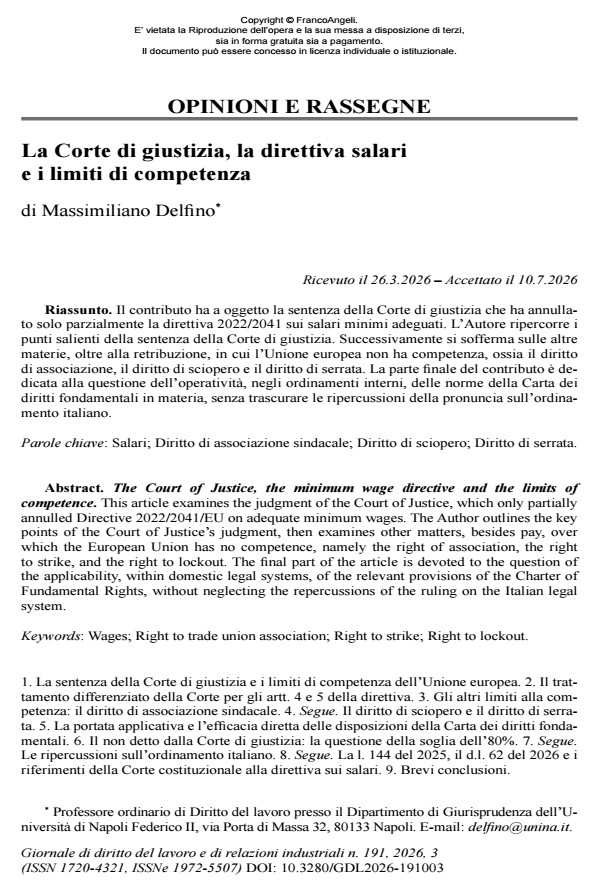
Below, you can see the article first page
If you want to buy this article in PDF format, you can do it, following the instructions to buy download credits
FrancoAngeli is member of Publishers International Linking Association, Inc (PILA), a not-for-profit association which run the CrossRef service enabling links to and from online scholarly content.
This article examines the judgment of the Court of Justice, which only partially annulled Directive 2022/2041/EU on adequate minimum wages. The Author outlines the key points of the Court of Justice’s judgment, then examines other matters, besides pay, over which the European Union has no competence, namely the right of association, the right to strike, and the right to lockout. The final part of the article is devoted to the question of the applicability, within domestic legal systems, of the relevant provisions of the Charter of Fundamental Rights, without neglecting the repercussions of the ruling on the Italian legal system.
Keywords: Wages; Right to trade union association; Right to strike; Right to lockout
- Ales E. (2018). Article 31 CFREU. In: Ales E., Bell M., Deinert O., RobinOlivier S. (eds.), International and European Labour Law. Beck/Hart/Nomos, 1207 ss.
- Borelli S. (2026). La direttiva sui salari minimi adeguati è salva… ma le contraddizioni restano. Labor: 197 ss.
- Brameshuber E. (2025). EU competence in the field of social policy, why the AG’s opinion on the Adequate Minimum Wage Directive in C19/23 (does not) matter(s). EULL, 31.1.2025. Brameshuber E. (2026). EuGH bestätigt Kompetenzkonformität der „Mindestlohn
- RL”weitgehend – oder sollte sie doch „RL über unionsrechtliche Rahmenbedingungen für nationale Tarifverhandlungen”heißen? ZAS: 24 ss.
- Countouris N. (2025). Evitare un altro momento “Viking e Laval”. Un’analisi critica delle conclusioni dell’Avvocato generale sulla direttiva sul salario minimo adeguato nella causa C19/23. RGL – Newsletter.
- Delfino M. (2025). La competenza contesa fra Unione europea e Stati membri in materia di salari minimi adeguati. Note a margine delle Conclusioni dell’Avvocato Generale nella causa Danimarca c. Parlamento e Consiglio. RGL – Newsletter.
- Kilpatrick C., Steiert M. (2025). A little learning is a dangerous thing: AG Emiliou on the Adequate Minimum Wages Directive (C19/23, Opinion of 14 January 2025). EUIL WP, 2.
- Lo Faro A. (2026). Salari adeguati e competenze dell’Unione tra continuità giurisprudenziale e sensibilità politica. LD: 57 ss.
- Loffredo A. (2026). “C’è del marcio in Danimarca”: la Corte di Giustizia salva la direttiva in materia di salari minimi adeguati. DLM: 137 ss.
- Menegatti E. (2025). All’s well that ends well? The Court’s “saving” of the Adequate Minimum Wage Directive. ILLeJ: 1 ss.
- Müller T. (2025). I’m Still Standing: Transposition and political impact of the Directive on Adequate Minimum Wages in the EU. ILLeJ: 1 ss.
- Ratti L. (2025a). La misurazione delle soglie di adeguatezza del salario minimo nell’ordinamento multilivello. DLRI: 63 ss.
- Ratti L. (2025b). Out of the Shadows: The Court of Justice and the Limits of EU Law Competence on Determining Minimum Wages. EU Live, 2428.11.2025.
- Zampieri G. (2025). La Corte di giustizia si pronuncia sulla Direttiva (Ue) 2022/2041: è (quasi) salva la disciplina europea in materia di salari minimi adeguati. LPO, news.
Massimiliano Delfino, La Corte di giustizia, la direttiva salari e i limiti di competenza in "GIORNALE DI DIRITTO DEL LAVORO E DI RELAZIONI INDUSTRIALI " 191/2026, pp 387-406, DOI: 10.3280/GDL2026-191003