The Social Impact Assessment of Assisted Voluntary Returns in Italy: An Interpretation from Neoinstitutionalism
Journal title MONDI MIGRANTI
Author/s Umberto Di Maggio, Consuelo Corradi, Stellamarina Donato
Publishing Year 2026 Issue 2026/2
Language Italian Pages 21 P. 113-133 File size 228 KB
DOI 10.3280/MM2026-002007
DOI is like a bar code for intellectual property: to have more infomation
click here
Below, you can see the article first page
If you want to buy this article in PDF format, you can do it, following the instructions to buy download credits
FrancoAngeli is member of Publishers International Linking Association, Inc (PILA), a not-for-profit association which run the CrossRef service enabling links to and from online scholarly content.
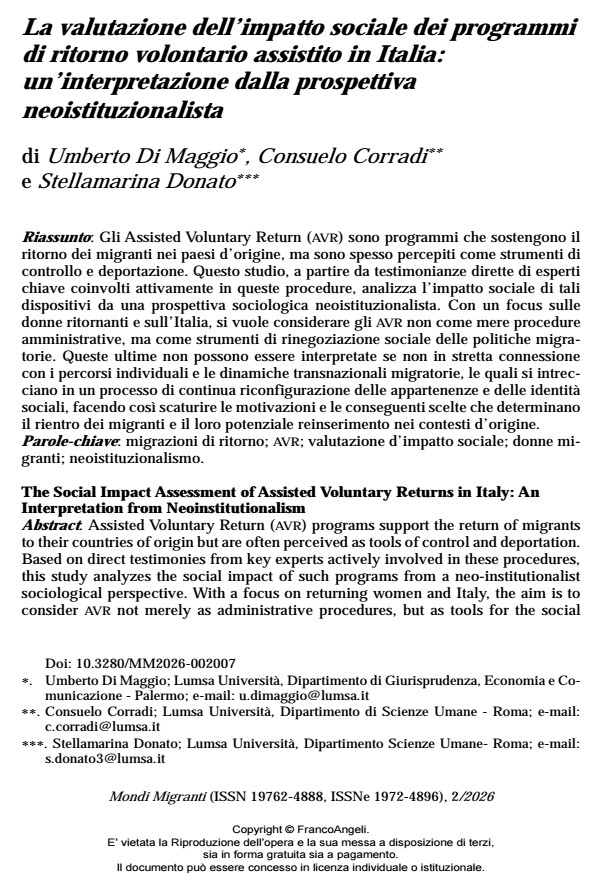
Assisted Voluntary Return (AVR) programs support the return of migrants to their countries of origin but are often perceived as tools of control and deportation. Based on direct testimonies from key experts actively involved in these procedures, this study analyzes the social impact of such programs from a neo-institutionalist sociological perspective. With a focus on returning women and Italy, the aim is to consider AVR not merely as administrative procedures, but as tools for the social renegotiation of migration policies. These policies cannot be interpreted without closely connecting them to individual pathways and transnational migration dynamics, which continuously reconfigure belonging and social identities. This process generates the motivations and subsequent choices that determine migrants’ return and their potential readaptation and reintegration into their countries of origin.
Keywords: return migration; AVR; social impact assessment; migrant women; neoinstitutionalism.
- Ambrosini M. (2020). L’invasione immaginaria. L’immigrazione oltre i luoghi comuni. Roma-Bari: Laterza.
- Ambrosini M., Cinalli M. e Jacobson D., eds. (2020). Migration, borders and citizenship: Between policy and public spheres. Springer Nature.
- Arango J. (2024). Migration policies and politics. In: Research handbook on the sociology of migration (pp. 96-108). Cheltenham, UK Edward Elgar; DOI: 10.4337/9781839105463.00015.
- Bilecen T. (2022). To Stay or to Return? A Review on Return Migration Literature. Migration Letters, 19: 367-385.
- Black R. e Gent S. (2006). Sustainable return in post-conflict contexts. International Migration, 44, 3: 15-38;
- Braun V. e Clarke V. (2006). Using thematic analysis in psychology. Qualitative Research in Psychology, 3, 2: 77-101.
- Cantat C., Pécoud, A. e Thiollet H. (2023). Migration as crisis. American Behavioral Scientist. London: Sage Publications Inc.; DOI: 10.1177/00027642231182889.
- Caponio T. e Cappiali T.M. (2018). Italian migration policies in times of crisis: The policy gap reconsidered. South European Society and Politics, 23, 1: 115-132; DOI: 10.1080/13608746.2018.1435351
- Carling J. (2023). The phrase ‘refugees and migrants’ undermines analysis, policy and protection. International Migration, 61, 3: 399-403.
- Caron L. (2020). An intergenerational perspective on (re) migration: Return and onward mobility intentions across immigrant generations. International Migration Review, 54, 3: 820-852.
- Caselli M., Kadio A.A. e Rizzo C. (2022). Assisted voluntary return & reintegration policies and programmes in four EU countries: France, Germany, Italy and Spain. Italian Sociological Review, 12, 2: 409-434.
- Caselli M. and Marcu O. (2024). Pathways to reintegration in Senegal and Nigeria promoted by Italian assisted voluntary return programmes. International Migration, 62, 1: 285-302.
- Corte dei Conti (2022). Il rimpatrio volontario e assistito nella gestione dei flussi migratori; https://www.integrazionemigranti.gov.it/AnteprimaPDF.aspx?id=3469.
- Co?ciug A. (2023). Editorial Introduction: Exploring Return Migration and its Transformative Potential in Romania and Beyond. Social Change Review, 20, 1: 1-18;
- Czaika M., Bohnet H., Zardo F. e Bijak J. (2024). European migration governance in the context of uncertainty. International Migration, 62, 6: 93-110;
- De Haas H., Fokkema T. e Fihri M.F. (2015). Return migration as failure or success? Journal of International Migration and Integration, 16, 2: 415-429;
- DiMaggio P.J. e Powell W.W. (1983). The iron cage revisited: Institutional isomorphism and collective rationality in organizational fields. American Sociological Review, 48, 2: 147-160.
- Donato S. (2023). Women migrant returnees as intermediaries: Exploring empowerment and agency of migrant women returnees in the EU-MENA region. International Migration & Integration;
- Dünnwald, S. (2013). Voluntary return. In: Geiger M. and Pécoud A., eds., Disciplining the transnational mobility of people (pp. 228-249). London: Palgrave Macmillan UK; DOI: 10.1057/9781137263070_12
- Geddes A. (2022). Migration governance. In: Scholten P., ed., Introduction to migration studies: An interactive guide to the literatures on migration and diversity (pp. 311-323). Cham: Springer International Publishing.
- Gibney M.J. (2021). The ethics and politics of asylum: Liberal democracy and the response to refugees. Cambridge University Press.
- Gmelch G. (1980). Return migration. Annual Review of Anthropology, 9: 135-159,
- Guiraudon V. (2018). The 2015 refugee crisis was not a turning point: Explaining policy inertia in EU border control. European Political Science, 17, 1: 151-160;
- Hadj Abdou L. e Pettrachin A. (2023). Exploring the EU’s status quo tendency in the migration policy field: A network-centred perspective. Journal of European Public Policy, 30, 6: 1013-1032.
- IOM. (2024). 2023 return and reintegration key highlights – Annexes. Geneva: International Organization for Migration.
- IOM. (2019). Glossary on Migration. Geneva: International Organization for Migration.
- Jeffery L. e Murison J. (2011). The temporal, social, spatial, and legal dimensions of return and onward migration. Population, Space and Place, 17, 2: 131-139.
- King R. e Kuschminder K. (2022). Introduction: Definitions, typologies and theories of return migration. In: King R. and Kuschminder K., eds., Handbook of return migration (pp. 1-22). Cheltenham, UK: Elgar.
- Koser K. and Kuschminder K. (2015). Comparative research on the assisted voluntary return and reintegration of migrants. Geneva: International Organization for Migration.
- Kuschminder K. (2017). Interrogating the relationship between remigration and sustainable return. International Migration, 55, 6: 107-121.
- Lasswell H.D. (1927). The theory of political propaganda. American Political Science Review, 21, 3: 627-631.
- Leerkes A., van Os R. e Boersema E. (2017). What drives ‘soft deportation’? Understanding the rise in Assisted Voluntary Return among rejected asylum seekers in the Netherlands. Population, Space and Place, 23, 8: e2059.
- Lietaert I., Broekaert E. and Derluyn I. (2017). From social instrument to migration management tool: Assisted voluntary return programmes – the case of Belgium. Social Policy & Administration, 51, 7: 961-980.
- Lindblom C.E. (1959). The science of “muddling through.” Public Administration Review, 19, 2: 79-88.
- Meyer J.W. and Rowan B. (1977). Institutionalized organizations: Formal structure as myth and ceremony. American Journal of Sociology, 83, 2: 340-363.
- North D.C. (1990). Institutions, institutional change and economic performance. Cambridge University Press.
- Ortensi L.E. e Kingston L.N. (2022). Asylum seekers’ experiences on the migration journey to Italy (and beyond): Risk factors and future planning within a shifting political landscape. International Migration, 60, 1: 228-243;
- Piore M.J. (1979). Birds of passage: Migrant labor and industrial societies. Cambridge University Press.
- Piperno F. (2010). Dalla catena della cura al welfare globale. L’impatto delle migrazioni sui regimi di cura nei contesti di origine e le nuove sfide per una politica di co-sviluppo sociale. Mondi Migranti, 3; DOI: 10.3280/MM2010-003004/
- Ponzo I. (2023). Looking into policy change: How the Italian asylum regime came of age. In: IMISCOE research series (pp. 283-302); DOI: 10.1007/978-3-031-26002-5_15/
- Radogna R.M. (2022). The Concept of Habitus in Migration Studies. A Systematic Literature Review. Sociologie Româneasca, 20, 1: 108-125.
- Sacchetto D., Vianello F.A. e Andrijasevic R. (2016). Introduzione. Le migrazioni lavorative intra-UE: modelli, pratiche e traiettorie di mobilità dei cittadini europei. Mondi Migranti, 3/2016, 23-31; DOI: 10.3280/MM2016-003002/
- Sahin-Mencütek Z. (2024). Conceptual Complexity About Return Migration of Refugees/Asylum Seekers. Journal of Asian and African Studies, 59, 7: 2125-2138; DOI: 10.1177/00219096241283651
- Scott W.R. (2014). Institutions and organizations: Ideas, interests, and identities (4th ed.). London: Sage Publications.
- Schweitzer R. (2022). “Voluntary Return” Without Civil Society?: How the Exclusion of Nongovernment Actors from the Austrian and British Return Regimes Affects the Quality of Voluntariness. Migration and Society, 5, 1: 29-42;
- Stancová K. (2010). Assisted Voluntary Return of Irregular Migrants: Policy and Practice in the Slovak Republic. International Migration, 48, 4: 186-200;
- Trauner F. e Ripoll Servent A. (2016). The communitarization of the area of freedom, security and justice: Why institutional change does not translate into policy change. JCMS: Journal of Common Market Studies, 54, 6: 1417-1432;
- Vandevoordt R. (2016). Between humanitarian assistance and migration management: on civil actors’ role in voluntary return from Belgium. Journal of Ethnic and Migration Studies, 43, 11: 1907-1922; DOI: 10.1080/1369183X.2016.1245609
- Webber F. (2011). How voluntary are voluntary returns? Race & Class, 52, 4: 98-107; DOI: 10.1177/0306396810396606/
- Yalaz E. e Zapata-Barrero R. (2018). Mapping the qualitative migration research in Europe: an exploratory analysis (pp. 9-31). Springer International Publishing.
Umberto Di Maggio, Consuelo Corradi, Stellamarina Donato, La valutazione dell’impatto sociale dei programmi di ritorno volontario assistito in Italia: un’interpretazione dalla prospettiva neoistituzionalista in "MONDI MIGRANTI" 2/2026, pp 113-133, DOI: 10.3280/MM2026-002007