Forms of Afrodescendant engagement: between biographical reflexivity and social change
Journal title MONDI MIGRANTI
Author/s Marta Visioli
Publishing Year 2026 Issue 2026/2
Language Italian Pages 22 P. 185-206 File size 280 KB
DOI 10.3280/MM2026-002010
DOI is like a bar code for intellectual property: to have more infomation
click here
Below, you can see the article first page
If you want to buy this article in PDF format, you can do it, following the instructions to buy download credits
FrancoAngeli is member of Publishers International Linking Association, Inc (PILA), a not-for-profit association which run the CrossRef service enabling links to and from online scholarly content.
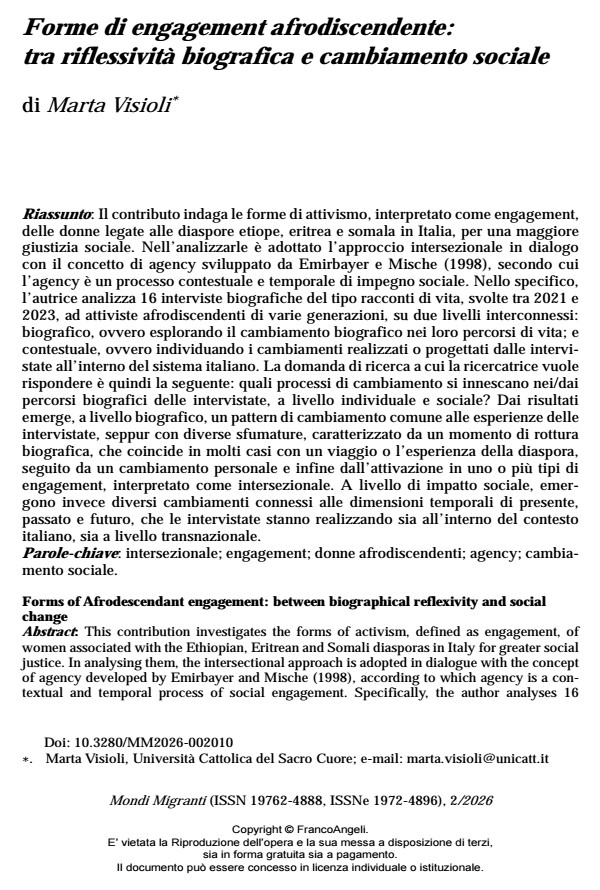
This contribution investigates the forms of activism, defined as engagement, of women associated with the Ethiopian, Eritrean and Somali diasporas in Italy for greater social justice. In analysing them, the intersectional approach is adopted in dialogue with the concept of agency developed by Emirbayer and Mische (1998), according to which agency is a contextual and temporal process of social engagement. Specifically, the author analyses 16 biographical interviews, carried out between 2021 and 2023, with Afrodescendant women activists of various generations, on two interconnected levels: biographical, i.e. exploring biographical change in their life paths; and contextual, i.e. identifying the changes realised or planned by the interviewees within the Italian system. The research question to be answered by the researcher is therefore the following: what processes of change are generated in/by the biographical paths of the interviewees, at an individual and social level? From the results emerge, at the biographical level, a pattern of change common to the experiences of the interviewees, albeit with different nuances, characterised by a moment of biographical rupture, which coincides in many cases with a journey or the experience of diaspora, followed by a personal change and finally by the activation in one or more types of engagement, interpreted as intersectional. At the level of social impact, instead, several changes emerge connected to the temporal dimensions of present, past and future, which the interviewees are realising both within the Italian context and transnationally.
Keywords: intersectional; engagement; Afrodescendant women; agency; social change.
- Al-Ali N. (2007). Iraqi Women in Diasporic Spaces: Political Mobilization, Gender & Citizenship. Revue Des Mondes Musulmans Et De La Méditerranée, 117(117-118): 137-154;
- Apitzsch U. e Siouti I. (2015). Transnational Biographies. Zeitschrift für Qualitative Forschung, 14:11-23; DOI: 10.1080/23254823.2021.1960877
- Barrett M. e Brunton-Smith I. (2014) Political and Civic Engagement and Participation: Towards an Integrative Perspective, Journal of Civil Society, 10, 1: 5-28; DOI: 10.1080/17448689.2013.871911.
- Molony B. e Nelson J. (2017). Women’s Activism and “Second Wave” Feminism. Transnational Histories. Londra: Bloomsbury Academic.
- Baser B. e Toivanen, M. (2017). Politicized and depoliticized ethnicities, power relations and temporality: Insights to outsider research from comparative and transnational fieldwork. Ethnic and Racial Studies, 41, 11: 2067-2084; http://dx.doi.org/10.1080/01419870.2017.1348530.
- Bernstein L. e Ndinda C. (2008). Women’s activism for gender equity in Africa and the Diaspora. Journal of International Women’s Studies, 10, 1: 1-4; https://vc.bridgew.edu/jiws/vol10/iss1/1.
- Bichi R. (2002). L’intervista biografica: Una proposta metodologica. Milano: Vita e Pensiero.
- Sanchez W.T. e Brenman M. (2014). Social Activism. In: Michalos A. C., edited by, Encyclopedia of Quality of Life and Well-being Research. Springer.
- Broad L.K. (2017). Social Movement Intersectionality and Re-centring Intersectional Activism. Atlantis Critical Studies in Gender, Culture and Social Justice, 38, 1: 41-53.
- Caretta M.A. e Pérez M.A. (2019). When participants do not agree: Member checking and challenges to epistemic authority in participatory research. Field Methods, 31, 4: 359-374; DOI: 10.1177/1525822X19866578
- Collins H.P. (2015). Intersectionality’s definitional dilemmas. Annual Review of Sociology, 41, 1: 1-20;
- Collins H.P. (2012). On Intellectual Activism. Pennsylvania: Temple University Press.
- Coser L.A. (1957). Social conflict and the theory of social change. The British Journal of Sociology, 8, 3: 197-207; DOI: 10.2307/586859.
- Crenshaw K. (1991). Mapping the Margins: Intersectionality, Identity Politics, and Violence against Women of Color. Stanford Law Review, 43, 6: 1241-1299; DOI: 10.2307/1229039
- Del Boca A. (2006). Italiani, brava gente? Un mito duro a morire. Vicenza: Neri Pozza.
- Duraccio C. (2020). Relazionarsi con la terra di origine: Shirin Ramzanali Fazel, Igiaba Scego e Maryam Maio. Revista Internacional De Culturas Y Literaturas (Online), 23, 23: 203-216; http://dx.doi.org/ 10.12795/RICL.2020.i23.15.
- Emirbayer M. e Mische A. (1998). What is agency? The American Journal of Sociology, 103(4): 962-1023; DOI: 10.1086/231294
- Fusari V. (2020). Between Legacy and Agency: Italo-Eritreans Raised in Orphanages and Their Access to Italian Citizenship. Northeast African Studies, 20(1/2): 59-90; https://dx.doi.org/10.14321/nortafristud.20.1-2.0059.
- Giddens A. (1979). Central problems in social theory: Action, structure and contradiction in social analysis. Londra: Red Globe Press.
- Hawthorne C. (2022). Contesting Race and Citizenship: Youth Politics in the Black Mediterranean. Ithaca: Cornell University Press (trad. it.: Razza e cittadinanza. Frontiere contese e contestate nel Mediterraneo Nero. Pisa: AstArte, 2023).
- Hooks b. (1984). Feminist Theory: From Margin to Center. Boston: South End Press.
- Isin E. (2017). ‘Performative Citizenship’. In: Shachar A. and others, eds., The Oxford Handbook of Citizenship (pp. 175-193).
- Lahire B. (2016). Tableaux de famille: Heurs et malheurs scolaires en milieux populaires. Lione: Points.
- Lister, R. (2007). Inclusive Citizenship: Realizing the Potential. Citizenship Studies, 11, 1: 49-61; DOI: 10.1080/13621020601099856
- Marchetti S. (2011). Le ragazze di Asmara. Roma: Futura Editrice.
- Marzagora, S. (2015). Re-writing history in the literature of the Ethiopian diaspora in Italy. African Identities, 13, 3: 211-225; DOI: 10.1080/14725843.2015.1074538/
- Miceli S. (2019). Un posto nel mondo: Donne migranti e pratiche di scrittura. Cosenza: Luigi Pellegrini Editore.
- Moon D.G. e Holling M.A. (2020). “White supremacy in heels”: (white) feminism, white supremacy, and discursive violence. Communication and Critical/Cultural Studies, 17, 2: 253- 260; DOI: 10.1080/14791420.2020.1770819/
- Norris P. (Oct 1-2 2004). Young People & Political Activism. Paper for the Conference “Civic engagement in the 21st Century: Toward a Scholarly and Practical Agenda”. University of Southern California.
- Nowicka M. e Ryan L. (2015). Beyond Insiders and Outsiders in Migration Research: Rejecting A Priori Commonalities. FQS Forum: Qualitative Social Research, 16, 2, Art. 18.
- Ortensi L. e Riniolo V. (2019). Do Migrants Get Involved in Politics? Levels, Forms and Drivers of Migrant Political Participation in Italy. Journal of International Migration and Integration, 21: 133-153;
- Perrin-Joly C. e Kushtanina, V. (2018). La composition biographique. quels effets des choix conceptuels pour saisir les temporalités? Recherches Sociologiques Et Anthropologiques, 49, 2: 115-134;
- Pesarini A. (2020). Bodies crossing borders, Rives méditerranéennes, 60, 21-38;
- Pinedo A., Diemer M.A. e Frisby M.B. (2024). Critical Consciousness and Youth Political Activism. Annual Review of Developmental Psychology, 6: 351-372;
- Rebughini P. (2021) Agency in intersectionality. Towards a method for studying the situatedness of action, Socio, 15, 15: 189-205;
- Riemann G. e Schütze F. (1991). “Trajectory” as a basic theoretical concept for analyzing suffering and disorderly social processes. In: Maines D.R., ed., Social organization and social process essays in honor of Anselm Strauss. New York: de Gruyter.
- Santagati M. (2020). Family Migration and Education Mobility. Pathways to Success in Autobiographies of Moroccan-origin Girls. Journal of Mediterranean Knowledge, 5, 2: 193-217; DOI: 10.26409/2020JMK5.2.13
- Soerdigo J. e Glas A. (2020). Toward Active Reflexivity: Positionality and Practice in the Production of Knowledge. PS: Political Science & Politics, 53, 3: 527-531; DOI: 10.1017/S1049096519002233
- Spivak C.G. (2000). Diasporas old and new: Women in the transnational world. In: Trifonas P.P., ed., Revolutionary Pedagogies: Cultural Politics, Education, and Discourse of Theory. New York: Routledge.
- VanderHaagen S. (2012). Practical Truths: Black Feminist Agency and Public Memory in Biographies for Children. Women’s Studies in Communication, 35, 1: 18-41; DOI: 10.1080/07491409.2012.668101
- Visioli M., a cura di (2024). Anna Julia Cooper. Voce di una donna Nera del sud. Milano: Vita e Pensiero.
- Walker A. (1983). In Search of Our Mothers’ Gardens. ?California: Harcourt Brace.
Marta Visioli, Forme di engagement afrodiscendente: tra riflessività biografica e cambiamento sociale in "MONDI MIGRANTI" 2/2026, pp 185-206, DOI: 10.3280/MM2026-002010