Family systems therapy in families with a chronic physical illness: A critical review of scientific evidence
Journal title TERAPIA FAMILIARE
Author/s Paolo Gritti
Publishing Year 2026 Issue 2026/141
Language Italian Pages 21 P. 83-103 File size 153 KB
DOI 10.3280/TF2026-141007
DOI is like a bar code for intellectual property: to have more infomation
click here
Below, you can see the article first page
If you want to buy this article in PDF format, you can do it, following the instructions to buy download credits
FrancoAngeli is member of Publishers International Linking Association, Inc (PILA), a not-for-profit association which run the CrossRef service enabling links to and from online scholarly content.
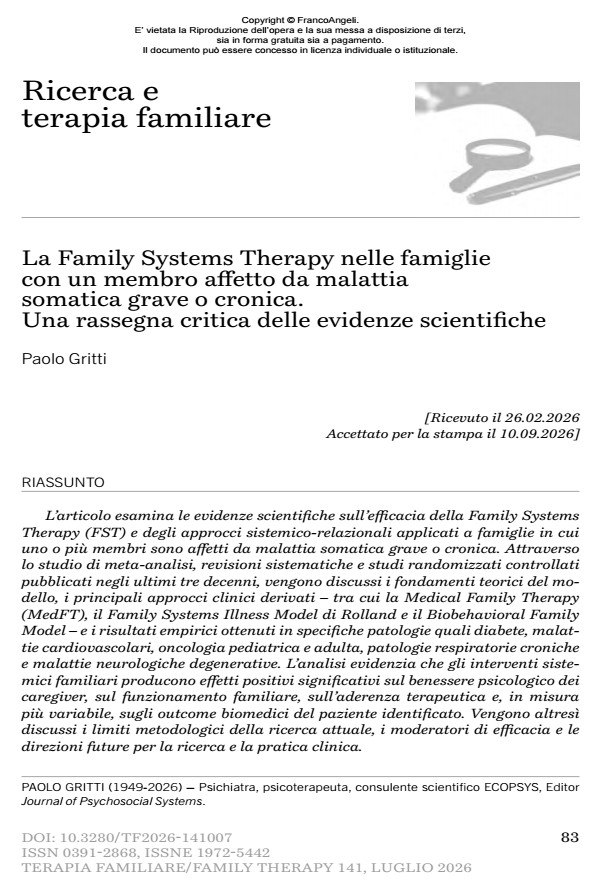
This paper systematically examines the scientific evidence on the efficacy of Family Systems Therapy (FST) and systemicrelational approaches applied to families in which one or more members are affected by serious or chronic somatic illness. Through the analysis of metaanalyses, systematic reviews, and randomized controlled trials published over the past three decades, the theoretical foundations of the model are discussed, along with the main derived clinical approaches – including Medical Family Therapy (MedFT), Rolland’s Family Systems Illness Model, and the Biobehavioral Family Model – and the empirical results obtained in specific conditions such as diabetes, cardiovascular diseases, pediatric and adult oncology, chronic respiratory diseases, and degenerative neurological conditions. The analysis shows that systemic family interventions produce significant positive effects on caregivers’ psychological wellbeing, family functioning, therapeutic adherence and, to a more variable degree, on the biomedical outcomes of the identified patient. Methodological limitations of current research, efficacy moderators, and future directions for research and clinical practice are also discussed.
Keywords: family systems therapy, chronic illness, medical family therapy, caregiver, biopsychosocial, family interventions.
- Allen M., Scarinci N., Hickson L. (2018). Patient and familycentred care for young people with chronic disease. A systematic review. Patient, 11(4): 399416.
- Anderson S.E., Whitaker R.C. (2010). Household routines and obesity in US preschoolaged children. Pediatrics, 125(3): 420428.
- Armour T.A., Norris S.L., Jack L., Zhang X., Fisher L. (2005). The effectiveness of family interventions in people with diabetes mellitus. A systematic review. Diabetic Medicine, 22: 12951305.
- Broadbent E., Petrie K.J., Main J., Weinman J. (2006). The Brief Illness Perception Questionnaire. Journal of Psychosomatic Research, 60: 631637.
- Brown g.W., Birley J.L.T., Wing J.K. (1972). Influence of family life on the course of schizophrenic disorders. British Journal of Psychiatry, 121: 241258.
- Brown g.W., Monck E.M., Carstairs g.M., Wing J.K. (1962). Influence of family life on the course of schizophrenic illness. British Journal of Preventive & Social Medicine, 16: 5568.
- Campbell T.L. (2003). The effectiveness of family interventions for physical disorders. Journal of Marital and Family Therapy, 29: 263281.
- Carneiro T. (2013). Family routines and rituals in the context of chronic conditions. A review. International Journal of Psychology, 48(5): 729746. DOI: 10.1080/00207594.2013.780080
- Carr A. (2000). Evidencebased practice in family therapy and systemic consultation. Journal of Family Therapy, 22: 2960. DOI: 10.1111/14676427.00137
- Carr A. (2009). The effectiveness of family therapy and systemic interventions for adultfocused problems. Journal of Family Therapy, 31: 4674.
- Carr A. (2019). Family therapy and systemic interventions for childfocused problems. The current evidence base. Journal of Family Therapy, 41: 153213. DOI: 10.1111/14676427.12226
- Carr A. (2020). Evidence for the efficacy and effectiveness of systemic family therapy. In: Wampler K.S. (ed.), The handbook of systemic family therapy, vol. 1, pp. 119146. Hoboken: Wiley.
- Carr A. (2025). Couple therapy and systemic interventions for adultfocused problems. The evidence base. Journal of Family Therapy, 47(1): e12481. DOI: 10.1111/14676427.12481
- Carter E.A., McGoldrick M. (eds.) (1980). The family life cycle. A framework for family therapy. New York: Gardner Press.
- Chow S., Majmudar R., Haber E., Nataraj N., Murtagh Kurowski E., Gray M. (2023). Familycentered care interventions for children with chronic conditions. A scoping review. Academic Pediatrics, 23(3): 509520.
- ClarkeSteffen L. (1993). A model of the family transition to living with childhood cancer. Cancer Practice, 1(4): 285292.
- Cohen M.S. (1999). Families coping with childhood chronic illness. A research review. Families, Systems & Health, 17(2): 149164.
- Coleman E.A., Parry C., Chalmers S., Min S.J. (2004). Preparing patients and caregivers to participate in care delivered across settings. The Care Transitions Intervention. Journal of the American Geriatrics Society, 52(11): 18171825.
- Crespo C., Santos S., Canavarro M.C., Kielpikowski M., Pryor J. e FéresDashiff C.J. (1993). Parents’ perceptions of diabetes in adolescent daughters and its impact on the family. Journal of Pediatric Nursing, 8(6): 361369.
- de Rotrou J., Cantegreil I., Faucounau V., Wenisch E., Chausson C., Gallagher D., Rigaud A.S. (2011). Do patients diagnosed with Alzheimer’s disease benefit from a psychoeducational programme for family caregivers? A randomised controlled study. International Journal of Geriatric Psychiatry, 26(8): 833842.
- Deek H., Hamilton S., Brown N., Inglis S.C., Digiacomo M., Newton P.J., Noureddine S., MacDonald P.S., Davidson P.M. (2016). Familycentred approaches to healthcare interventions in chronic diseases in adults: a quanti tative systematic review. Journal of Advanced Nursing, 72(5): 968979.
- Eccleston C., Palermo T.M., Fisher E., Law E. (2012). Psychological interventions for parents of children and adolescents with chronic illness. Cochrane Database of Systematic Reviews, 15, 4(4): CD009660.pub3. DOI: 10.1002/14651858.CD009660
- Ellis D.A., Frey M.A., NaarKing S., Templin T., Cunningham P. e Cakan N. (2005). The effects of multisystemic therapy on diabetes stress among adolescents with chronically poorly controlled type 1 diabetes. Diabetes Care, 28: 16041610.
- Engel g.L. (1977). The need for a new medical model. A challenge for biomedicine. Science, 196(4287): 129136.
- McDaniel S.H., Doherty W.J., Hepworth J. (2014). Medical family therapy and integrated care (II ed.). APA Publications.
- Etemadifar S., Bahrami M., Shahriari M., Farsani A.K. (2014). The effectiveness of a supportive educative group intervention on family caregiver burden of patients with heart failure. Iran Journal of Nursing and Midwifery Research, 19(3): 217223.
- Fiese B.H., Tomcho T.J., Douglas M., Josephs K., Poltrock S., Baker T. (2002). A review of 50 years of research on naturally occurring family routines and rituals: Cause for celebration? Journal of Family Psychology, 16(4): 381390. DOI: 10.1037//08933200.16.4.381
- Gilliss C.L., Pan W., Davis L.L. (2019). Family involvement in adult chronic disease care: Reviewing the systematic reviews. Journal of Family Nursing, 25(1): 327. DOI: 10.1177/1074840718822365
- Goldstein G., Kenet G. (2002). The impact of chronic disease on the family. Haemophilia, 8(3): 461465.
- Gonzalez S., Steinglass P., Reiss D. (1989). Putting the illness in its place: Discussion groups for families with chronic medical illnesses. Family Process, 28: 6987.
- Gritti P. (2021). La psicoterapia sistemicorelazionale nel contesto clinico della oncologia. In: Gabanelli P. (a cura di), Psicoterapie in PsicoOncologia. 4978. Milano: Mimesis Edizioni.
- Gritti P. (2022). Interventi con la famiglia in medicina palliativa. In: Grassi L. (a cura di), Cure psicosociali in medicina palliativa (pp. 163169). Milano: Poletto Editore.
- Hartmann M., Bäzner E., Wild B., Eisler I., Herzog W. (2010). Effects of interventions involving the family in the treatment of adult patients with chronic physical diseases. A metaanalysis. Psychotherapy and Psychosomatics, 79(3): 136 148. DOI: 10.1159/000286958
- Jerrett M.D. (1994). Parents’ experience of coming to know the care of a chronically ill child. Journal of Advanced Nursing, 19(6): 10501056.
- KiecoltGlaser J.K., Glaser R., Shuttleworth E.C., Dyer C.S., Ogrocki P. e Speicher C.E. (1987). Chronic stress and immunity in family caregivers of Alzheimer’s disease victims. Psychosomatic Medicine, 49(5): 523535. DOI: 10.1097/0000684219870900000008
- KiecoltGlaser J.K., Preacher K.J., MacCallum R.C., Atkinson C., Malarkey W.B., glaser R. (2003). Chronic stress and agerelated increases in the proinflammatory cytokine IL6. Proceedings of the National Academy of Sciences, 100(15): 90909095.
- Knafl K.A., gilliss C.L. (2002). Families and chronic illness. A synthesis of current research. Journal of Family Nursing, 8(3): 178198. DOI: 10.1177/107484070200800302
- Lamson A.L., Meadors P., Fielder R.L., Holloway N., Stewart A.L. & Hodge T.L. (2022). A strategic review of couple and family interventions for highmortality health conditions (20102019). Journal of Marital and Family Therapy, 48(2): 307345.
- Law E.F., Fisher E., Fales J., Noel M., Eccleston C. (2014). Systematic review and metaanalysis of parent and familybased interventions for children and adolescents with chronic medical conditions. Journal of Pediatric Psychology, 39(8): 866886.
- Leventhal H., Brissette I., Leventhal E.A. (2003). The commonsense model of selfregulation of health and illness. In: Cameron L.D., Leventhal H. (eds.), The SelfRegulation of Health and Illness Behaviour. New Jersey: Routledge.
- Martire L.M., Lustig A.P., Schulz R., Miller G.E., Helgeson V.S. (2004). Is it beneficial to involve a family member? A metaanalysis of psychosocial interventions for chronic illness. Health Psychology, 23(6): 599611. DOI: 10.1037/02786133.23.6.599
- Martire L.M., Schulz R., Helgeson V.S., Small B.J., Saghafi E.M. (2010). Review and metaanalysis of coupleoriented interventions for chronic illness. Annals of Behavioral Medicine, 40(3): 325342.
- McDaniel S.H., Hepworth J., Doherty W.J. (1992). Medical family therapy. A biopsychosocial approach to families with health problems. New York: Basic Books.
- Mestre T., Rocha M., Santos M.R., Lucas H., de São José J.M.S. (2024). Family selfcare in the management of chronic disease. A conceptual paper. SAGE Open Nursing, 10: 17. DOI: 10.1177/23779608231226069
- Minuchin S. (1974). Families and family therapy. Harvard University Press (trad. it.: Famiglie e terapia della famiglia. Roma: Astrolabio ubaldini, 1978).
- Minuchin S., Baker L., Rosman B.L., Liebman R., Milman L., Todd T.C. (1975). A conceptual model of psychosomatic illness in children. Archives of General Psychiatry, 32: 10311038.
- Minuchin S., Rosman B.L., Baker L. (1978). Psychosomatic families. Anorexia nervosa in context. Harvard University Press (trad. it.: Famiglie psicosomatiche. L’anoressia mentale nel contesto familiare. Roma: Astrolabio Ubaldini, 1980).
- Mittelman M.S., Roth D.L., Coon D.W., Haley W.E. (2004). Sustained benefit of supportive intervention for depressive symptoms in caregivers of patients with Alzheimer’s disease. American Journal of Psychiatry, 161(5): 850856.
- Osservatorio Nazionale sulla Salute nelle Regioni Italiane (Osservasalute) (2025). Rapporto Osservasalute 2025: Stato di salute e qualità dell’assistenza nelle Regioni Italiane. Osservatorio Nazionale sulla Salute nelle Regioni Italiane.
- Pai A.L.H., Drotar D., Zebracki K., Moore M., Youngstrom E. (2006). A metaanalysis of the effects of psychological interventions in pediatric oncology on outcomes of psychological distress and adjustment. Journal of Pediatric Psychology, 31: 978988.
- Patterson J.M., Garwick A.W. (1994). The impact of chronic illness on families. A family systems perspective. Annals of Behavioral Medicine, 16(2): 131142.
- Pratt K.J., Sonney J.T. (2020). Family science and familybased research in integrated and health care contexts: Future considerations for Families, Systems, & Health. Families, Systems, & Health, 38(1): 15.
- Remien R.H., Stirratt M.J., Dolezal C., Dognin J.S., Wagner G.J., CarballoDiéguez A., ElBassel N., Jung T.M. (2005). Couplefocused support to improve HIV medication adherence. A randomized controlled trial. AIDS, 19(8): 807814.
- Rolland J.S. (1987). Chronic illness and the life cycle. A conceptual framework. Family Process, 26: 203221.
- Rolland J.S. (1990). Anticipatory loss. A family systems developmental framework. Family Process, 29(3): 229244.
- Rolland J.S. (1994). Families, illness, and disability. An integrative treatment model. New York: Basic Books.
- Rolland J.S. (2018). Helping couples and families navigate illness and disability. An integrative approach. New York: Guilford Press.
- Rolland J.S. (2025). Chronic illness and disability. A multisystemic practice model. Journal of Family Nursing, 31(2): 6374. DOI: 10.1177/10748407251329694
- Rosland A.M., Heisler M., Piette J.D. (2010). Emerging models for mobilizing family support for chronic disease management. A structured review. Chronic Illness, 6(1): 721. DOI: 10.1177/1742395309352254
- Sexton T.L., Whiston S.C., Bleuer J.C., Walz g.R. (1997). Integrating outcome research into counseling practice and training. American Counseling Association.
- Sousa H., Ribeiro O., Afreixo V., Costa E., Paul C., Ribeiro F., Figueiredo D. (2021). “Should WE Stand Together?”. A systematic review and metaanalysis of the effectiveness of familybased interventions for adults with chronic physical diseases. Family Process, 60(4): 10981116.
- Sprenkle D.H. (2012). Intervention research in couple and family therapy. A methodological and substantive review and an introduction to the special issue. Journal of Marital and Family Therapy, 38(1): 429.
- Stratton P. (2011). The evidence base of family therapy and systemic practice. Association for Family Therapy. www.aft.org.uk.
- Von Sydow K., Beher S., Schweitzer J., Retzlaff R. (2010). The efficacy of systemic therapy with adult patients. A metacontent analysis of 38 randomized controlled trials. Family Process, 49(4): 457485.
- Wearden A.J., Cook L., Tarrier N. (2000). A survey of expressed emotion in the significant others of people with type II diabetes. Journal of Psychosomatic Research, 48: 369373.
- Weihs K., Fisher L., Baird M. (2002). Families, health, and behavior. Families, Systems & Health, 20(1): 746.
- Weisman de Mamani A., Tuchman N., Duarte E.A., Eibel B., Vargas C., Gurak K. (2014). Expressed emotion and its relationship to pediatric obsessivecompulsive disorder and attention deficit/hyperactivity disorder. Psychiatry Research, 216(1): 133138.
- Whyte F.A. (1992). A family nursing approach to the care of a child with cystic fibrosis. Journal of Advanced Nursing, 17(3): 317327.
- Wood B.L. (1993). Beyond the “psychosomatic family”. A biobehavioral family model of pediatric illness. Family Process, 32: 261278.
- Wood B.L. (2000). A biobehavioral family model. Researchbased interventions for pediatric asthma. In: Drotar D. (ed.), Handbook of research in pediatric and clinical child psychology, pp. 427452. Dordrecht: Kluwer Academic.
- Wood B.L., Lim J., Miller B.D., Cheah P.A., Zwetsch T., Ramesh S., Simmens S. (2008). Family emotional climate, depression, emotional triggering of asthma, and disease severity in pediatric asthma. Journal of Pediatric Psychology, 33(9): 10761088.
- Wood B.L., Watkins J.B., Boyle J.T., Nogueira J., Zimand E., Carroll L. (1989). The “psychosomatic family” model. An empirical and theoretical analysis. Family Process, 28(4): 399417.
- Wuest J., Stern P.N. (1990). The impact of role making on family coping with juvenile rheumatoid arthritis. Rehabilitation Nursing, 15(4): 174179.
- Wysocki T., Harris M.A., Buckloh L.M. et al. (2007). Randomized trial of behavioral family systems therapy for diabetes: Maintenance of effects on diabetes outcomes in adolescents. Diabetes Care, 30: 555560.
Paolo Gritti, La Family Systems Therapy nelle famiglie con un membro affetto da malattia somatica grave o cronica. Una rassegna critica delle evidenze scientifiche in "TERAPIA FAMILIARE" 141/2026, pp 83-103, DOI: 10.3280/TF2026-141007