Economic sociology and the Olympic Games: a social lens on global economic impact
Titolo Rivista SOCIOLOGIA E RICERCA SOCIALE
Autori/Curatori Valerio della Sala
Anno di pubblicazione 2026 Fascicolo 2025/138
Lingua Inglese Numero pagine 28 P. 94-121 Dimensione file 250 KB
DOI 10.3280/SR2025-138005
Il DOI è il codice a barre della proprietà intellettuale: per saperne di più
clicca qui
Qui sotto puoi vedere in anteprima la prima pagina di questo articolo.
Se questo articolo ti interessa, lo puoi acquistare (e scaricare in formato pdf) seguendo le facili indicazioni per acquistare il download credit. Acquista Download Credits per scaricare questo Articolo in formato PDF
FrancoAngeli è membro della Publishers International Linking Association, Inc (PILA), associazione indipendente e non profit per facilitare (attraverso i servizi tecnologici implementati da CrossRef.org) l’accesso degli studiosi ai contenuti digitali nelle pubblicazioni professionali e scientifiche.
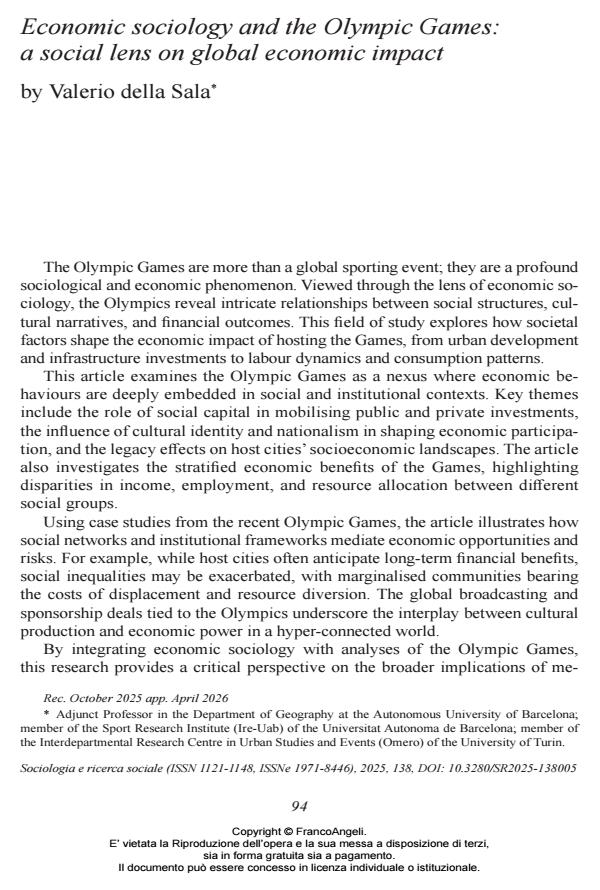
The Olympic Games are more than a global sporting event; they are a pro-found sociological and economic phenomenon. Viewed through the lens of economic sociology, the Olympics reveal intricate relationships between social structures, cultural narratives, and financial outcomes. This field of study ex-plores how societal factors shape the economic impact of hosting the Games, from urban development and infrastructure investments to labour dynamics and consumption patterns. This article examines the Olympic Games as a nexus where economic be-haviours are deeply embedded in social and institutional contexts. Key themes include the role of social capital in mobilising public and private investments, the influence of cultural identity and nationalism in shaping economic participa-tion, and the legacy effects on host cities’ socioeconomic landscapes. The arti-cle also investigates the stratified economic benefits of the Games, highlighting disparities in income, employment, and resource allocation between different social groups. Using case studies from the recent Olympic Games, the article illustrates how social networks and institutional frameworks mediate economic opportunities and risks. For example, while host cities often anticipate long-term financial benefits, social inequalities may be exacerbated, with marginalised communities bearing the costs of displacement and resource diversion. The global broadcasting and sponsorship deals tied to the Olympics underscore the interplay between cultural production and economic power in a hyperconnected world. By integrating economic sociology with analyses of the Olympic Games, this research provides a critical perspective on the broader implications of me-ga-events. It argues for more equitable and sustainable approaches to planning and evaluating such events, emphasising the need to balance economic ambitions with social responsibilities.
Valerio della Sala, Economic sociology and the Olympic Games: a social lens on global economic impact in "SOCIOLOGIA E RICERCA SOCIALE " 138/2025, pp 94-121, DOI: 10.3280/SR2025-138005