Identities, Otherness, and Mental Health: from Discrimination to Social Resilience
Titolo Rivista RIVISTA SPERIMENTALE DI FRENIATRIA
Autori/Curatori Antonio Ventriglio, Fabiana Ricci, Daniela Giallanella, Julio Torales, João Maurício Castaldelli-Maia, Tomás Caycho-Rodríguez, Antonello Bellomo
Anno di pubblicazione 2026 Fascicolo 2026/2
Lingua Inglese Numero pagine 16 P. 55-70 Dimensione file 264 KB
DOI 10.3280/RSF2026-002004
Il DOI è il codice a barre della proprietà intellettuale: per saperne di più
clicca qui
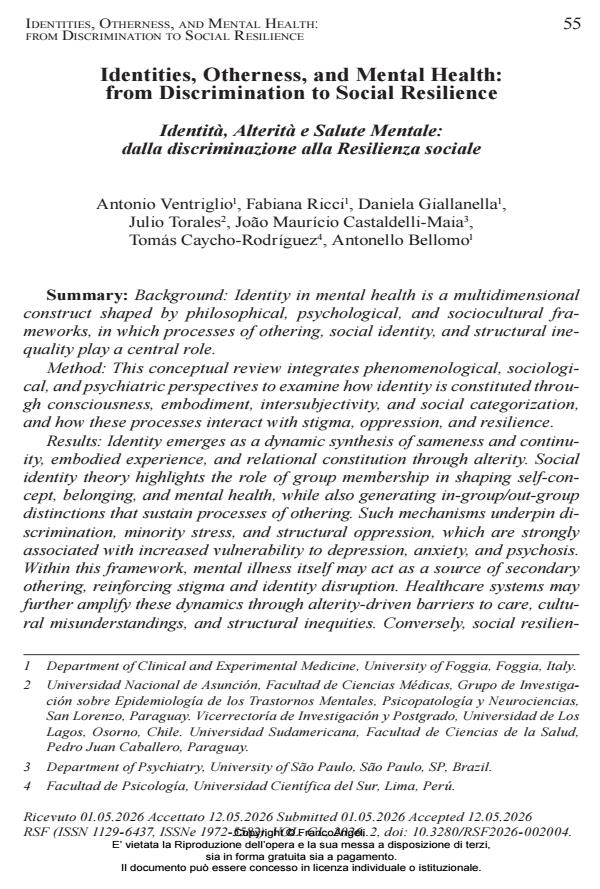
Qui sotto puoi vedere in anteprima la prima pagina di questo articolo.
Se questo articolo ti interessa, lo puoi acquistare (e scaricare in formato pdf) seguendo le facili indicazioni per acquistare il download credit. Acquista Download Credits per scaricare questo Articolo in formato PDF
FrancoAngeli è membro della Publishers International Linking Association, Inc (PILA), associazione indipendente e non profit per facilitare (attraverso i servizi tecnologici implementati da CrossRef.org) l’accesso degli studiosi ai contenuti digitali nelle pubblicazioni professionali e scientifiche.
Background: Identity in mental health is a multidimensional construct shaped by philosophical, psychological, and sociocultural frameworks, in which processes of othering, social identity, and structural inequality play a central role. Method: This conceptual review integrates phenomenological, sociological, and psychiatric perspectives to examine how identity is constituted through consciousness, embodiment, intersubjectivity, and social categorization, and how these processes interact with stigma, oppression, and resilience. Results: Identity emerges as a dynamic synthesis of sameness and continuity, embodied experience, and relational constitution through alterity. Social identity theory highlights the role of group membership in shaping selfconcept, belonging, and mental health, while also generating ingroup/outgroup distinctions that sustain processes of othering. Such mechanisms underpin discrimination, minority stress, and structural oppression, which are strongly associated with increased vulnerability to depression, anxiety, and psychosis. Within this framework, mental illness itself may act as a source of secondary othering, reinforcing stigma and identity disruption. Healthcare systems may further amplify these dynamics through alteritydriven barriers to care, cultural misunderstandings, and structural inequities. Conversely, social resilience plays as a protective and complementary process that reinforces individual identity by fostering belonging, cohesion, and shared identity reconstruction. Conclusions: Identity is a socially embedded, relational, and dynamic construct continuously shaped by otherness, structural inequality, and resilience processes. Strengthening social resilience and inclusive systems is essential to contrast stigma, inequities, and promote both personal and collective identity integration.
Background: L’identità rappresenta un costrutto multidimensionale, definito da aspetti filosofici, psicologici e socioculturali, all’interno dei quali i processi di Othering, l’identità sociale e le disuguaglianze strutturali della società svolgono un ruolo centrale. Metodi: Questa analisi concettuale integra prospettive fenomenologiche, sociologiche e psichiatriche al fine di esaminare come l’identità si costituisca attraverso la coscienza, l’embodiment, l’intersoggettività e la categorizzazione sociale, nonché come tali processi interagiscano con fenomeni sociali come lo stigma, l’oppressione e la resilienza. Risultati: L’identità emerge come una sintesi dinamica di senso di sé, continuità, esperienza incarnata e costituzione relazionale attraverso l’alterità. Il costrutto di identità sociale evidenzia il ruolo dell’appartenenza ai gruppi sociali nel plasmare il concetto di sé, il senso di appartenenza e la salute mentale, generando al contempo distinzioni tra ingroup e outgroup che alimentano processi di Othering. Tali meccanismi sono alla base di discriminazione, stress da minoranza e oppressione strutturale, fortemente associati a una maggiore vulnerabilità per depressione, ansia e psicosi. In questo quadro, la malattia mentale stessa può configurarsi come una forma di Othering secondario, rafforzando stigma e frammentazione identitaria. I sistemi sanitari possono ulteriormente includere queste dinamiche attraverso barriere di accesso basate sull’alterità, incompetenza culturale e disuguaglianze strutturali. Al contrario, la resilienza sociale si configura come un processo protettivo e complementare, in grado di rafforzare l’identità individuale promuovendo appartenenza, coesione e ricostruzione identitaria condivisa. Conclusioni: L’identità è un costrutto relazionale, dinamico e socialmente fondato, continuamente plasmato dall’alterità, dalle disuguaglianze strutturali e dai processi di resilienza. Il rafforzamento della resilienza sociale e di sistemi inclusivi è essenziale per contrastare lo stigma, ridurre le disuguaglianze e promuovere l’integrazione dell’identità sia a livello individuale che collettivo.
Parole chiave:Identità, Alterità, Identità sociale, Discriminazione, Resilienza sociale.
- [1.] Husserl E. On the phenomenology of the consciousness of internal time (18931917). Dordrecht: Kluwer Academic Publishers; 1991.
- [2.] Ricoeur P. Oneself as another. Chicago: University of Chicago Press; 1992.
- [3.] MerleauPonty M. Phénoménologie de la perception. Paris: Gallimard; 1945.
- [4.] Levinas E. Totalité et infini: essai sur l’extériorité. La Haye: Martinus Nijhoff; 1961.
- [5.] Sartre JP. Being and nothingness: an essay on phenomenological ontology. London: Routledge; 2003.
- [6.] Erikson EH. Identity: youth and crisis. New York: Norton; 1968.
- [7.] Harris HW. Introduction: a conceptual overview of race, ethnicity and identity. In: Harris HW, Blue HC, Griffith EH, ed. Racial and ethnic identity. London: Routledge; 1995. p. 114.
- [8.] Morris B. Anthropology of the self: the individual in the cultural perspective. London: Pluto Press; 1994.
- [9.] Sollberger D. On identity: from a philosophical point of view. Child and Adolescent Psychiatry and Mental Health 2013; 7(1): 29. DOI: 10.1186/1753200072
- [10.] Wachter M, Ventriglio A, Bhugra D. Microidentities, adjustment and stigma. The International Journal of Social Psychiatry 2015; 61(5): 436 7. DOI: 10.1177/002076401559008
- [11.] Lacan J. Écrits. New York: Norton; 2006.
- [12.] Abbagnano N. Dizionario di filosofia. Torino: UTET; 1971.
- [13.] Bindan D. Ape to Apollo: aesthetics and the idea of race in the 18th century. London: Reaction Books; 2002.
- [14.] Said EW. Orientalism. New York: Pantheon Books; 1978.
- [15.] Isaac B. The invention of racism in classical antiquity. Princeton: Princeton University Press; 2006.
- [16.] Snowden FM. Before color prejudice: the ancient view of blacks. Cambridge: Harvard University Press; 1983.
- [17.] Kapuscinski R. The other. London: Verso; 2009.
- [18.] Bhugra D, Bhui K. Racism in psychiatry: paradigm lost–paradigm regained. Int Rev Psychiatry 1999; 11(23): 23643.
- [19.] Tajfel H, Turner JC. The social identity theory of intergroup behavior. In: Worchel S, Austin WG, ed. Psychology of intergroup relations. Chicago: NelsonHall; 1986. p. 724.
- [20.] Hogg MA, Abrams D. Social identifications: a social psychology of intergroup relations and group processes. London: Routledge; 1988. health: findings from Tibetan college students in China. Front Psychol 2021; 12, 747515.
- [22.] Zevallos Z. What is otherness? 2011. Available at: https://othersociologist.com/othernessresources/.
- [23.] Dingle GA, Cruwys T, Frings D. Social identities as pathways into and out of addiction. Front Psychol 2015; 6: 1795.
- [24.] Jensen SQ. Othering, identity formation and agency. Qualitative Studies 2011; 2(2): 6378.
- [25.] [25] Okolie AC. Introduction to the special issue – identity: now you don’t see it; now you do. Identity 2003; 3(1): 17. DOI: 10.1207/S1532706XID0301_01
- [26.] Canales MK. Othering: toward an understanding of difference. J Adv Nurs 2000; 22(4): 1631. DOI: 10.1097/0001227220000600000003
- [27.] Akbulut N, Razum O. Why othering should be considered in research on health inequalities: theoretical perspectives and research needs. Soc Sci Med Popul Health 2022; 20, 101286.
- [28.] McManus S, Bebbington P, Jenkins R, Brugha T, ed. Mental health and wellbeing in England: adult psychiatric morbidity survey 2014. Leeds: NHS Digital; 2016.
- [29.] Wallace S, Nazroo J, Bécares L. Cumulative effect of racial discrimination on the mental health of ethnic minorities in the United Kingdom. Am J Public Health 2016; 106(7): 1294300. DOI: 10.2105/AJPH.2016.303121
- [30.] NHS Digital. Psychological therapies: annual report on the use of IAPT services England, 201516. Leeds: NHS Digital; 2016.
- [31.] Meyer IH. Prejudice, social stress, and mental health in lesbian, gay, and bisexual populations: conceptual issues and research evidence. Psychol Bull 2003; 129(5): 67497. DOI: 10.1037/00332909.129.5.674
- [32.] Ricci F, Torales J, Bener A, CastaldelliMaia JM, Chumakov E, Bellomo A, Ventriglio A. Mental health of ethnic minorities: the role of racism. Int Rev Psychiatry 2023; 35(34): 25867. DOI: 10.1080/09540261.2023.2189951
- [33.] Herman G. Ritualised friendship and the Greek city. Cambridge: Cambridge University Press; 1987.
- [34.] Benveniste É. IndoEuropean language and society. Miami: University of Miami Press; 1973.
- [35.] LéviStrauss C. The savage mind. Chicago: University of Chicago Press; 1966.
- [36.] Bauman Z. Modernity and ambivalence. Ithaca: Cornell University Press; 1991.
- [37.] Allport GW. The nature of prejudice. Reading: AddisonWesley; 1954.
- [38.] Jensen SQ. Othering, identity formation and agency. Qualitative Studies 2011; 2(2): 6378.
- [39.] Gilbert P. Depression. In: The evolution of powerlessness. Hove: Psychology Press; 1992.
- [40.] Allen NB, Badcock PB. The social risk hypothesis of depressed mood: evolutionary, psychosocial, and neurobiological perspectives. Psychol Bull 2003; 129(6): 887913. DOI: 10.1037/00332909.129.6.887
- [41.] Rüsen J. How to overcome ethnocentrism: approaches to a culture of recognition by history in the twentyfirst century. Hist Theory 2004; 43(4): 11829.
- [42.] Ventriglio A, CastaldelliMaia JM, Torales J, Chumakov E, De Berardis D, Bhugra D. New approaches for mental health of social minorities. Int Rev Psychiatry 2022; 34(78): 7609. DOI: 10.1080/09540261.2022.2133993
- [43.] Ricci F, Torales J, Bener A, CastaldelliMaia JM, Chumakov E, Bellomo A, Ventriglio A. Mental health of ethnic minorities: the role of racism. Int Rev Psychiatry 2023; 35(34): 25867. DOI: 10.1080/09540261.2023.2189951
- [44.] Díaz RM, Ayala G, Bein E, Henne J, Marin BV. The impact of homophobia, poverty, and racism on the mental health of gay and bisexual Latino men: findings from 3 US cities. Am J Public Health 2001; 91(6): 92732.
- [45.] Bourque F, van der Ven E, Malla A. A metaanalysis of the risk for psychotic disorders among first and secondgeneration immigrants. Psychol Med 2011; 41(5): 897910. DOI: 10.1017/S0033291710001406
- [46.] Bardol O, Grot S, Oh H, Poulet E, ZerougVial H, Brunelin J, Leaune
- E. Perceived ethnic discrimination as a risk factor for psychotic symptoms: a systematic review and metaanalysis. Psychol Med 2020; 50(7): 107789. DOI: 10.1017/S003329172000094X
- [47.] Best MW, Bowie CR. Social exclusion in psychotic disorders: an interactional processing model. Schizophr Res 2022; 244: 91100.
- [48.] CantorGraae E, Selten JP. Schizophrenia and migration: a metaanalysis and review. Am J Psychiatry 2005; 162(1): 1224.
- [49.] Ventriglio A, Gaggiano C, Ricci F, Giallanella D, Luciano M, Sampogna G, Della Rocca B, Di Vincenzo M, Fiorillo A, Bellomo A. Hospitalization trends among immigrants and natives in an acute psychiatric service: a descriptive study from Italy. Int Rev Psychiatry 2025; 37(34): 20310.
- [50.] Lazaridou FB, Schubert SJ, Ringeisen T, Kaminski J, Heinz A, Kluge U. Racism and psychosis: an umbrella review and qualitative analysis of the mental health consequences of racism. Eur Arch Psychiatry Clin Neurosci 2022: 114.
- [51.] Bhugra D, Watson C, Ventriglio A. Migration, cultural capital and acculturation. Int Rev Psychiatry 2021; 33(12): 12631. DOI: 10.1080/09540261.2020.1733786
- [52.] Della Rocca B, Di Vincenzo M, Giallanella D, Gaggiano C, Martinelli F, Ricci F, Sampogna G, Luciano M, Ventriglio A, Bellomo A, Fiorillo A. Acculturation stress and mental health outcomes in a sample of migrant inpatients: findings from a naturalistic study. Int J Soc Psychiatry 2025; 71(2): 32837. DOI: 10.1177/00207640241291506
- [53.] Huebner DM, Kegeles SM, Rebchook GM, Peterson JL, Neilands TB, Johnson WD, Eke AN. Social oppression, psychological vulnerability, and unprotected intercourse among young Black men who have sex with men. Health Psychol 2014; 33(12): 156878.
- [54.] Bhugra D, Smith A, Liebrenz M, Ventriglio A, Gnanapragasam SN, Buadze A, Pemberton M, Poulter D. “Otherness”, otherism, discrimination, and health inequalities: entrenched challenges for modern psychiatric disciplines. Int Rev Psychiatry 2023; 35(34): 23441. DOI: 10.1080/09540261.2023.2192275
- [55.] Crenshaw K. Demarginalizing the intersection of race and sex: a Black feminist critique of antidiscrimination doctrine, feminist theory and antiracist politics. Univ Chicago Legal Forum 1989; 1989: 13967.
- [56.] Bhugra D, Ventriglio A. Others, othering, otherism and social psychiatry. Int J Soc Psychiatry 2024; 70(5): 8378. DOI: 10.1177/00207640241269086
- [57.] Silveri G, Schimmenti S, Prina E, Gios L, Mirandola M, Converti M, Fiorillo A, Pinna F, Ventriglio A, Galeazzi GM, Sherriff N, Zeeman L, Amaddeo F, Italian Working Group on LGBTQI Mental Health. Barriers in care pathways and unmet mental health needs in LGBTIQ+ communities. Int Rev Psychiatry 2022; 34(34): 21529. DOI: 10.1080/09540261.2022.2075256
- [58.] Persaud A, Bhugra D, Ventriglio A. Addressing visa inequities in health: a geopsychiatry perspective. J R Soc Med 2025; 118(1): 269. DOI: 10.1177/01410768241290726
- [59.] Walsh D, Foster J. Understanding the public stigma of mental illness: a mixedmethods, multilevel, exploratory triangulation study. BMC Psychol 2024; 12(1): 403.
- [60.] Ren Y, Wang S, Fu X, Shi X. A systematic review and metaanalysis of implicit stigma toward people with mental illness among different groups: measurement, extent, and correlates. Psychol Res Behav Manag 2025; 18: 85175. DOI: 10.2147/PRBM.S503942
- [61.] Adger WN. Social and ecological resilience: are they related? Prog
- [62.] Ventriglio A, Torales J, CastaldelliMaia JM. Social resilience and collective mental health. Int J Soc Psychiatry 2025; 71(4): 61921. DOI: 10.1177/00207640251347683
- [63.] Ventriglio A, Ricci F, Torales J, CastaldelliMaia JM, Bener A, Smith A, Liebrenz M. Navigating a world in conflict: the mental health implications of contemporary geopolitical crises. Ind Psychiatry J 2024; 33(Suppl 1): S26871.
Antonio Ventriglio, Fabiana Ricci, Daniela Giallanella, Julio Torales, João Maurício Castaldelli-Maia, Tomás Caycho-Rodríguez, Antonello Bellomo, Identities, Otherness, and Mental Health: from Discrimination to Social Resilience in "RIVISTA SPERIMENTALE DI FRENIATRIA" 2/2026, pp 55-70, DOI: 10.3280/RSF2026-002004