Voci dai margini: COVID-19 e l’esperienza abitativa precaria dei migranti poco qualificati in Italia
Titolo Rivista MONDI MIGRANTI
Autori/Curatori Senyo Dotsey
Anno di pubblicazione 2026 Fascicolo 2026/2
Lingua Italiano Numero pagine 25 P. 160-184 Dimensione file 291 KB
DOI 10.3280/MM2026-002009
Il DOI è il codice a barre della proprietà intellettuale: per saperne di più
clicca qui
Qui sotto puoi vedere in anteprima la prima pagina di questo articolo.
Se questo articolo ti interessa, lo puoi acquistare (e scaricare in formato pdf) seguendo le facili indicazioni per acquistare il download credit. Acquista Download Credits per scaricare questo Articolo in formato PDF
FrancoAngeli è membro della Publishers International Linking Association, Inc (PILA), associazione indipendente e non profit per facilitare (attraverso i servizi tecnologici implementati da CrossRef.org) l’accesso degli studiosi ai contenuti digitali nelle pubblicazioni professionali e scientifiche.
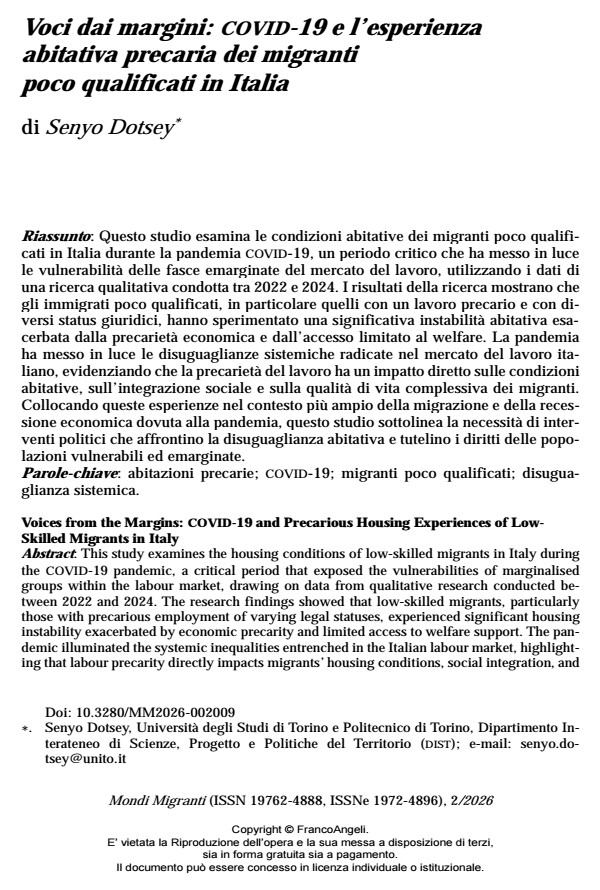
Questo studio esamina le condizioni abitative dei migranti poco qualificati in Italia durante la pandemia COVID-19, un periodo critico che ha messo in luce le vulnerabilità delle fasce emarginate del mercato del lavoro, utilizzando i dati di una ricerca qualitativa condotta tra 2022 e 2024. I risultati della ricerca mostrano che gli immigrati poco qualificati, in particolare quelli con un lavoro precario e con diversi status giuridici, hanno sperimentato una significativa instabilità abitativa esacerbata dalla precarietà economica e dall’accesso limitato al welfare. La pandemia ha messo in luce le disuguaglianze sistemiche radicate nel mercato del lavoro italiano, evidenziando che la precarietà del lavoro ha un impatto diretto sulle condizioni abitative, sull’integrazione sociale e sulla qualità di vita complessiva dei migranti. Collocando queste esperienze nel contesto più ampio della migrazione e della recessione economica dovuta alla pandemia, questo studio sottolinea la necessità di interventi politici che affrontino la disuguaglianza abitativa e tutelino i diritti delle popolazioni vulnerabili ed emarginate.
Parole chiave:abitazioni precarie; COVID-19; migranti poco qualificati; disuguaglianza sistemica.
- Ager A. e Strang A. (2008). Understanding integration: A conceptual framework. Journal of Refugee Studies, 21, 2: 166-191; https://doi.org/10.1093/jrs/fen016/.
- Alberti G., Bessa I., Hardy K., Trappmann V. e Umney, C. (2018). In, Against and Beyond Precarity: Work in Insecure Times. Work, Employment and Society, 32, 3: 447-457; https://doi.org/10.1177/0950017018762088/.
- Anderson B. (2012). Who Needs Them? Care Work, Migration and Public Policy. Cuadernos de Relaciones Laborales, 30, 1: 45-61; https://doi.org/10.5209/rev_CRLA.2012.v30.n1.39113/.
- Anderson B. (2010). Migration, immigration controls and the fashioning of precarious workers. Work, employment and society, 24, 2: 300-317; https://doi.org/10.1177/0950017010362141/.
- Anderson B. e Andrijasevic, R. (2008). Sex, slaves and citizens: the politics of anti-trafficking. Soundings, 40: 135-145; DOI: 10.3898/136266208820465065/
- Angeli D. (2016). Demand in the Context of Trafficking in Human Beings in the Domestic Work Sector in Cyprus, DemandAT Country Study No.2. https://cadmus.eui.eu/handle/1814/41925/.
- ANSA. (2023). Nearly 100,000 homeless in Italy says ISTAT; https://www.ansa.it/english/news/general_news/2023/01/05/nearly-100000-homeless-in-italy-says-istat_84ae3b8b-8c3a-47b1-a349-ab286a8cf5c7.html/.
- Baldini M. e Poggio T. (2012). Housing policy toward the rental sector in Italy: A distributive assessment. Housing Studies, 27, 5: 1-20; https://doi.org/10.1080/02673037.2012.697549/.
- Banki S. (2013). Precarity of place: a complement to the growing precariat literature. Global Discourse, 3, 3-4: 450-463; https://doi.org/10.1080/23269995.2014.881139/.
- Barbier J.-C. (2002). A survey of the use of the term précarité in French economics and sociology. Document de travail, 19: 1-37; https://www.sudoc.fr/160949319/.
- Beirens H., Le Coz C., Hooper K., Popp K., Schneider J. e Süss J. (2019). Legal Migration for Work and Training: Mobility Options to Europe for those not in Need of Protection. SVR’s Research Unit: Study, 2019-2, MPI Europe; https://www.migrationpolicy.org/research/legal-migration-work-and-training-mobility-options-europe/.
- Bonizzoni P. e Dotsey S. (2021). Migration and Legal Precarity in the Time of Pandemic: Qualitative Research on the Italian Case. Two Homelands, 54: 117-130; https://doi.org/10.3986/dd.2021.2.09/.
- Bourdieu P. (1998). Acts of Resistance. Against the Tyranny of the Market. New York: The New Press.
- Bourdieu P. (1963). Travail Et Travailleurs En Algérie. Mouton et Co.
- FEANTSA (2020) Feantsa Country Fiche. Italy. December 2020. https://www.feantsa.org/public/user/Resources/country_profiles/IT_-_Country_Profile_2020.pdf/.
- Centro Studi Investment Sociali (CENSIS). (2005). Housing policies and services for immigrants in Italy. http://sitiarcheologici.lavoro.gov.it/AreaLavoro/Immigrazione_SpostatoInAreaSociale/Documents/Rapportomonitoraggiopoliticheabitativeinlinguainglese.pdf/.
- Cranston S. (2017). Expatriate as a “good” migrant: Thinking through skilled international migrant categories. Population, Place and Space, 23, 6: 2058; https://doi.org/10.1002/psp.2058/.
- Dell’Olio F. (2004). Immigration and immigrant policy in Italy and the UK: is housing policy a barrier to a common approach towards immigration in the EU? Journal of Ethnic and Migration Studies, 30, 1: 107-128; https://doi.org/10.1080/1369183032000170196/.
- Dotsey S. (2026). Shelter from the storm: exploring the role of third-sector organizations in addressing migrant homelessness in Italy. In: Weishaupt J.T., Weckwerth J. and Hinrichs C., eds., Homelessness in Affluent Societies: Linking Theory and Praxis. Cheltenham, UK: Elgar.
- Dotsey S. (2024). COVID-19 and the precarious low-skilled workforce in the European Union: Time to call the shots. International Journal of Population Studies, 10, 3: 114-120; https://doi.org/10.36922/ijps.2165.
- Dotsey S. (2023). Foreign Healthcare Workers and COVID-19 in Europe: The Paradox of Unemployed Skilled Labour. Social Sciences, 12, 4: 211; https://doi.org/10.3390/socsci12040211/.
- Dotsey S. (2022). “Seeing like integration”: an exploratory study of Bergamo’s integration model, Italy. Ethnic and Racial Studies, 45, 11: 2069-2093; https://doi.org/10.1080/01419870.2021.1998566/.
- Dotsey S. (2021). Operatori sanitari stranieri e COVID-19 nell’UE: Gli ‘invisibili’ diventano ‘visibili’? Quaderni CNEL, 16: 1-29; https://doi.org/10.13140/RG.2.2.32310.27206/.
- Dotsey S. (2018). International migration and livelihood dynamics during the recent economic crisis: A study of Ghanaian migrants in the Como province, Italy. Migration and Development, 7, 1: 104-123; https://doi.org/10.1080/21632324.2017.1345146/.
- Dotsey S., Lumley-Sapanski A. e Ambrosini M. (2023). COVID-19 and (Im)migrant Carers in Italy: The Production of Carer Precarity. International Journal of Environmental Research and Public Health, 20, 12, 6108; https://doi.org/10.3390/ijerph20126108/.
- Dotsey S. e Lumley-Sapanski A. (2021). Temporality, Refugees, and Housing: The Effects of Temporary Assistance on Refugee Housing Outcomes in Italy. Cities, 111: 103100; https://doi.org/10.1016/j.cities.2020.103100/.
- Dotsey S. e Chiodelli F. (2021). Housing Precarity: A Fourfold Epistemological Lancet for Dissecting the Housing Conditions of Migrants. City, 25, 5, 6: 720-739; https://doi.org/10.1080/13604813.2021.1979802/.
- Dotsey S. e Ambrosini M. (2025). Migration, (il)legal status and housing precarity: Difficulties and coping strategies. Journal of Urban Affairs, 47, 4: 1328-1347; https://doi.org/10.1080/07352166.2023.2224021/.
- Dotsey S., Bozzi M. e Pala S. (2025). COVID-19, Employment, and (the Limits of) Legal Status: Exploring Migrants’ Precarious Experiences in Italy. American Behavioral Scientist, 0(0); https://doi.org/10.1177/00027642251367532.
- Fantone L. (2007). Precarious changes: Gender and generational politics in contemporary Italy. Feminist Review, 87, 1: 5-20; https://doi.org/10.1057/palgrave.fr.9400357/.
- Fasani F. e Mazza J. (2020a). A Vulnerable Workforce - Migrant Workers in the COVID-19 Pandemic. European Commission, Joint Research Centre; https://data.europa.eu/doi/10.2760/316665/.
- Fasani F. e Mazza J. (2020b). Immigrant Key Workers: Their Contribution to Europe’s COVID-19 Response; https://docs.iza.org/pp155.pdf/.
- Fevre R. (2007). Employment Insecurity and Social Theory: The Power of Nightmares. Work, Employment and Society, 21, 3: 517-535; https://doi.org/10.1177/0950017007080013/.
- Fix M., Demetrios G. P., Batalova J., Terrazas A., Yi-Ying Lin S. e Mittelstadt M. (2009). Migration and the global recession. A Report Commissioned by the BBC World Service. Migration Policy Institute. www.migrationpolicy.org/pubs//MPI-BBCreport- Sept09.pdf/.
- Foley L. e Piper N. (2020). COVID-19 and Women Migrant Workers: Impacts and Implications. Switzerland: IOM.
- Fondazione Leone Moressa (2015). Tasse sulla casa: Una dote di 27 milioni dai nuclei stranieri; http:// www.fondazioneleonemoressa.org/.
- Fravega E. (2022). L’abitare migrante. Racconti di vita e percorsi abitativi di migranti in Italia. Milano: Meltemi.
- Giammarinaro M.G. e Palumbo L. (2020). COVID-19 and inequalities: Protecting the human rights of migrants in a time of pandemic. Migration Policy Practice, 10, 2: 21-26. 1065067871PDFsam_2.Covid19.pdf/.
- Guadagno L. (2020). Migrants and the COVID-19 pandemic: An initial analysis. Migration Research Series.
- ILO. (2020). Impact of the COVID-19 Crisis on Loss of Jobs and Hours among Domestic Workers; https:/ www.ilo.org/wcmsp5/groups/public/.
- ISTAT. (2018). Vita e percorsi di integrazione degli immigrati in Italia. ISTAT.
- ISTAT. (2026). Aumentano le abitazioni occupate da residenti; https://www.istat.it/wp-content/uploads/2026/02/Abitazioni-occupate-Anni-2021-2023.pdf/.
- IOM-CREST (2020). COVID-19 places migrant workers in highly vulnerable situations. IOM, Ho Chi Minh City, 26 March.
- Johnson G., Scutella R., Tseng Y. e Wood G. (2015). Examining the relationship between structural factors, individual characteristics, and homelessness (AHURI Positioning Paper No. 161). Australian Housing and Urban Research Institute; https://apo.org.au/sites/default/files/resource-files/2015-01/apo-nid52649.pdf/.
- Ioannoni V. e Paluzzi E. (2023). Homeless: a new approach in Italian Population Census and Household surveys. Working paper 5. Unece: Economic Commission for Europe.
- Kalleberg A.L. (2009). Precarious Work, Insecure Workers: Employment Relations in Transition. American Sociological Review, 74, 1: 1-22. https://doi.org/10.1177/0003122409074001/.
- Kissoon P. (2010). From persecution to destitution: A snapshot of asylum seekers’ housing and settlement experiences in Canada and the United Kingdom. Journal of Immigrant & Refugee Studies, 8, 1: 4-31; https://doi.org/10.1080/15562940903575020/.
- Kuhlmann E., Falkenbach M., Klasa K., Pavolini E. e Ungureanu M-I. (2020). Migrant carers in Europe in times of COVID-19: A call to action for European health workforce governance and a public health approach. European Journal of Public Health, 30(Suppl. 4), iv22–iv27. https://doi.org/10.1093/eurpub/ckaa126.
- Leiblfinger M., Prieler V., Rogoz M. e Sekulová M. (2021). Confronted with COVID-19: Migrant live-in care during the pandemic. Glob Soc Policy, 21, 3: 490-507; DOI: 10.1177/14680181211008340
- Lewis H., Dwyer P., Hodkinson S. e Waite L. (2015). Hyper-precarious Lives: Migrants, Work and Forced Labor in the Global North. Progress in Human Geography, 39, 5: 580-600; DOI: 10.1177/0309132514548303
- Lombard M. (2021). The experience of precarity: low-paid economic migrants’ housing in Manchester. Housing Studies, 38, 2: 307-326; https://doi.org/10.1080/02673037.2021.1882663/.
- Marra C. (2012). La casa degli immigrati. Famiglie, reti, trasformazioni sociali. Milano: FrancoAngeli.
- Matilla-Santander N., Ahonen E., Albin M., Baron S., Bolíbar M., Bosmans K., Burström B., Cuervo I., Davis L., Gunn V., Håkansta C., Hemmingsson T., Hogstedt C., Jonsson J., Julià M., Kjellberg K., Kreshpaj B., Lewchuk W., Muntaner C., O’Campo P., Orellana C., Östergren P.O., Padrosa E., Ruiz M.E., Vanroelen C., Vignola E., Vives A., Wegman D.H. e Bodin T. (2021). All Members of the PWR Study Consortium. COVID-19 and Precarious Employment: Consequences of the Evolving Crisis. Int J Health Serv., 51, 2: 226-228; DOI: 10.1177/0020731420986694
- McKee M., Reeves A., Clair A. e Stuckler D. (2017). Living on the edge: precariousness and why it matters for health. Archives of Public Health 75, 13: 1-10; https://doi.org/10.1186/s13690-017-0183-y/.
- McQuade A. (2017). What new government must do to tackle slavery. Anti-Slavery International; https://www.antislavery.org/want-new-british-government/.
- Millar M.K. (2017). Toward a critical politics of precarity. Sociology Compass, 11, 6: 1-11; https://doi.org/10.1111/soc4.12483/.
- Möhring K., Naumann E., Reifenscheid M., Wenz A., Retttig T., Krieger U., Friedel S., Finkel M., Cornesse C. e Blom A.G. (2021). The COVID-19 pandemic and subjective well-being: Longitudinal evidence on satisfaction with work and family. European Societies, 23, 1: S601-S617; https://doi.org/10.1080/14616696.2020.1833066/.
- Montanari M.G. (2024). Better-off abroad? The overqualification of Eastern migrants to Western Europe. International Sociology, 40, 1: 33-57; https://doi.org/10.1177/02685809241279780/.
- Neilson B. e Rossiter N. (2006). From Precarity to Precariousness and Back Again: Labour, Life, and Unstable Networks. The Fibreculture Journal, 5; http://five.fibreculturejournal.org/fcj-022-from-precarity-to-precariousness- and-back-again-labour-life-and-unstable-networks/.
- Pagani G., Conti F., Giacomelli A., Oreni L., Beltrami M., Pezzati L., Casalini G., Rondanin R., Prina A., Zagari A., Rusconi S. e Galli M. (2021). Differences in the prevalence of SARS-CoV-2 infection and access to care between Italians and non-Italians in a social-housing neighborhood of Milan, Italy. IJRPH, 18, 20: 10621; https://doi.org/10.3390/ijerph182010621/.
- Paret M., Gleeson S. (2016). Precarity and agency through a migration lens. Citizenship Studies, 20, 3-4: 277-294; https://doi.org/10.1080/13621025.2016.1158356/.
- Petrillo A. (2018). La crisi dell’abitare migrante in Italia. Una prospettiva storica. Sociologica Urbana e Rurale, 117, 19-37; DOI: 10.3280/SUR2018-117002/
- Pittini A., Ghekiere L., Dijol J. e Kiss I. (2015). The State of Housing in the EU 2015. Brussels: Housing Europe Observatory.
- Poggio T. e Boreiko D. (2017). Social housing in Italy: Old problems, older vices, and some new virtues? Critical Housing Analysis, 4, 1: 112-123; https://doi.org/10.13060/23362839.2017.4.1.330/.
- Polaris. (2020). Labor Trafficking Red Flags in Latest Work Visa Program Changes, Blog, 23 June 2020; https://polarisproject.org/blog/2020/06/labor-trafficking-red-flags-in-latest-work-visa-program-changes/.
- Portes A. e Zhou M. (1993). The New Second Generation: Segmented Assimilation and its Variants. The Annals of the American Academy of Political and Social Science, 530: 74-96; http://www.jstor.org/stable/1047678/.
- Quaranta R., Trenitni F. e Villosio C. (2020). Gli effetti del COVID-19 sulla popolazione in età da lavoro straniera in Italia. Mondi Migranti, 1: 61-83. DOI: 10.3280/MM2021-001004
- Ricard-Guay A. (2016). Addressing demand in the context of trafficking in the domestic work sector: perspectives from seven European countries, DemandAT, Working Paper no. 7; www.demandat.eu/.
- Ruhs M. (2020). Expanding Legal Labour Migration Pathways to the EU: Will This Time Be Different? Istituto Affari Internazionale; https://www.iai.it/sites/default/files/iaicom2095.pdf/.
- Sager M. (2015). Precarity at Work: Asylum Rights and Paradoxes of Labour in Sweden. In: Waite L., Craig G., Lewis H. e Skrivankova K., eds., Vulnerability, Exploitation and Migrants Insecure Work in a Globalised Economy (pp. 115-128). Basingstoke: Palgrave Macmillan.
- Samers M. (2010). Migration. London: Routledge.
- Sanfelici M. (2021). The Impact of the COVID-19 Crisis on Marginal Migrant Populations in Italy. American Behavioral Scientist, 65, 10: 1323-1341; https://doi.org/10.1177/00027642211000413/.
- Shier L.M., Graham R.J., Fukuda E. e Turner A. (2016). Predictors of living in precarious housing among immigrants accessing housing support services. Journal of International Migration and Integration, 17, 1: 173-192; https://doi.org/10.1007/s12134-014-0396-7/.
- Standing G. (2011). The precariat: The new dangerous class. Bloomsbury.
- Tradardi, S. (2004). Casa e politiche abitative. In: Coin F., ed., Gli immigrati, il lavoro, la casa. Tra segregazione e mobilitazione (pp.137-174). Milano: FrancoAngeli.
- Ullah Ahsan A.K.M., Faraha Nawaz F. e Chattoraj D. (2021). Locked up under lockdown: The COVID-19 pandemic and the migrant population. Social Sciences & Humanities Open, 3, 1: 100126; https://doi.org/10.1016/j.ssaho.2021.100126/.
- UNODC. (2021). COVID-19 and the smuggling of migrants: a call for safeguarding the rights of smuggled migrants facing increased risks and vulnerabilities; https://www.unodc.org/documents/human-trafficking/SOM_and_ COVID -19_Publication_final_EN_final.pdf/.
- United Nations Research Institute for Social Development (UNRISD). (2015). Multiple Forms of Migrant Precarity - Beyond “Management” of Migration to an Integrated Rights-Based Approach. Event Brief 03 December 2015; http://www.unrisd.org/eb3/.
- van Hooren F. (2020). COVID-19: Migrant Workers and the Resilience of Social Care in Europe; Think Piece No. 4 of the MigResHub at the Migration Policy Centre, RSCAS; Florence, Italy: European University Institute.
- Waite L. (2009). A place and space for a critical geography of precarity? Geography Compass, 3, 1: 412-433; https://doi.org/10.1111/j.1749-8198.2008.00184.x/.
- WFO-OIM. (2020). Populations at Risk: Implications of COVID-19 for Hunger, Migration and Displacement; https://www.wfp.org/.
- Werheller J. e Hirt C. (2017). Career patterns of young highly skilled migrants from Southeast Europe in Austria. Personnel Review, 46, 2: 222-236; https://doi.org/10.1108/PR-05-2015-0148/.
- Wu Q. (Miranda). (2023). Employment Precarity, COVID-19 Risk, and Workers’ Well-Being During the Pandemic in Europe. Work and Occupations, 50, 2: 188-211; https://doi.org/10.1177/07308884221126415.
Senyo Dotsey, Voci dai margini: COVID-19 e l’esperienza abitativa precaria dei migranti poco qualificati in Italia in "MONDI MIGRANTI" 2/2026, pp 160-184, DOI: 10.3280/MM2026-002009